How big must a hand-coded audit be before you can trust a coder's counts?
research/qual-equivalence
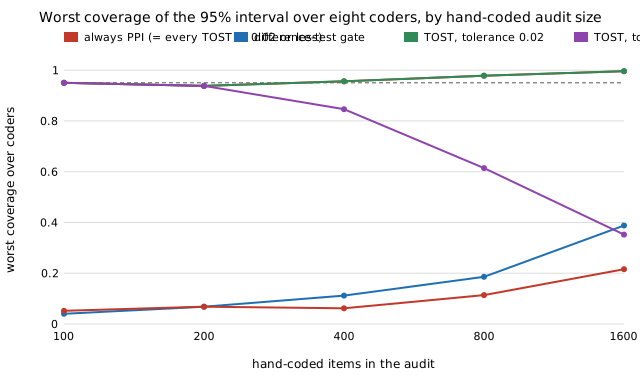
How big must a hand-coded audit be before you can trust a coder's counts? On 3,188 GoEmotions comments, a tight equivalence test never passed the coder and a loose one passed it too often (coverage 0.35 at 1,600 audited items). Not an LLM; one corpus.
What it found
On 3,188 real GoEmotions comments, an equivalence (TOST) audit gate either never passed the coder (tolerance 0.02 or tighter, so it equalled always applying the prediction-powered correction, coverage 0.94–1.00) or passed it too often (tolerance 0.05, worst coverage 0.95 at 100 hand-coded items falling to 0.35 at 1,600). Showing a bias under 0.01, the naive interval's scale, needs about 7,700 audited items, more than the corpus. The earlier difference-test gate was at 0.39 worst case with 1,600 items, and splitting the sample did not help. The coders are a naive-Bayes classifier with a moved cut-off and a word list, not LLMs; one corpus, one seed.
A figure from its own output
Paper, code and results
More in Machine learning on qualitative data
- Do a dozen codebook codes predict better than bag-of-words when labels are scarce?Do a dozen codebook codes predict better than bag-of-words when labels are scarce? On GoEmotions, 12 word-list codes reached 0.65 AUC at 100 labels against 0.56 for bag-of-words, and still led at 1,600 (0.75 against 0.67). Word lists, not an LLM; no learned embedding tested.
- Do LLM-style qualitative codes predict outcomes better than bag-of-words at the same labelling budget?Do LLM-style qualitative codes predict outcomes better than bag-of-words at the same labelling budget? On 5,313 GoEmotions comments, not for a reply-vs-top-level outcome: emotion codes (human, an upper bound) reach AUC 0.527 against 0.557 for words and 0.595 for LSA, and 5% coder error erases their gain. All sets are weak; not an LLM.
- Does a hand-coded audit protect a group gap when it only checks the overall count?Does a hand-coded audit protect a group gap when it only checks the overall count? On 3,188 GoEmotions comments, a coder with zero overall bias still distorted a short-vs-long gap by 0.20, and the overall-bias gate covered the gap 0.4% of the time at 1,600 audited items. Not an LLM; one corpus.
- Can you estimate a group gap from an audit that hand-codes only a few of the coder's negatives?Can you estimate a group gap from an audit that hand-codes only a few of the coder's negatives? Not usefully: 0.9-wide intervals at 5 items, and a plain random audit (0.23 wide) beats the design. Pooling the groups' negatives covers 3%. 3,188 GoEmotions comments, not an LLM.
- If a hand-coded audit finds no bias in a coder, can you trust its counts?If a hand-coded audit finds no bias in a coder, can you trust its counts? On 3,188 GoEmotions comments, an audit-then-trust rule covered the truth in 8% of draws for a coder 2.6 points off, while always applying the prediction-powered correction covered 94–97%. Not an LLM; one corpus.
- Does a low audit rate for coder-negatives pay when the coder has high recall?Does a low audit rate for coder-negatives pay when the coder has high recall? On 3,188 GoEmotions comments the best share falls with recall (50%, 20%, 2%), but the narrowest interval (0.115–0.119 at 200 items) only matches a random audit with no coder (0.1195). Not an LLM.
All 23 Machine learning on qualitative data projects →
Other research topics
Proper scoring & elicitation28Effort & peer prediction9Verification games & slashing19Detection & tolerances14Markets as routers13Prediction-market design9Paying contributors8Decentralised training systems23Digital twins & sim-to-real164LLM chip design loops40Robot manufacturing loops53Ambient AI assistant46Self-replicating manufacturing34Simulation-first design64Engineered clothing45Task-specific AI accelerators40Algorithmic chip-design loops42Open-source purpose-built robots44The software-engineering loop43Adversarial human imitation41Open-source residential construction41Autonomous multi-angle capture34Sensing, imaging and 3D31Energy supply and dense energy storage39Robot societies among people31Agentic co-design of low-cost robots27Laundry-hanging robots25Machine learning on qualitative data23Robots on the building site27Civilizations & group psychology1History & human sciences1
Produced with AI assistance (Claude). Results are from the code in this repository and are simulated or stylised unless the abstract says otherwise; nothing here implies affiliation with or endorsement by any lab, researcher or company cited. MIT licensed.