What is a UAV launch wind limit worth in money, and should the launch threshold sit below the design limit when the forecast is wrong?
research/osrobot-uavvalue
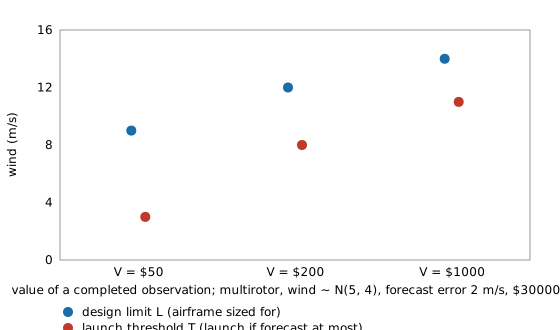
What is a UAV launch wind limit worth in money, and should the launch threshold sit below the design limit when the forecast is wrong? With an assumed expensive airframe and a 2 m/s forecast error the best threshold sits 1 to 6 m/s below the design limit, worth up to $284 per attempt, with failures at or below 0.1%; with a cheap airframe the best design covers nearly every wind. Stylised, assumed prices.
What it found
A stdlib extension of osrobot-uavnogo puts a money value on a completed observation, the loss of an aircraft on a failure and a scrubbed day, then searches the design wind limit L and the launch threshold T together (exact probabilities, no sampling noise). With a cheap airframe ($1,500/kg, assumed) the best design is for nearly every wind (L at 14 m/s or more in 17 of 18 cases, 11 on the grid edge) and the rule barely matters. With an expensive one ($30,000/kg, assumed) the optimum is interior, and with a 2 m/s forecast error the best T sits 1 to 6 m/s below L in all 9 cases, worth up to $284 per attempt over tying T to L, with failures at or below 0.1%. Money figures are assumptions, many optima sit on the grid edge, and a failure is assumed to lose the whole airframe. Stylised, no aircraft designed or flown.
A figure from its own output
Paper, code and results
More in Open-source purpose-built robots
- When does one shared robot beat a dedicated robot per job in a pick-and-place shop?When does one shared robot beat a dedicated robot per job in a pick-and-place shop? Sharing wins while the total load fits one machine and changeover is short (4 jobs, trays within 0.4 m: shared cheapest at demand 0.2 per job, dedicated from 0.3); the shared arm often cannot hold tight tolerances. Stylised, assumed costs.
- What does a shared pick-and-place robot cost once it has to stay up, and do spares change when sharing beats a robot per job?What does a shared pick-and-place robot cost once it must stay up? Spares priced per job or for every job at once: the shared fleet costs the same fraction of a robot per job when its load fits one machine (0.68 at 4 jobs), and falls to 0.34 to 0.51 when all jobs must run at once. Stylised, assumed availabilities.
- When a spoon-feeding arm meets a moving mouth, what sets the force on the lips: the sensor, the approach speed or a force cap?What sets the force on the lips when a spoon-feeding arm meets a swaying mouth: the sensor, the approach speed or a force cap? Peak force tracks approach speed (1.0 N at 0.05 m/s, 4.0 N at 0.20), a camera cuts how often the lips are touched (0.40 against 0.72 of trials) but not how hard, and latency erodes that gain. Stylised point-mass model, assumed constants.
- Does a spoon-feeding arm need more than two joints? Tip mass, lip force and servo cost of 2 to 6 joint armsDoes a spoon-feeding arm need more than two joints? From 2 to 6 joints the tip mass moves only 0.63 to 0.50 kg and lip force not clearly at all, while servo cost triples (stylised; extends
osrobot-assist). - Does the stylised feeding-arm lip-force result survive real contact physics? osrobot-assist re-run in MuJoCoDoes the stylised feeding-arm lip-force result survive MuJoCo contact physics? The steady push matches
KP × LEAD × speed, but the impact peak is 1.84 × higher and the share fed at most 2 N falls from 1.00 to 0.45 at 0.10 m/s (stylised; extendsosrobot-assist). - Is the peak force of a feeding arm on the lips set by the lips' stiffness, the arm's force loop, or its approach lead?Is the peak force of a feeding arm on the lips set by lip stiffness, the force loop or the approach lead? Lip stiffness moves the mean peak from 0.32 to 2.02 N at 0.20 m/s (stylised; extends
osrobot-assist).
All 44 Open-source purpose-built robots projects →
Other research topics
Proper scoring & elicitation28Effort & peer prediction9Verification games & slashing19Detection & tolerances14Markets as routers13Prediction-market design9Paying contributors8Decentralised training systems23Digital twins & sim-to-real164LLM chip design loops40Robot manufacturing loops53Ambient AI assistant46Self-replicating manufacturing34Simulation-first design64Engineered clothing45Task-specific AI accelerators40Algorithmic chip-design loops42Open-source purpose-built robots44The software-engineering loop43Adversarial human imitation41Open-source residential construction41Autonomous multi-angle capture34Sensing, imaging and 3D31Energy supply and dense energy storage39Robot societies among people31Agentic co-design of low-cost robots27Laundry-hanging robots25Machine learning on qualitative data23Robots on the building site27Civilizations & group psychology1History & human sciences1
Produced with AI assistance (Claude). Results are from the code in this repository and are simulated or stylised unless the abstract says otherwise; nothing here implies affiliation with or endorsement by any lab, researcher or company cited. MIT licensed.