When a spoon-feeding arm meets a moving mouth, what sets the force on the lips: the sensor, the approach speed or a force cap?
research/osrobot-assist
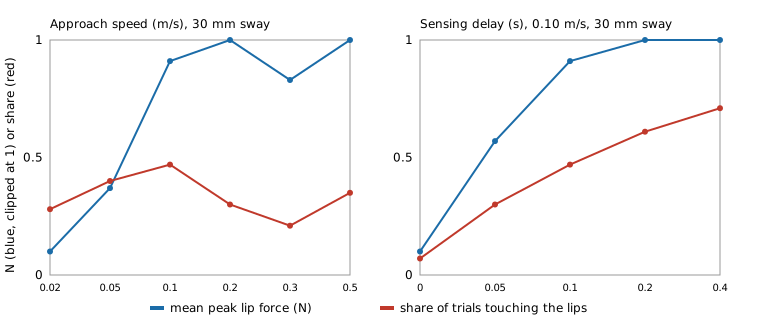
What sets the force on the lips when a spoon-feeding arm meets a swaying mouth: the sensor, the approach speed or a force cap? Peak force tracks approach speed (1.0 N at 0.05 m/s, 4.0 N at 0.20), a camera cuts how often the lips are touched (0.40 against 0.72 of trials) but not how hard, and latency erodes that gain. Stylised point-mass model, assumed constants.
What it found
A stdlib planar point-mass twin of a feeding arm and a swaying mouth, with 200 paired trials per row. With a 0.05 s forward lead the push on a blocked tip is 20 N·s/m × speed, so peak lip force tracks approach speed (1.0 N at 0.05 m/s, 4.0 N at 0.20). A camera lowers the share of trials that touch the lips (0.40 against 0.72 at 30 mm sway) without lowering the peak, and its advantage fades with latency (touch share 0.07 at no delay, 0.71 at 0.4 s). A 1 N force cap trims the worst peak but not the share of comfortable feeds. Stylised: all constants are assumed, the peak-force result is largely an identity of the chosen controller, and no human model or Assistive Gym was used.
A figure from its own output
Paper, code and results
More in Open-source purpose-built robots
- Does a spoon-feeding arm need more than two joints? Tip mass, lip force and servo cost of 2 to 6 joint armsDoes a spoon-feeding arm need more than two joints? From 2 to 6 joints the tip mass moves only 0.63 to 0.50 kg and lip force not clearly at all, while servo cost triples (stylised; extends
osrobot-assist). - Does the stylised feeding-arm lip-force result survive real contact physics? osrobot-assist re-run in MuJoCoDoes the stylised feeding-arm lip-force result survive MuJoCo contact physics? The steady push matches
KP × LEAD × speed, but the impact peak is 1.84 × higher and the share fed at most 2 N falls from 1.00 to 0.45 at 0.10 m/s (stylised; extendsosrobot-assist). - Is the peak force of a feeding arm on the lips set by the lips' stiffness, the arm's force loop, or its approach lead?Is the peak force of a feeding arm on the lips set by lip stiffness, the force loop or the approach lead? Lip stiffness moves the mean peak from 0.32 to 2.02 N at 0.20 m/s (stylised; extends
osrobot-assist). - If the person being fed judges the spoon better as it nears the mouth, how much of a camera's value does a blind feeding arm get back?If the person being fed judges the spoon better as it nears the mouth, how much of a camera's value does a blind arm get back? A misjudgement shrinking to zero at the lips lifts the blind arm's safe share at 40 mm from 0.47 to 0.84 and restores every feed; stylised, extends
osrobot-leannoise. - If the person being fed misjudges the spoon, or sees it late, can a blind feeding arm still do without a camera?If the person being fed misjudges the spoon or sees it late, can a blind feeding arm still do without a camera? A 20 mm misjudgement drops the blind arm's safe share from 1.00 to 0.60 (camera arm 0.78); stylised, extends
osrobot-lean. - If the person being fed leans toward the spoon, can a blind feeding arm do without a camera?If the person being fed leans toward the spoon, can a blind feeding arm do without a camera? At 30 mm sway and 0.20 m/s the blind arm's safe share rises from 0.21 to 1.00 as the lean reaches 100 mm/s (stylised; extends
osrobot-assist).
All 44 Open-source purpose-built robots projects →
Other research topics
Proper scoring & elicitation28Effort & peer prediction9Verification games & slashing19Detection & tolerances14Markets as routers13Prediction-market design9Paying contributors8Decentralised training systems23Digital twins & sim-to-real164LLM chip design loops40Robot manufacturing loops53Ambient AI assistant46Self-replicating manufacturing34Simulation-first design64Engineered clothing45Task-specific AI accelerators40Algorithmic chip-design loops42Open-source purpose-built robots44The software-engineering loop43Adversarial human imitation41Open-source residential construction41Autonomous multi-angle capture34Sensing, imaging and 3D31Energy supply and dense energy storage39Robot societies among people31Agentic co-design of low-cost robots27Laundry-hanging robots25Machine learning on qualitative data23Robots on the building site27Civilizations & group psychology1History & human sciences1
Produced with AI assistance (Claude). Results are from the code in this repository and are simulated or stylised unless the abstract says otherwise; nothing here implies affiliation with or endorsement by any lab, researcher or company cited. MIT licensed.