How heavy must a purpose-built UAV for targeted observation be, and when does a hover-capable airframe stop being worth its weight?
research/osrobot-uav
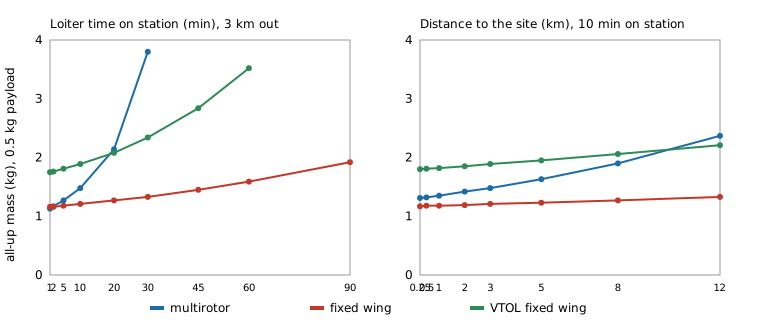
How heavy must a purpose-built UAV for targeted observation be, and when is a hover-capable airframe worth its weight? At 3 km out and 20 min on station a fixed wing closes at 1.27 kg against 2.14 kg for a quadrotor and 2.08 kg for a VTOL wing, and the quadrotor stops closing at 45 min (stylised, assumed constants, no flight stack run).
What it found
A stdlib mass-closure sizing model closes a quadrotor, a fixed wing and a fixed wing with a vertical-lift system for the same mission, choosing rotor diameter or wing area for least mass. For 3 km out, 20 min on station and a 0.5 kg payload the plain fixed wing is lightest (1.27 kg), against 2.14 kg for the quadrotor and 2.08 kg for the VTOL wing. The quadrotor does not close at 45 min on station; the VTOL wing is lighter than it from 30 min or beyond about 10 km. Stylised: every technology constant is assumed, no flight stack was run, and a fixed wing cannot hover or launch unaided.
A figure from its own output
Paper, code and results
More in Open-source purpose-built robots
- Does a steady wind change which purpose-built observation UAV is lightest, and what is wind worth to a multirotor?Does a steady wind change which purpose-built observation UAV is lightest? At 3 km and 20 min on station the fixed wing stays lightest from 0 to 18 m/s (1.27 to 1.50 kg) while the quadrotor goes 2.14 to 7.0 kg; the multirotor's still-air win at 1 min on station ends near 10 m/s. Stylised, steady known wind only.
- How much heavier must an observation UAV be if the wind is uncertain, and is designing to a wind quantile cheaper than a bigger battery reserve?How much heavier must an observation UAV be if the wind is uncertain? Designing to the 95th-percentile of wind ~ N(8, 3) m/s costs the fixed wing +3.7% and the multirotor +11.7% mass, and a bigger battery reserve buys about the same reliability for about the same mass; stylised, one steady wind per mission.
- If an observation UAV only launches when the forecast wind is below a limit, how much does forecast error bring failures back, and what does it cost in scrubbed missions?If an observation UAV launches only when the forecast wind is under a limit, how much does forecast error bring failures back? A perfect forecast turns every failure into a scrub (fixed wing, wind ~ N(5, 4) m/s: 4.6% scrubbed at the 95th-percentile limit); a 2 m/s error gives 6.8% failures at the median limit but 1.1% at the 95th. Stylised, one steady wind per mission.
- If a scrubbed observation-UAV launch can be retried later the same day, how much does persistent wind limit what retrying buys, and does retrying bring failures back?If a scrubbed observation-UAV launch can be retried later the same day, how much does persistent wind limit the gain, and do retries bring failures back? Fixed wing, median-wind limit, perfect forecast: eight slots complete 99.7% of days with independent wind but 71.5% with persistence 0.95; with a 2 m/s forecast error eight slots raise failures from 6.8% to 13.6% of days (23.7% at persistence 0.95). Stylised.
- What is a UAV launch wind limit worth in money, and should the launch threshold sit below the design limit when the forecast is wrong?What is a UAV launch wind limit worth in money, and should the launch threshold sit below the design limit when the forecast is wrong? With an assumed expensive airframe and a 2 m/s forecast error the best threshold sits 1 to 6 m/s below the design limit, worth up to $284 per attempt, with failures at or below 0.1%; with a cheap airframe the best design covers nearly every wind. Stylised, assumed prices.
- When does one shared robot beat a dedicated robot per job in a pick-and-place shop?When does one shared robot beat a dedicated robot per job in a pick-and-place shop? Sharing wins while the total load fits one machine and changeover is short (4 jobs, trays within 0.4 m: shared cheapest at demand 0.2 per job, dedicated from 0.3); the shared arm often cannot hold tight tolerances. Stylised, assumed costs.
All 44 Open-source purpose-built robots projects →
Other research topics
Proper scoring & elicitation28Effort & peer prediction9Verification games & slashing19Detection & tolerances14Markets as routers13Prediction-market design9Paying contributors8Decentralised training systems23Digital twins & sim-to-real164LLM chip design loops40Robot manufacturing loops53Ambient AI assistant46Self-replicating manufacturing34Simulation-first design64Engineered clothing45Task-specific AI accelerators40Algorithmic chip-design loops42Open-source purpose-built robots44The software-engineering loop43Adversarial human imitation41Open-source residential construction41Autonomous multi-angle capture34Sensing, imaging and 3D31Energy supply and dense energy storage39Robot societies among people31Agentic co-design of low-cost robots27Laundry-hanging robots25Machine learning on qualitative data23Robots on the building site27Civilizations & group psychology1History & human sciences1
Produced with AI assistance (Claude). Results are from the code in this repository and are simulated or stylised unless the abstract says otherwise; nothing here implies affiliation with or endorsement by any lab, researcher or company cited. MIT licensed.