Does co-designing an arm's link lengths and controller beat tuning the controller on a fixed body?
research/osrobot-morph
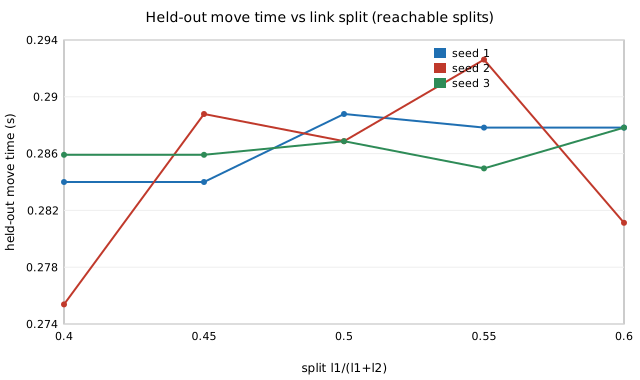
Does co-designing an arm's link split and controller beat tuning the controller on a fixed body? Co-design gained 1.9% in held-out move time (0.283 against 0.289 s), within three-seed noise; tuning the controller mattered about 37%. Stylised, preliminary, mostly negative.
What it found
A stdlib planar two-link arm model searches the split of a fixed 0.50 m reach together with PD gains, against an equal-link body with tuned gains, at equal search budget. The tray is reachable only for splits of 0.40 to 0.60. Co-design gained 1.9% in held-out move time (0.283 against 0.289 s), within three-seed noise, while tuning the controller cut hand-set gains' 0.460 s by about 37%. Stylised, preliminary and mostly negative: one body parameter and an assumed torque limit.
A figure from its own output
Paper, code and results
More in Open-source purpose-built robots
- Can a small twin of a liquid-handling bench catch protocol errors before they run, and how much pipetting error does a serial dilution tolerate?Can a small twin of a liquid-handling bench catch protocol errors before they run, and how much pipetting error does a serial dilution tolerate? It flags 366 of 522 injected faults against 100 for a syntax-only baseline, and an assumed error curve gives a final-well CV of 0.187 at 10 µL and 0.035 at 100 µL transfers (stylised, circular fault set).
- Does the real Opentrons simulator catch the protocol faults a small stdlib liquid-handling twin catches?Does the real Opentrons simulator catch the faults the stdlib liquid-handling twin catches? On the same 522 seeded faults it raises on 270 and the twin flags 366; everything the simulator catches the twin catches too, while tip reuse, a 5 µL dispense and a half-empty source pass the simulator. Mostly policy differences; the fault set was written for the twin (stylised).
- Does searching an arm’s joint count, link lengths and mount, with its controller tuned in the loop, beat a fixed three-link body at the same cost?Does searching a planar arm's joint count, links and mount, with its controller tuned, beat a fixed three-link body at equal cost? On a shelf task with a tool-down constraint, 0.95 held-out success against 0.26; on a long position-only reach, no gain (stylised, kinematic).
- How heavy must a purpose-built UAV for targeted observation be, and when does a hover-capable airframe stop being worth its weight?How heavy must a purpose-built UAV for targeted observation be, and when is a hover-capable airframe worth its weight? At 3 km out and 20 min on station a fixed wing closes at 1.27 kg against 2.14 kg for a quadrotor and 2.08 kg for a VTOL wing, and the quadrotor stops closing at 45 min (stylised, assumed constants, no flight stack run).
- Does a steady wind change which purpose-built observation UAV is lightest, and what is wind worth to a multirotor?Does a steady wind change which purpose-built observation UAV is lightest? At 3 km and 20 min on station the fixed wing stays lightest from 0 to 18 m/s (1.27 to 1.50 kg) while the quadrotor goes 2.14 to 7.0 kg; the multirotor's still-air win at 1 min on station ends near 10 m/s. Stylised, steady known wind only.
- How much heavier must an observation UAV be if the wind is uncertain, and is designing to a wind quantile cheaper than a bigger battery reserve?How much heavier must an observation UAV be if the wind is uncertain? Designing to the 95th-percentile of wind ~ N(8, 3) m/s costs the fixed wing +3.7% and the multirotor +11.7% mass, and a bigger battery reserve buys about the same reliability for about the same mass; stylised, one steady wind per mission.
All 44 Open-source purpose-built robots projects →
Other research topics
Proper scoring & elicitation28Effort & peer prediction9Verification games & slashing19Detection & tolerances14Markets as routers13Prediction-market design9Paying contributors8Decentralised training systems23Digital twins & sim-to-real164LLM chip design loops40Robot manufacturing loops53Ambient AI assistant46Self-replicating manufacturing34Simulation-first design64Engineered clothing45Task-specific AI accelerators40Algorithmic chip-design loops42Open-source purpose-built robots44The software-engineering loop43Adversarial human imitation41Open-source residential construction41Autonomous multi-angle capture34Sensing, imaging and 3D31Energy supply and dense energy storage39Robot societies among people31Agentic co-design of low-cost robots27Laundry-hanging robots25Machine learning on qualitative data23Robots on the building site27Civilizations & group psychology1History & human sciences1
Produced with AI assistance (Claude). Results are from the code in this repository and are simulated or stylised unless the abstract says otherwise; nothing here implies affiliation with or endorsement by any lab, researcher or company cited. MIT licensed.