Is the feeding-arm tip's contact pressure computable at a measured face modulus?
research/osrobot-mjmodulus
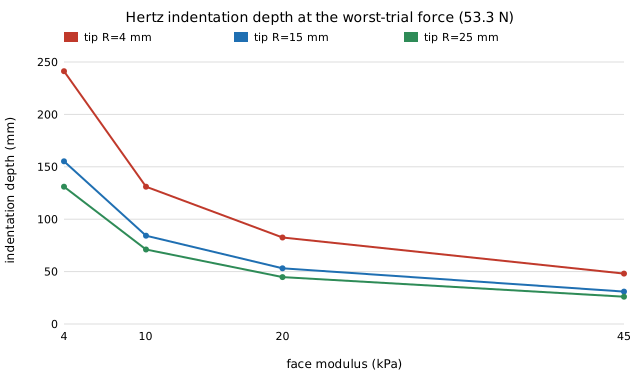
Published in-vivo face and lip moduli are 4 to 45 kPa, below the 0.05 to 5 MPa that osrobot-mjpress swept; at them a 4 mm tip at 53 N would sink 48 to 241 mm in a Hertz model, so the model is out of range and tip radius or depth, not 65 N, is the design question (closed-form, simulation forces)
What it found
osrobot-mjpress found the pass or fail of the feeding arm's tip pressure flipped on an unsourced face modulus swept from 0.05 to 5 MPa. Published in-vivo values are 4 to 45 kPa (a one-subject lip and cheek device, Hertz fits to skin indentation, an aspiration study), all below that sweep. At those moduli a Hertz sphere of the 4 mm tip at the worst trial force (53.3 N) has a contact radius 3.5 to 7.8 times the tip radius and an indentation depth of 48 to 241 mm, so the half-space model is out of range and its 1.8 to 8.8 N/cm² pressures are a bound, not a result. Hertz holds (a/R ≤ 0.5) only for a tip radius of about 73 to 245 mm. The forces come from a stiff kinematic-lip simulation that is not self-consistent with a soft face; the modulus values come from small studies read as summaries; pressure limits remain unconfirmed. Not a safety case.
A figure from its own output
Paper, code and results
More in Open-source purpose-built robots
- Does the feeding arm's tip pressure, not its force, break the ISO/TS 15066 face limits?A 4 mm feeding-arm tip that meets the 65 N face force limit still needs 0.5 to 2.7 cm² of contact to meet a 110 to 20 N/cm² pressure limit at its worst trial (53 N); the answer flips on an unsourced face modulus (MuJoCo, simulation only)
- What happens when a feeding arm meets a soft lip instead of a spring, and does a force cap help?Replacing the 75,000 N/m spring with a bonded tissue layer (4 to 45 kPa, 5 or 15 mm) cuts simulated peaks to 1 to 3 N in most cells but still breaks the 30 % depth limit in about half the trials; a 0.2 to 0.5 N cap fixes steady pushes, slowing to 0.02 m/s fixes a 10 kPa, 15 mm lip, and nothing fixes a thin 4 kPa one by speed alone (MuJoCo dynamics, closed-form tissue force)
- How fast can a purpose-built robot fill a 96-well plate, and does the robot or the number of channels matter more?How fast can a purpose-built robot fill a 96-well plate, and does the robot or the number of channels matter more? Eight channels cut the time by 86 to 88 % (9.5 s against 69.7 s for a gantry at 10 µL) while gantry against arm moves it 4 to 14 %, since about 76 % is fixed pipetting actions (stylised; every speed, price and accuracy figure assumed).
- Does the scout-and-treater weeding fleet still lose to inline robots when the machines are priced from published list prices?Re-runs osrobot-deadlineloss with a Holybro X500 V2 drone (609 USD) and an AgileX Scout Mini (4,500 USD) at list price: pipeline over inline cost moves from 1.49 to 1.54 at 0.18 ha and 1.07 to 1.15 at 1.62 ha, ties at a 4,500 USD ground platform, and flips with an unsourced loaded flight time
- Does the osrobot-uav multirotor energy model match real aircraft?Does the osrobot-uav multirotor energy model match real aircraft? With the Mavic 3's published 9.4 in propellers (0.239 m) it predicts 1.3 to 1.6 times the published 45 min endurance, so it is optimistic; the Anafi UKR rotor size was not found, so that row remains a sweep.
- Is one slow weeding pass better than several fast ones, and does treating on the move change that?A laser-weeding robot that drives three fast passes (4 km/h) kills 0.780 of the weeds in 75 min, against 0.607 in 83 min for one slow pass (1 km/h), and treating on the move instead of stopping cuts time by 6% at 0.3 weeds/m² and 39% at 3 weeds/m²; the ranking survives 30% of weeds being invisible to the detector
All 44 Open-source purpose-built robots projects →
Other research topics
Proper scoring & elicitation28Effort & peer prediction9Verification games & slashing19Detection & tolerances14Markets as routers13Prediction-market design9Paying contributors8Decentralised training systems23Digital twins & sim-to-real164LLM chip design loops40Robot manufacturing loops53Ambient AI assistant46Self-replicating manufacturing34Simulation-first design64Engineered clothing45Task-specific AI accelerators40Algorithmic chip-design loops42Open-source purpose-built robots44The software-engineering loop43Adversarial human imitation41Open-source residential construction41Autonomous multi-angle capture34Sensing, imaging and 3D31Energy supply and dense energy storage39Robot societies among people31Agentic co-design of low-cost robots27Laundry-hanging robots25Machine learning on qualitative data23Robots on the building site27Civilizations & group psychology1History & human sciences1
Produced with AI assistance (Claude). Results are from the code in this repository and are simulated or stylised unless the abstract says otherwise; nothing here implies affiliation with or endorsement by any lab, researcher or company cited. MIT licensed.