Who trades decides how liquid a verification market should be
research/order-flow-liquidity
Glosten–Milgrom vs LMSR for a verification market: informed share fixes b* = 1/(2 atanh m) (verified to 2e-16), peak misspecification regret is scale-free and overconfident b costs 1.5–2.4× more, LMSR subsidy → b* ln 2 is the spread GM charges.
What it found
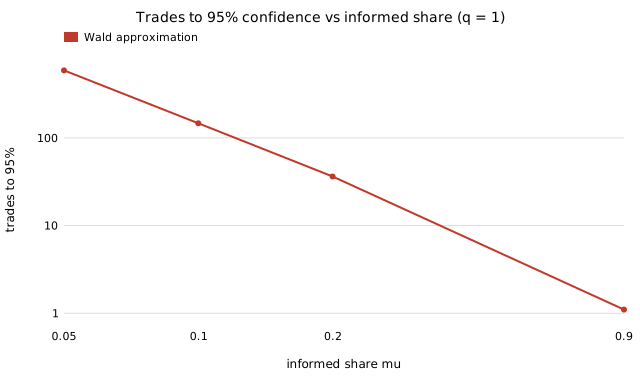
A Glosten–Milgrom market maker facing an informed share μ with accuracy q moves its posterior log-odds by exactly 2·atanh(μ(2q−1)) per net buy, so its price path is an LMSR with b* = 1/(2 atanh m) (verified to 2×10⁻¹⁶). A wrong b costs log loss only in a transient whose peak is scale-free in m and 1.8–2.5× worse when overconfident; the LMSR subsidy tends to b* ln 2, exactly the spread the GM maker charges. Stylised.
A figure from its own output
Paper, code and results
More in Prediction-market design
- What does a fee do to a prediction market’s price?Proportional fees on an LMSR verification market: exact no-trade band
[q/(1+f),(q+f)/(1+f)], price lagq/(1+f), dead-market clifff ≥ 2a−1(threshold2 atanh fat ½), exact fee revenuef·b·ln((1−p₀)/(1−p_T)), and a break-even fee that costs +38% Brier error. - What is a seat in a prediction market worth?Sequential LMSR seat rents are conditional mutual information: they telescope to the maker's expected loss (≤
b ln 2), fall with position at the Chernoff rate, order only redistributes a fixed total, and entry costs make error fall only ~1/bin the subsidy. - How fast does a prediction market converge when traders only understand part of it?Convergence of cost-function markets with partially informed traders as randomized subspace descent: maker loss telescopes to
½(e₀'Ae₀−e_T'Ae_T), closed-form slowdown from correlated securities (31→356 rounds at c=0.95, d=5), A-conjugate bundles restore1−1/dexactly, noisy-belief step size is an SGD step (running mean beats best constant step), LMSR simulation checks the local rates. - What does a constant-product pool concede to informed traders?Constant-product AMMs as cost-function prediction markets: worst-case loss
C0never attained, informed-trader profit exactlyC0(1−n·GM(π))(ratio to LMSR →ln n, crossover at n=e), polynomial price tails (p=0.999 costs 3.4× LMSR), exact regret identity, no forgiveness gain under regime switches. - What does not knowing the horizon cost a market maker?LMSR with time-varying liquidity as anytime Hedge:
b_t = c*√tcosts exactly√2over the horizon-aware bound, doubling is 1.70× worse, and self-tuning liquidity makes the subsidy equal the accumulated mixability gap (1.3 vs 102 on easy data). - The subsidy cost of privacy in prediction marketsDifferentially private LMSR via the binary-tree mechanism: path-wise loss bound, and the accuracy/subsidy cost of privacy.
All 9 Prediction-market design projects →
Other research topics
Proper scoring & elicitation28Effort & peer prediction9Verification games & slashing19Detection & tolerances14Markets as routers13Prediction-market design9Paying contributors8Decentralised training systems23Digital twins & sim-to-real164LLM chip design loops40Robot manufacturing loops53Ambient AI assistant46Self-replicating manufacturing34Simulation-first design64Engineered clothing45Task-specific AI accelerators40Algorithmic chip-design loops42Open-source purpose-built robots44The software-engineering loop43Adversarial human imitation41Open-source residential construction41Autonomous multi-angle capture34Sensing, imaging and 3D31Energy supply and dense energy storage39Robot societies among people31Agentic co-design of low-cost robots27Laundry-hanging robots25Machine learning on qualitative data23Robots on the building site27Civilizations & group psychology1History & human sciences1
Produced with AI assistance (Claude). Results are from the code in this repository and are simulated or stylised unless the abstract says otherwise; nothing here implies affiliation with or endorsement by any lab, researcher or company cited. MIT licensed.