What does a constant-product pool concede to informed traders?
research/cfmm-markets
Constant-product AMMs as cost-function prediction markets: worst-case loss C0 never attained, informed-trader profit exactly C0(1−n·GM(π)) (ratio to LMSR → ln n, crossover at n=e), polynomial price tails (p=0.999 costs 3.4× LMSR), exact regret identity, no forgiveness gain under regime switches.
What it found
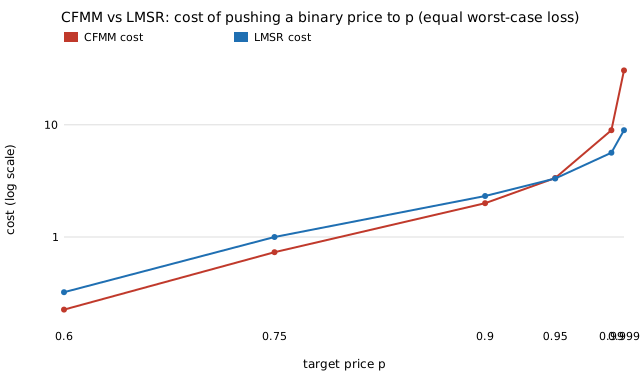
A Uniswap-style pool with invariant ∏ri = C0n is a cost-function prediction market: its worst-case loss is C0 and is never attained, and a trader who moves the price to belief π earns exactly C0(1 − n·GM(π)) with GM the geometric mean, against C0(1 − H(π)/ln n) for LMSR at equal worst-case loss. Near uniform beliefs the ratio is exactly ln n, so the pool is cheaper than LMSR for two outcomes and dearer from three. Its price tails are polynomial, (C0/gap)n, so pushing a binary price to 0.999 costs 3.4× LMSR. As an expert router it satisfies an exact regret identity (settlement term ≤ C0 plus Bregman terms), but under regime switches it shows no advantage over Hedge (negative result). Symmetric pools, no fees. Pure-Python, 10 tests.
A figure from its own output
Paper, code and results
More in Prediction-market design
- What does not knowing the horizon cost a market maker?LMSR with time-varying liquidity as anytime Hedge:
b_t = c*√tcosts exactly√2over the horizon-aware bound, doubling is 1.70× worse, and self-tuning liquidity makes the subsidy equal the accumulated mixability gap (1.3 vs 102 on easy data). - The subsidy cost of privacy in prediction marketsDifferentially private LMSR via the binary-tree mechanism: path-wise loss bound, and the accuracy/subsidy cost of privacy.
- Who pays for the information in a manipulated market?Manipulating an LMSR verification market: manipulator loss
b·KL(q‖τ)equals the extra informed rent, and manipulation raises accuracy only in a liquidity band (thin: costs1−2q; deep: neutral). - What does a slippage limit give away in a prediction market?Sandwiching an LMSR verification market: attacker profit is exactly the victim's slippage tolerance times its fair cost, needs capital
≈ εb/(1−p), dies to a fee≈ v(1−p)/(2b); pro-rata batching keeps 99% of the extraction, random ordering cuts it 3×. - Who trades decides how liquid a verification market should beGlosten–Milgrom vs LMSR for a verification market: informed share fixes
b* = 1/(2 atanh m)(verified to 2e-16), peak misspecification regret is scale-free and overconfidentbcosts 1.5–2.4× more, LMSR subsidy→ b* ln 2is the spread GM charges. - What does a fee do to a prediction market’s price?Proportional fees on an LMSR verification market: exact no-trade band
[q/(1+f),(q+f)/(1+f)], price lagq/(1+f), dead-market clifff ≥ 2a−1(threshold2 atanh fat ½), exact fee revenuef·b·ln((1−p₀)/(1−p_T)), and a break-even fee that costs +38% Brier error.
All 9 Prediction-market design projects →
Other research topics
Proper scoring & elicitation28Effort & peer prediction9Verification games & slashing19Detection & tolerances14Markets as routers13Prediction-market design9Paying contributors8Decentralised training systems23Digital twins & sim-to-real164LLM chip design loops40Robot manufacturing loops53Ambient AI assistant46Self-replicating manufacturing34Simulation-first design64Engineered clothing45Task-specific AI accelerators40Algorithmic chip-design loops42Open-source purpose-built robots44The software-engineering loop43Adversarial human imitation41Open-source residential construction41Autonomous multi-angle capture34Sensing, imaging and 3D31Energy supply and dense energy storage39Robot societies among people31Agentic co-design of low-cost robots27Laundry-hanging robots25Machine learning on qualitative data23Robots on the building site27Civilizations & group psychology1History & human sciences1
Produced with AI assistance (Claude). Results are from the code in this repository and are simulated or stylised unless the abstract says otherwise; nothing here implies affiliation with or endorsement by any lab, researcher or company cited. MIT licensed.