Does a digital twin that a classifier can tell apart from the real system also make a worse controller?
research/mimic-twinregret
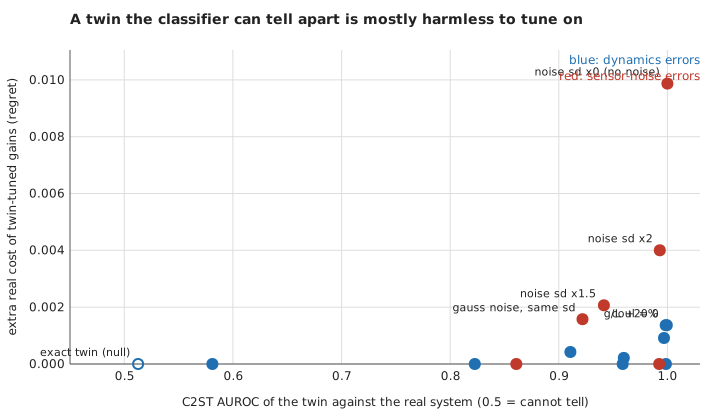
Does a digital twin that a classifier can tell apart from the real system also make a worse controller? Stylised pendulum: 6 of 15 wrong twins have zero controller regret at C2ST AUROC 0.58 to 0.999; the worst regret (3.8%) comes from a twin with no sensor noise and zero paired error. Preliminary, simulated only.
What it found
In the stylised pendulum of mimic-twinc2st with a torque input, a PD controller on noisy feedback is tuned on each wrong twin (48-point gain grid, 200 twin start angles) and scored on 2,000 held-out start angles on the ‘real’ system. Regret is its real cost minus the best grid point’s (0.259). Six of 15 wrong twins have regret exactly 0 in all 12 tuning seeds although the classifier two-sample test separates them from the real system with AUROC 0.58–0.999, among them g/L −20%, whose paired error is the largest (0.25 rad). The largest regret, 0.0099 (3.8%), comes from a twin with no sensor noise at all, whose paired error is 0. Across the 15 twins AUROC and regret correlate only loosely (Spearman 0.46, p = 0.08) and paired RMSE not at all (−0.28). Detecting a twin is not the same as the twin mattering for the task. Limits: one system, one task, a coarse grid that quantises regret, 12 tuning seeds. Stylised, simulated, no LLM: a side piece of track 11.
A figure from its own output
Paper, code and results
More in Adversarial human imitation
- On a swing-up task where friction matters, does a digital twin's detectability predict what tuning on it costs?On a swing-up task where friction matters, does a twin's detectability predict what tuning on it costs? Stylised pendulum: only the two gravity-error twins cost much (3.7% and 8.3% extra real cost); 13 others cost under 0.3% at C2ST AUROC 0.51 to 1.0. Preliminary, simulated only.
- Does a finer controller grid change which wrong digital twins cost something on a swing-up task?Does a finer controller grid change which wrong pendulum twins cost something on the swing-up task? No: the same two gravity-error twins cost 3.8% and 6.1%, the rest under 0.3%; detectability vs regret ρ = 0.38 (p = 0.16). Preliminary, simulated only.
- Does a wider gain grid, or a controller that uses the twin's gravity, change which wrong digital twins are costly?Does a wider gain grid, or a controller that uses the twin's gravity, change which wrong pendulum twins are costly? Gravity errors stay the costly ones; giving the controller the twin's g/L made g/L −20% regret 13 times larger (0.013 to 0.177). Preliminary, simulated only.
- Does domain randomization over a wrong digital twin cut the controller regret of tuning on one wrong twin?Does tuning a controller on a spread of randomized twins cut the regret of tuning on one wrong twin? Stylised pendulum: it brings the no-noise twin's regret from 0.0098 to 0.00006, but a very wide range raises a doubled-noise twin's worst-seed regret 7.5-fold. Preliminary, no LLM.
- Does randomizing only the sensor-noise level of a wrong digital twin keep domain randomization's rescue without its blow-up?Does randomizing only the noise level of a wrong twin keep domain randomization's rescue without its blow-up? Stylised pendulum: the no-noise twin's regret goes 0.0098 to 0 and stays small at a wide range (worst seed 0.0015 vs 0.042 for all-four), but friction and gravity errors are not helped. Preliminary, no LLM.
- How many real trajectories does a classifier test need to flag a wrong digital twin, and are the twins it flags the ones that cost a controller?How many real trajectories does a classifier test need to flag a wrong digital twin, and are the twins it flags the ones that cost a controller? Stylised pendulum: all six twins with controller regret of at least 0.001 are flagged by 80 real trajectories, and so are three that cost nothing. Preliminary, simulated only.
All 41 Adversarial human imitation projects →
Other research topics
Proper scoring & elicitation28Effort & peer prediction9Verification games & slashing19Detection & tolerances14Markets as routers13Prediction-market design9Paying contributors8Decentralised training systems23Digital twins & sim-to-real164LLM chip design loops40Robot manufacturing loops53Ambient AI assistant46Self-replicating manufacturing34Simulation-first design64Engineered clothing45Task-specific AI accelerators40Algorithmic chip-design loops42Open-source purpose-built robots44The software-engineering loop43Adversarial human imitation41Open-source residential construction41Autonomous multi-angle capture34Sensing, imaging and 3D31Energy supply and dense energy storage39Robot societies among people31Agentic co-design of low-cost robots27Laundry-hanging robots25Machine learning on qualitative data23Robots on the building site27Civilizations & group psychology1History & human sciences1
Produced with AI assistance (Claude). Results are from the code in this repository and are simulated or stylised unless the abstract says otherwise; nothing here implies affiliation with or endorsement by any lab, researcher or company cited. MIT licensed.