Does domain randomization over a wrong digital twin cut the controller regret of tuning on one wrong twin?
research/mimic-twinrand
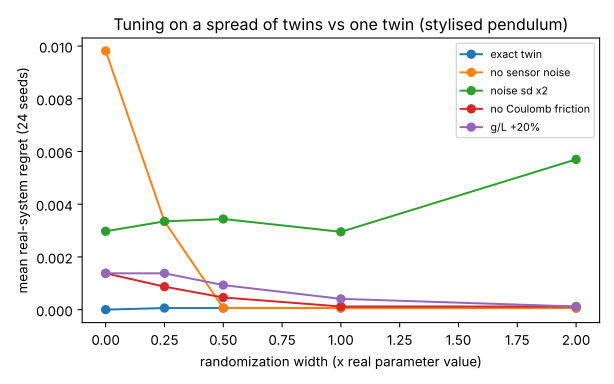
Does tuning a controller on a spread of randomized twins cut the regret of tuning on one wrong twin? Stylised pendulum: it brings the no-noise twin's regret from 0.0098 to 0.00006, but a very wide range raises a doubled-noise twin's worst-seed regret 7.5-fold. Preliminary, no LLM.
What it found
Follow-up to mimic-twinregret on the same stylised pendulum and noisy-feedback PD task. Gains are tuned on 200 start angles spread over 8 randomized twins (noise level, Coulomb and viscous friction, g/L each uniform on nominal ± w× the real value) and scored on 2,000 held-out real start angles, over 24 tuning seeds. For the no-noise twin, whose single-twin regret is 0.0098, randomization with w = 0.5 brings it to 0.00006, the same as the exact twin. No-Coulomb and g/L +20% twins fall from 0.0014 to 0.00012 at w = 1–2. It does not always help: for a doubled-noise twin regret stays about 0.003 for w ≤ 1 and at w = 2 the mean rises to 0.0057 with a worst seed 7.5× the single-twin worst. Limits: one system and task, a 48-point grid that quantises regret, one randomization family with a shared width. Stylised, simulated, no LLM.
A figure from its own output
Paper, code and results
More in Adversarial human imitation
- Does randomizing only the sensor-noise level of a wrong digital twin keep domain randomization's rescue without its blow-up?Does randomizing only the noise level of a wrong twin keep domain randomization's rescue without its blow-up? Stylised pendulum: the no-noise twin's regret goes 0.0098 to 0 and stays small at a wide range (worst seed 0.0015 vs 0.042 for all-four), but friction and gravity errors are not helped. Preliminary, no LLM.
- How many real trajectories does a classifier test need to flag a wrong digital twin, and are the twins it flags the ones that cost a controller?How many real trajectories does a classifier test need to flag a wrong digital twin, and are the twins it flags the ones that cost a controller? Stylised pendulum: all six twins with controller regret of at least 0.001 are flagged by 80 real trajectories, and so are three that cost nothing. Preliminary, simulated only.
- Does a second turn make a plainly prompted LLM easier to spot in dialogue?Does a second turn make a plainly prompted LLM easier to spot in dialogue? A prompt-free n-gram detector gets AUROC 0.93 on one imitated user turn and 0.98 on two, on 400 OpenAssistant threads with a 0.5B imitator. Stylised baseline, no prompt optimised.
- Can an imitator that changes its own code fool a human-vs-bot cursor detector, and does shared feedback help either side?Can an imitator that changes its own code fool a human-vs-bot cursor detector, and does shared feedback help? On DUX cursor strokes of 46 people, a held-out reference detector catches every final imitator at AUROC 0.99 to 1.00 in all four feedback conditions; two-way sharing gave the strongest detectors in cross-play (0.81 vs 0.70 blind, interval includes 0), and an 8x larger search stops at 0.88, the level of replaying real strokes. Preliminary.
- Can a generator imitate a person's webcam emotion signals well enough to fool a detector?Can a generator imitate a person's webcam emotion signals well enough to fool a detector? On DUX Affectiva scores of 46 people, every fixed generator and every loop-tuned imitator is caught at AUROC 0.997 or higher by a detector the loop never saw; only replaying real windows gets close to chance (0.61). Preliminary.
- Does giving a webcam-signal generator real heavy tails and bursts fool a detector?Does giving a webcam-signal generator real heavy tails and bursts fool a detector? No: copula and quiet/burst generators still separate from held-out people at AUROC 1.000 (8 seeds); restoring per-window level and spread brings level and spread to near chance, but extremes (0.995) still give it away; copying a real window's value set (G6) puts those at chance too, yet all-groups AUROC stays 0.998 on temporal structure.
All 41 Adversarial human imitation projects →
Other research topics
Proper scoring & elicitation28Effort & peer prediction9Verification games & slashing19Detection & tolerances14Markets as routers13Prediction-market design9Paying contributors8Decentralised training systems23Digital twins & sim-to-real164LLM chip design loops40Robot manufacturing loops53Ambient AI assistant46Self-replicating manufacturing34Simulation-first design64Engineered clothing45Task-specific AI accelerators40Algorithmic chip-design loops42Open-source purpose-built robots44The software-engineering loop43Adversarial human imitation41Open-source residential construction41Autonomous multi-angle capture34Sensing, imaging and 3D31Energy supply and dense energy storage39Robot societies among people31Agentic co-design of low-cost robots27Laundry-hanging robots25Machine learning on qualitative data23Robots on the building site27Civilizations & group psychology1History & human sciences1
Produced with AI assistance (Claude). Results are from the code in this repository and are simulated or stylised unless the abstract says otherwise; nothing here implies affiliation with or endorsement by any lab, researcher or company cited. MIT licensed.