What does a too-clean odometry twin do to a SLAM loop-closure gate?
research/loopclosure-twin
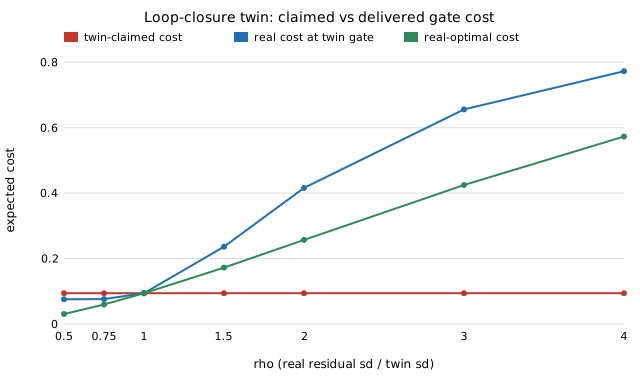
A SLAM loop-closure gate tuned in a too-clean odometry twin: exact chi-square gate costs and closed-form optimal gate, real noise 2× the twin's rejects 38% of true closures (claimed 2%) at 4.4× the claimed cost, pessimistic twins are not safe either, and ~59 ground-truthed closures repair it.
What it found
A back end accepts a loop closure when its squared residual is below a gate; true closures are N(0, s2I), aliased ones are wider, and the cost is a weighted sum of two chi-square probabilities with a closed-form optimal gate in 2-D. A twin whose odometry noise is half the real value picks a gate that claims a cost of 0.094 and 2.1% of true closures rejected; in reality it rejects 38.2% (checked against simulation), costs 4.4× the claim and has 62% regret; a conventional α = 1% gate rejects α1/ρ2 = 32%. A too-pessimistic twin (ρ = 0.5) is not safe either (145% regret), regret depends strongly on how costly a false closure is, a fixed inflation factor is a bet on the true noise, and re-fitting the variance from about 59 ground-truthed closures brings regret under 1% of the twin’s. Stylised: isotropic Gaussian 2-D residuals, hard gate, known costs, no real odometry data.
A figure from its own output
Paper, code and results
More in Digital twins & sim-to-real
- What does an odometry twin that is too clean do to a loop-closure gate?A chi-square loop-closure gate tuned in a too-clean odometry twin: exact real error 2.1× the claim at drift-sd ratio 2, rejected genuine closures compound into lock-out (9–16× the ungated error, growing with horizon), the gate halves aliasing error when the twin is right but is 8× worse than no gate when it is not, and ~30 measured drifts make the repair safe.
- How often should a mapping team rendezvous when its twin's odometry drift has no bias?How often a mapping team should rendezvous when its twin's odometry drift has no bias: real error is exactly
√(1+ρ)times the claim, cost-optimal interval solves a cubic, twin regret 0.19–34.6%, shared bias cancels in the pairwise frame (5.3%→0.10%), and repair needs a long-lag ground-truth fit. - What does a simulator tuned on one-step odometry noise get wrong about drift, relocalisation and loop closure?A twin tuned on one-step odometry noise cannot see drift: variance ratio exactly
1+(T−1)ρ, relocalisation interval 3.4× too long (real miss 51.6% vs 5%), twin-tuned loop-closure gate recall 0.64 at T=200, closed-loop runaway, aliasing limits calibrated gates. - How wrong is a safety margin certified in a Gaussian-disturbance simulator when real gusts are heavy-tailed?A corridor-keeping safety margin certified in a Gaussian-disturbance twin: same variance, heavy-tailed real gusts give 0.29 real failure at a claimed 0.01, needed margin 7.3× at
δ=0.001 (ν=3), variance inflation misses by 24×, conformal needsn≥1/δ, a Hill tail fit from one-step data repairs it. - How wrong is the thinnest obstacle a lidar twin certifies as detectable when real beam dropout is clustered?A lidar twin with i.i.d. beam dropout certifies the thinnest detectable obstacle: real clustered dropout (same rate, lag-1 correlation 0.6) misses 41× more at the certified width and the range claim is 4× too long (exact Markov miss law,
p·q^(m−1)); a fitted persistence recovers the median width but needs a margin. - Can a digital twin shorten a real-world safety certification?Can a twin shorten a real-world safety certification? Worst-case size of any
k ≤ crule is exactlyP(Bin(n,ε) ≤ c), so a twin prior cannot cut real trials at a fixed level (299 exact zero-failure trials; twin prior reaches 133 only at size 0.26); wrong twins inflate size or block certification.
All 164 Digital twins & sim-to-real projects →
Other research topics
Proper scoring & elicitation28Effort & peer prediction9Verification games & slashing19Detection & tolerances14Markets as routers13Prediction-market design9Paying contributors8Decentralised training systems23Digital twins & sim-to-real164LLM chip design loops40Robot manufacturing loops53Ambient AI assistant46Self-replicating manufacturing34Simulation-first design64Engineered clothing45Task-specific AI accelerators40Algorithmic chip-design loops42Open-source purpose-built robots44The software-engineering loop43Adversarial human imitation41Open-source residential construction41Autonomous multi-angle capture34Sensing, imaging and 3D31Energy supply and dense energy storage39Robot societies among people31Agentic co-design of low-cost robots27Laundry-hanging robots25Machine learning on qualitative data23Robots on the building site27Civilizations & group psychology1History & human sciences1
Produced with AI assistance (Claude). Results are from the code in this repository and are simulated or stylised unless the abstract says otherwise; nothing here implies affiliation with or endorsement by any lab, researcher or company cited. MIT licensed.