How wrong is the thinnest obstacle a lidar twin certifies as detectable when real beam dropout is clustered?
research/dropout-twin
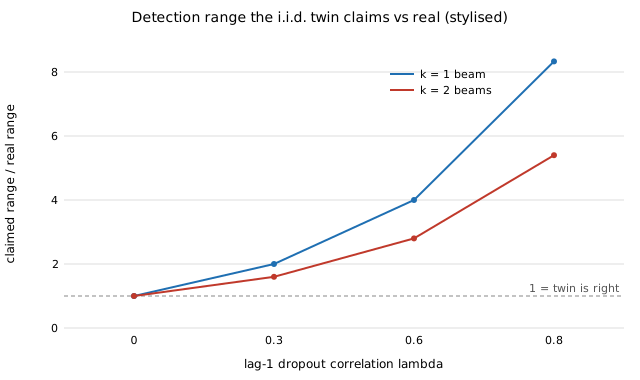
A lidar twin with i.i.d. beam dropout certifies the thinnest detectable obstacle: real clustered dropout (same rate, lag-1 correlation 0.6) misses 41× more at the certified width and the range claim is 4× too long (exact Markov miss law, p·q^(m−1)); a fitted persistence recovers the median width but needs a margin.
What it found
A thin obstacle covers m adjacent lidar beams and is detected if at least k return. The twin drops beams independently at 10%; the real sensor drops them in bursts (a Markov chain with the same rate and lag-1 correlation λ). The exact miss law is a small DP, and for k = 1 the real/twin ratio is (1 + λ(1−p)/p)m−1. At the width certified for miss 10−3 (m = 3) the real miss is 0.041 (λ = 0.6) to 0.067 (λ = 0.8), and the claimed detection range is 4× to 8.3× too long. Inflating the drop rate to match one width is wrong at the others. Fitting the chain from a flat-target log recovers the median width but 40% of repeats still miss the target at 5,000 beams; two extra beams cut that to 1%. Stylised: one scan, a simulated ‘real’ sensor, no lidar data.
A figure from its own output
Paper, code and results
More in Digital twins & sim-to-real
- Can a digital twin shorten a real-world safety certification?Can a twin shorten a real-world safety certification? Worst-case size of any
k ≤ crule is exactlyP(Bin(n,ε) ≤ c), so a twin prior cannot cut real trials at a fixed level (299 exact zero-failure trials; twin prior reaches 133 only at size 0.26); wrong twins inflate size or block certification. - How optimistic is the cost a planner quotes from its own twin rollouts?The cost a planner quotes from its own twin rollouts is optimistic by exactly
e_K·s(winner's curse; 95% intervals cover 60% at K=20), fresh rollouts fix the sampling part at a selection-quality price, but not the twin's own model error−e_K τ²/√(τ²+s²). - How many retries does a grasp need when the simulator treats attempts as independent?How many retries a grasp needs when the twin treats attempts as independent: exact Beta-mixture failure law (power law
k^{−a}vs geometric), twin budget 6 claims 0.004 and delivers 0.010–0.151, real budget 7–571, closed-form give-up rule, and a two-attempts-per-object repair that still needs a margin. - How optimistic is the best of K controllers chosen in a noisy digital twin?The best of K controllers picked in a noisy twin: winner's claim optimistic by exactly
τ²c_K/√(v²+τ²)(c_K=E max of K normals), under a fixed rollout budget more candidates can make the deployed one worse (best K=5–22), an exact-plant LQ twin's claim falls below what any gain can achieve, and screen-then-verify cuts claim bias 4.5×. - How many real rollouts does a biased digital twin save when evaluating a robot policy?Evaluating a robot policy with a biased twin as a control variate: unbiased whatever the twin's bias (+0.700 twin-only vs +0.001), exact variance
σ²((1−ρ²)/n+ρ²/N),ρ=ηfor a faithful twin but√ηfor a noise-free one (1.33× vs 2.0× real-sample gain), worth-it thresholdc_T/c_R<(1−√(1−ρ²))²/ρ²(0.072 at ρ=0.5), and 86–125 vs 164 real episodes per policy to rank correctly when twin bias favours the wrong one. - How big a pilot decides whether a biased digital twin is worth using?How big a pilot decides whether a biased twin is worth using: threshold
ρ*=2√r/(1+r)with a gain linear inρ−ρ*, so wrong calls are frequent but cheap (regret 0.004–0.016 atρ=0.5), decision-regret lawf·slope·(1−ρ*²)²/(2m)(ratio 0.63→1.00 for m=10→160), plug-in allocation≈0.27–0.30/m, and an adaptive two-stage design that stays unbiased (|bias| ≤ 0.002) with 0.946–0.955 coverage.
All 164 Digital twins & sim-to-real projects →
Other research topics
Proper scoring & elicitation28Effort & peer prediction9Verification games & slashing19Detection & tolerances14Markets as routers13Prediction-market design9Paying contributors8Decentralised training systems23Digital twins & sim-to-real164LLM chip design loops40Robot manufacturing loops53Ambient AI assistant46Self-replicating manufacturing34Simulation-first design64Engineered clothing45Task-specific AI accelerators40Algorithmic chip-design loops42Open-source purpose-built robots44The software-engineering loop43Adversarial human imitation41Open-source residential construction41Autonomous multi-angle capture34Sensing, imaging and 3D31Energy supply and dense energy storage39Robot societies among people31Agentic co-design of low-cost robots27Laundry-hanging robots25Machine learning on qualitative data23Robots on the building site27Civilizations & group psychology1History & human sciences1
Produced with AI assistance (Claude). Results are from the code in this repository and are simulated or stylised unless the abstract says otherwise; nothing here implies affiliation with or endorsement by any lab, researcher or company cited. MIT licensed.