How fast do excavators, skid steers and dozers lose value, and which machine size costs most per tonne?
research/heavy-market
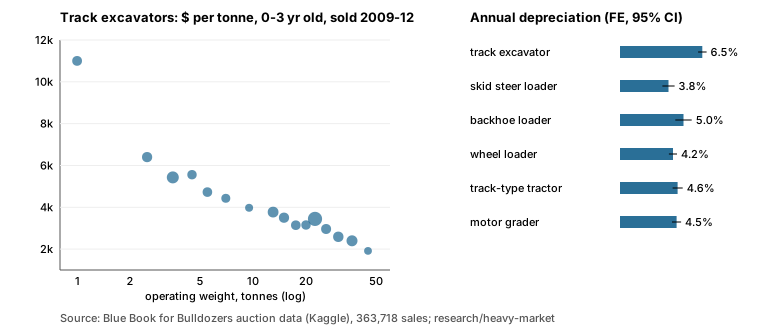
Heavy-equipment market, milestone 1a, real auction data: on 363,718 US auction sales (1989-2012) a two-way fixed-effects model puts annual depreciation at 6.5% for track excavators against 3.8 to 5.0% for skid steers, wheel loaders, dozers, graders and backhoes; among nearly new excavators price rises only with weight to the power 0.63, so a 1 t mini excavator sells for about 11,000 dollars a tonne against about 2,000 at 45 t
4 tests
What it found
Track 25's first market step, on real data: where the money goes in owning a heavy machine. The Kaggle Blue Book for Bulldozers file (412,698 US auction sales, 1989 to 2012; 363,718 kept with a valid year made) is fitted per machine class with log price on age plus model and sale-year fixed effects, so depreciation is measured within a model and within a year (inflation and the market cycle swept out), with 95% intervals clustered by model.
Annual depreciation: track excavators 6.5% [6.2, 6.8], backhoe loaders 5.0%, dozers 4.6%, motor graders 4.5%, wheel loaders 4.2%, skid steers 3.8% [3.4, 4.3]. Every class loses value two to three times faster in its first ten years (6.0 to 8.8% a year) than after (1.6 to 3.8%). Among track excavators 0 to 3 years old sold 2009 to 2012, sale price rises with operating weight to the power 0.634 [0.604, 0.665] (2,805 sales, 395 models), so price per tonne falls with size: about 11,000 dollars a tonne under 2 t, 5,400 at 3 to 4 t and 1,900 at 40 to 50 t.
That is the market side of the open-machine question: per tonne, compact machines carry the most price above their steel. Prices are nominal auction prices, not new list prices or dealer margins; the data ends in 2012; Kaggle's competition terms could not be opened from the session, so only aggregate statistics are published and the raw file is not redistributed. Research, not a valuation or advice.
A figure from its own output
heavy-market/experiments/price_per_tonne.svg, written by the project's own experiment code.
Research log
Ongoing: each run adds a batch and an entry, newest first. Source: LOG.md.
2026-11-10, milestone 1a: depreciation and size scaling from real auction prices
The session's proxy blocked the Open Source Ecology wiki, USACE and manufacturer sites, so the sourced new-price and BOM side of milestone 1 waits. A public GitHub mirror of Kaggle's Blue Book for Bulldozers data did clone; it gives real used prices.
Built a two-way fixed-effects estimator (alternating projections, clustered SE), checked on synthetic data with a known slope and a confounding sale-year trend (4 tests pass).
Results as in the README: excavators 6.5%/yr, skid steers 3.8%/yr; every class depreciates two to four times faster in years 0 to 10 than after; nearly new excavator price ~ weight^0.634.
Open item: Kaggle's competition rules were not readable from the session. Only aggregates are published; check the rules before a paper uses the data.
Which body carries a survey payload furthest per kWh? Hull choice for small autonomous boatsResearch programme (proposal stage): energy per survey kilometre of hull types for 100 to 500 kg autonomous boats; with a Michell wave term a catamaran out-ranges a monohull in 3.3% of 6,561 cases, none at equal length; with Slocum coefficients from the gliderflight package a glider never out-ranges a same-mass propeller AUV at equal hotel load (0 of 2,430 cases)…
Produced with AI assistance (Claude). Results are from the code in this repository and are simulated or stylised unless the abstract says otherwise; nothing here implies affiliation with or endorsement by any lab, researcher or company cited. MIT licensed.