How well does a small maritime segmentation network find floating obstacles, and what do fog and sun glint cost? MaSTr1325 on a CPU
research/marine-detect
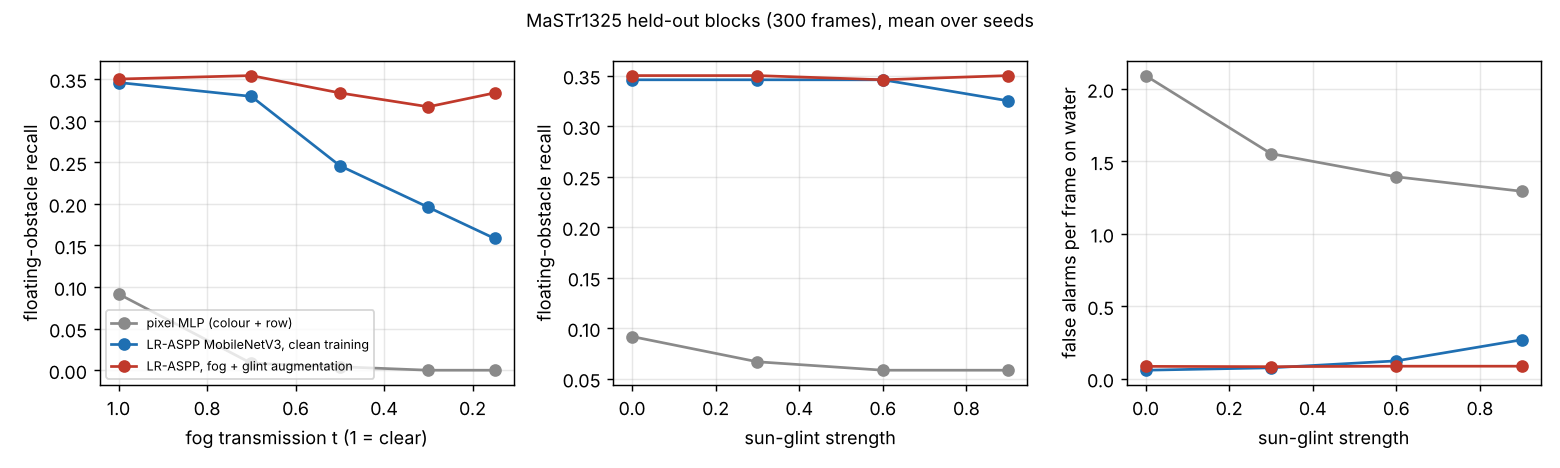
An LR-ASPP MobileNetV3 trained on MaSTr1325 scores 0.97 mIoU on held-out sequences yet finds only 35% of 80 floating obstacles (62% of those of 16 px or more); uniform fog at transmission 0.15 cuts the clean-trained net's large-object recall to 23% (wide seed spread), fog-and-glint augmentation holds it at 62% (same fog model), and glint raises false alarms on open water 4.6x for the clean-trained net
18 tests
What it found
Milestone 9a of track 23 (marine-detect), filed under the marine-hull programme. Public MaSTr1325 data (Bovcon et al. 2019, CC BY 4.0), split by blocks of 25 consecutive frames to avoid near-duplicate leakage (1025 train, 300 test), at 320×240 on 4 CPU cores. Models: LR-ASPP on an ImageNet MobileNetV3-Large backbone, trained clean and with fog plus glint augmentation, and a per-pixel colour-and-row MLP; 3 seeds each. Beyond pixel IoU, a MODS-style detection score from the masks: a floating obstacle (an 8-connected obstacle component of at least 4 px, ringed by water, not touching the frame) is found when half its pixels are predicted obstacle; a false alarm is a predicted blob of 4+ px wholly on water.
Fog is the Koschmieder scattering model with uniform transmission; glint is stylised saturating highlights with swept strength (no sourced glint statistics). Result (re-scored 2026-11-18 after a quality audit found 4-connected, no-floor counting that split thin structures into 1-px objects): mIoU 0.967 but 35% of 80 floating obstacles found (48 are 4–15 px, found 15–17%; 32 larger ones, 62–65%); fog at t = 0.15 cuts the clean net's large-object recall to 23% (±60 over seeds) while mIoU stays 0.88; augmentation keeps it at 62–66% on the same fog model; glint raises the clean net's false alarms from 0.06 to 0.27 per frame and leaves recall flat. Preliminary: reduced resolution, no IMU channel, not a reproduction of WaSR or the MODS protocol, one harbour in fair weather, uniform fog. Research code, not a certified perception system.
A figure from its own output
marine-detect/experiments/fig_degradation.png, written by the project's own experiment code.
Research log
Ongoing: each run adds a batch and an entry, newest first. Source: LOG.md.
2026-11-18 · Re-score with 8-connected obstacles and a 4-px floor (quality fix)
The 2026-11-17 quality audit found ground-truth obstacles labelled 4-connected with no size floor: 80 of 204 were single pixels, many from one diagonal pole. Now 8-connected and at least 4 px on both sides (false alarms already had the 4-px floor). MaSTr1325 archives re-downloaded; both SHA-256 matched the pinned values.
Counts on the 300 test frames: 204 (old rule), 141 (8-connected, no floor; 36 still single pixels), 80 (8-connected, >= 4 px). Objects of 16 px or more: 31 -> 32.
Retrained all nine runs and scored both rules on the same predictions. Old rule: 31.2% / 34.0% (first run 31.9% / 33.7%). New rule: 34.6% +- 7.2 / 35.0% +- 6.2 of 80; 16 px and up 61.5% / 64.6%. The headline (most floating obstacles missed) stands.
Changed: with augmentation, all-object recall no longer falls under fog (32-35%, was 34% -> 24%); the far-obstacle trend is withdrawn (nearest-horizon bin now 48%, no monotone pattern); the clean net's large-object loss under fog has a wide seed spread (t = 0.3: 29% +- 35).
Question: does a CPU-trainable published segmentation network find the obstacles a USV must avoid, and how much do fog and sun glint cost? Data: MaSTr1325 (22 MB + 2 MB from data.vicos.si, CC BY 4.0), split by hashed blocks of 25 consecutive frames (1025 / 300).
First pass counted zero floating obstacles: MaSTr1325 annotators leave an unknown margin round each object, so a 1-pixel ring saw only ignored pixels. Fixed with a 3-pixel ring that skips unknowns; counts are stable for rings of 3 to 8 px (204 to 189). Reran with per-object records so size and range could be binned afterwards.
173 of the 204 floating components are under 16 px at 320x240. A crop montage showed both real distant buoys and swimmers and fragments of thin structures (poles, a mooring line), so recall is reported above and below 16 px.
Outcome (experiments/results.txt): LR-ASPP mIoU 0.967, floating recall 32% (60% for 16 px or more); uniform fog t = 0.15 cuts large-object recall to 23% (clean training) and 61% (fog + glint augmentation); glint leaves recall flat but takes the clean net's false alarms from 0.08 to 0.28 per frame. The pixel MLP finds 8% and nothing at t = 0.5.
Not yet: MODS evaluation, WaSR, depth-dependent fog, the link to marine-colregs.
Which body carries a survey payload furthest per kWh? Hull choice for small autonomous boatsResearch programme (proposal stage): energy per survey kilometre of hull types for 100 to 500 kg autonomous boats; with a Michell wave term a catamaran out-ranges a monohull in 3.3% of 6,561 cases, none at equal length; with Slocum coefficients from the gliderflight package a glider never out-ranges a same-mass propeller AUV at equal hotel load (0 of 2,430 cases)…
How much does tacking cost a wing-sail drone, and does a tack-aware router win it back?In 54 simulated 38 km beats of a 4 m wing-sail drone (parametric wind and tide), a router blind to the tack stall loses a mean 4.5% in steady wind (max 9.8% at a 120 s tack), planning with the cost cuts that to 1.0%, and a greedy layline controller loses up to 17.6% with a 0.5 m/s tide and 3 to 25% when the wind shifts
Produced with AI assistance (Claude). Results are from the code in this repository and are simulated or stylised unless the abstract says otherwise; nothing here implies affiliation with or endorsement by any lab, researcher or company cited. MIT licensed.