Does a physics digital twin beat black-box models on a real two-tank rig? 0.53 V test RMSE with 8 parameters vs 0.66 V for the best black box
research/free-tanktwin
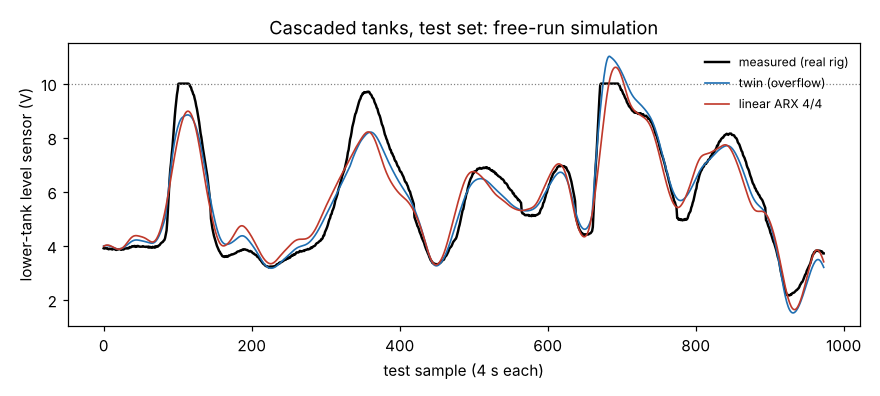
Does a physics digital twin beat black-box models on a real two-tank rig? An 8-parameter overflow twin gets 0.53 V test RMSE against 0.66 V for the best black box (9-parameter ARX); quadratic NARX models diverge in free run. One rig, one split, no confidence interval.
What it found
Fits a two-tank Torricelli twin, with and without an overflow path, to the real Cascaded Tanks benchmark measurements (Schoukens et al. 2016) and scores free-run simulation on the held-out experiment against linear ARX and quadratic NARX models. The 8-parameter overflow twin reaches 0.53 V test RMSE (0.51 V with the sensor’s 10 V saturation applied); the best black box, a 9-parameter linear ARX, gets 0.66 V, tied with the twin without overflow, so the gain comes from the overflow term. Quadratic NARX models are worse and the 3/3 and 4/4 fits diverge in free run (7.4 and 42 V) after a one-step fit. One rig, one split, no confidence interval; the spill gain sits near its fit bound; no published number is reproduced. Data are measured; no input is invented.
A figure from its own output
Paper, code and results
More in Digital twins & sim-to-real
- Can a 22-DOF home robot be printed in PLA around one $15 servo, and which of its twin's simplifications matter for learning to reach and pick?A 3D-printable 22-DOF bimanual mobile manipulator (two 7-DOF arms with geared elbows and parallel grippers, head, lift, omni base) on one $15 servo, $627–948 in parts, with a MuJoCo twin generated from the same parameters as the CAD: reach and pick policies trained on the exact twin ignore servo, friction and mass errors but fail at one 40 ms step of latency (reach 99→29%, pick 91→41%); randomisation fixes reaching almost for free but costs picking 14 points; an interference sweep over the printed solids caught an elbow range the twin allowed but the parts could not reach. Simulated only, not yet built.
- How few real trials certify a robot policy when a biased simulator supplies the rest?Research programme (milestones 3 to 6 logged): valid, bias-agnostic sim-to-real evaluation of robot policies, consolidating about 130 twin projects into one question, with 13 checked references, hypotheses H1 to H6 and CoRL as the target venue
- A stereo twin that adds Gaussian noise to depth gets the median right: what does it get wrong about over-range errors, safety margins and averaging compared with real disparity-space noise?Gaussian-depth-noise stereo twin vs real disparity-space noise: median exact, gated mean biased by ≈s², over-range errors up to 191× more frequent at 40 m, a twin 3σ margin exceeded 10× as often, mean-depth averaging floors while averaging disparity converges (negative result at the 60 m range floor). Stylised.
- A rigid-body twin of a cart carrying liquid predicts no slosh: how wrong is that, what does a slosh-safe move cost, and what does a stale frequency calibration do to it?A rigid twin of a cart carrying liquid predicts zero slosh: minimum-time move leaves 10.7 cm (10× tolerance), slosh-safe move is 55% slower, and a full-tank frequency calibration fails at low fill (28 s vs 8.7 s recalibrated; tuning-free bound 24.7 s).
- Can an input shaper make a liquid-carrying cart’s move robust to a stale slosh-frequency calibration, and how fast can it be?Input-shaped moves of a liquid-carrying cart: ZV/ZVD residual
sin(πε/2),sin²(πε/2)exactly multiplies the bang-bang residual, so a stale frequency calibration that breaks the null-tuned move (28 s) is harmless to a 5.9 s ZV move; closed-form tolerated error and a fill-band design that spends the tolerance on a shorter shaper. - What is a digital twin worth for training a controller?What a digital twin is worth for training a controller: exact LQ sim-to-real regret with a stability cliff, a validation blind spot (zero score gap yet mistrained control without probing), and a twin worth exactly
σ²/(vδ²)real samples at any accuracy.
All 164 Digital twins & sim-to-real projects →
Other research topics
Proper scoring & elicitation28Effort & peer prediction9Verification games & slashing19Detection & tolerances14Markets as routers13Prediction-market design9Paying contributors8Decentralised training systems23Digital twins & sim-to-real164LLM chip design loops40Robot manufacturing loops53Ambient AI assistant46Self-replicating manufacturing34Simulation-first design64Engineered clothing45Task-specific AI accelerators40Algorithmic chip-design loops42Open-source purpose-built robots44The software-engineering loop43Adversarial human imitation41Open-source residential construction41Autonomous multi-angle capture34Sensing, imaging and 3D31Energy supply and dense energy storage39Robot societies among people31Agentic co-design of low-cost robots27Laundry-hanging robots25Machine learning on qualitative data23Robots on the building site27Civilizations & group psychology1History & human sciences1
Produced with AI assistance (Claude). Results are from the code in this repository and are simulated or stylised unless the abstract says otherwise; nothing here implies affiliation with or endorsement by any lab, researcher or company cited. MIT licensed.