Does the overflow twin's lead over ARX survive refitting on a real two-tank rig? A 0.13 V gap in 100% of refits with 87.5% of the training data, but 0.07 V and 84 to 90% of refits with 50 to 75%
research/free-tankfit
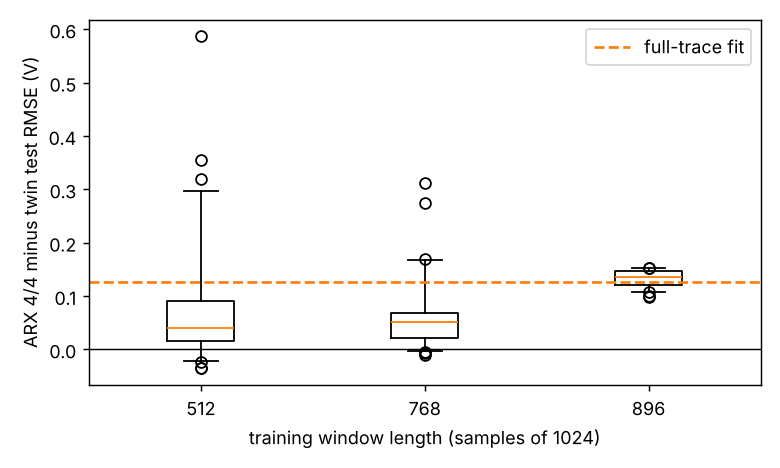
Does the overflow twin's lead over ARX survive refitting on a real two-tank rig? A 0.13 V gap in 100% of refits with 87.5% of the training data, but 0.07 V and 84 to 90% of refits with 50 to 75%. Overlapping windows, fixed optimiser start.
What it found
Adds fit variance to free-tankci. Refits the 8-parameter overflow twin and linear ARX 4/4 on 100 random contiguous windows of the real Cascaded Tanks training trace (Schoukens et al. 2016) at three window lengths and scores each on the fixed test trace as in free-tanktwin. With 896 of 1024 samples the twin's test RMSE is 0.518 V (sd 0.012) against 0.651 V (sd 0.004) for ARX, a gap of 0.133 V in all 100 refits. With 768 samples the gap is 0.066 V (2.5 to 97.5%: −0.004 to 0.169) and the twin wins 90%; with 512 it is 0.070 V and 84%. The twin's advantage therefore depends on the training trace covering the operating range. Windows overlap and shrinking them confounds fit variance with less information, so only the longest window approximates the same data refitted; the optimiser start is fixed. All data are measured; no input is invented.
A figure from its own output
Paper, code and results
More in Digital twins & sim-to-real
- Does a physics digital twin beat black-box models on a real two-tank rig? 0.53 V test RMSE with 8 parameters vs 0.66 V for the best black boxDoes a physics digital twin beat black-box models on a real two-tank rig? An 8-parameter overflow twin gets 0.53 V test RMSE against 0.66 V for the best black box (9-parameter ARX); quadratic NARX models diverge in free run. One rig, one split, no confidence interval.
- Can a 22-DOF home robot be printed in PLA around one $15 servo, and which of its twin's simplifications matter for learning to reach and pick?A 3D-printable 22-DOF bimanual mobile manipulator (two 7-DOF arms with geared elbows and parallel grippers, head, lift, omni base) on one $15 servo, $627–948 in parts, with a MuJoCo twin generated from the same parameters as the CAD: reach and pick policies trained on the exact twin ignore servo, friction and mass errors but fail at one 40 ms step of latency (reach 99→29%, pick 91→41%); randomisation fixes reaching almost for free but costs picking 14 points; an interference sweep over the printed solids caught an elbow range the twin allowed but the parts could not reach. Simulated only, not yet built.
- How few real trials certify a robot policy when a biased simulator supplies the rest?Research programme (milestones 3 to 6 logged): valid, bias-agnostic sim-to-real evaluation of robot policies, consolidating about 130 twin projects into one question, with 13 checked references, hypotheses H1 to H6 and CoRL as the target venue
- A stereo twin that adds Gaussian noise to depth gets the median right: what does it get wrong about over-range errors, safety margins and averaging compared with real disparity-space noise?Gaussian-depth-noise stereo twin vs real disparity-space noise: median exact, gated mean biased by ≈s², over-range errors up to 191× more frequent at 40 m, a twin 3σ margin exceeded 10× as often, mean-depth averaging floors while averaging disparity converges (negative result at the 60 m range floor). Stylised.
- A rigid-body twin of a cart carrying liquid predicts no slosh: how wrong is that, what does a slosh-safe move cost, and what does a stale frequency calibration do to it?A rigid twin of a cart carrying liquid predicts zero slosh: minimum-time move leaves 10.7 cm (10× tolerance), slosh-safe move is 55% slower, and a full-tank frequency calibration fails at low fill (28 s vs 8.7 s recalibrated; tuning-free bound 24.7 s).
- Can an input shaper make a liquid-carrying cart’s move robust to a stale slosh-frequency calibration, and how fast can it be?Input-shaped moves of a liquid-carrying cart: ZV/ZVD residual
sin(πε/2),sin²(πε/2)exactly multiplies the bang-bang residual, so a stale frequency calibration that breaks the null-tuned move (28 s) is harmless to a 5.9 s ZV move; closed-form tolerated error and a fill-band design that spends the tolerance on a shorter shaper.
All 164 Digital twins & sim-to-real projects →
Other research topics
Proper scoring & elicitation28Effort & peer prediction9Verification games & slashing19Detection & tolerances14Markets as routers13Prediction-market design9Paying contributors8Decentralised training systems23Digital twins & sim-to-real164LLM chip design loops40Robot manufacturing loops53Ambient AI assistant46Self-replicating manufacturing34Simulation-first design64Engineered clothing45Task-specific AI accelerators40Algorithmic chip-design loops42Open-source purpose-built robots44The software-engineering loop43Adversarial human imitation41Open-source residential construction41Autonomous multi-angle capture34Sensing, imaging and 3D31Energy supply and dense energy storage39Robot societies among people31Agentic co-design of low-cost robots27Laundry-hanging robots25Machine learning on qualitative data23Robots on the building site27Civilizations & group psychology1History & human sciences1
Produced with AI assistance (Claude). Results are from the code in this repository and are simulated or stylised unless the abstract says otherwise; nothing here implies affiliation with or endorsement by any lab, researcher or company cited. MIT licensed.