How many missed samples can a PD loop tuned on a fixed-period twin survive?
research/free-missedpd
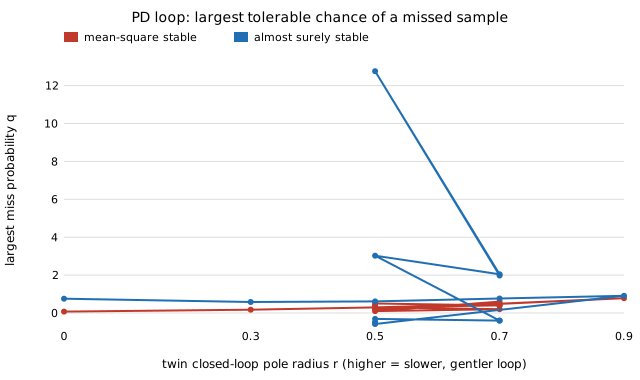
How many missed samples can a PD loop tuned on a fixed-period twin survive? With samples lost independently and the last command held, a double-integrator loop with twin poles at 0.5 is mean-square stable only up to a 29% loss rate but almost surely stable up to 61%; a deadbeat twin tolerates 7% in mean square.
What it found
Double-integrator plant under PD control with zero-order hold; gains place both closed-loop poles of the fixed-period twin at z = r (h0 = 0.1). Each sample is lost independently with probability q, so the interval is m h0 with geometric m. Mean-square stability is an exact 3×3 second-moment operator with a Jury test; almost-sure stability is a Lyapunov exponent from a 200,000-sample product. For r = 0.5 the loop is mean-square stable up to q = 0.293 and almost surely up to 0.611 (999 of 1,000 runs converge at 0.55); deadbeat r = 0 gives 0.070 and 0.753, slow r = 0.9 gives 0.780 and 0.907. The operator matches Monte Carlo where the tails are sampled and a 400,000-run Monte Carlo of the mean square misses it by 6% at q = 0.3. Stylised: one chosen plant and loop, independent losses, no noise, delay or saturation, none taken from a robot or datasheet.
A figure from its own output
Paper, code and results
More in Digital twins & sim-to-real
- Does an inverted-pendulum loop tuned on a fixed-period twin survive missed samples, and does an interval-aware gain fix it?On a linearised pendulum (L = 0.5 m) a fixed twin-tuned gain survives any miss probability with slow poles unless the plant is very unstable per sample (limit q = 0.21 at ωh₀ = 1.4), a deadbeat tuning fails by q = 0.03 to 0.10, and a gain recomputed from the actual interval was stable at every q in all 15 cases. Linear, noise-free, simulated.
- How many solver iterations does a physics twin need to hold a stack of boxes still?How many solver iterations does a physics twin need to hold a stack of boxes still? A projected Gauss-Seidel solver at 60 Hz needs 16 for 4 boxes, about 128 for 6 and over 2048 for 16 or more, and extra iterations do not reliably help.
- If the twin is optimistic, how often does a rollout test certify a policy that is not safe?Exact: a twin that fails 10% less often than reality lifts the chance of certifying a 5%-failure policy from 0.049 to 0.087 (fixed test, 1% vs 5%), 20% less often to 0.147, and guarding against a 1.5x optimism costs 2.2 times the rollouts
- Can a rollout cap on a sequential certification test be set without losing the 5% error guarantee, and what does it cost?Follow-up to free-sprtcap: re-tuning a capped SPRT's boundaries and final cut so both errors stay at or below 5% exactly costs, for 1% vs 5% (fixed test 181 rollouts), a mean of 107 rollouts at a cap equal to the fixed size and 90 at twice it, against 90 to 95 for the plain capped test that overshoots the error; the fixed test needs 181.
- What is the cheapest capped certification test in the worst case, not just at the two design rates, and what does it cost at the ends?Follow-up to free-sprtopt: an exact linear programme gives the capped certification test with the smallest worst-case mean over failure rates between p1 and p0; for 1% vs 5% at a cap of 362 it needs 123.8 rollouts at worst against 131.0 for the average-optimal test and 181 for the fixed test, at the price of 3 to 6% more rollouts at the two design rates.
- How few rollouts can a capped certification test need while keeping both errors at 5%, and how far is the tuned SPRT from that optimum?Follow-up to free-sprtcut: backward induction gives the optimal capped test, 98.9 rollouts on average for 1% vs 5% at a cap of 181 (proved within 0.2% by a dual bound), against 107.3 for the grid-tuned SPRT and 181 for the fixed test; the tuned SPRT is 3 to 9% above the optimum at every cap tried.
All 164 Digital twins & sim-to-real projects →
Other research topics
Proper scoring & elicitation28Effort & peer prediction9Verification games & slashing19Detection & tolerances14Markets as routers13Prediction-market design9Paying contributors8Decentralised training systems23Digital twins & sim-to-real164LLM chip design loops40Robot manufacturing loops53Ambient AI assistant46Self-replicating manufacturing34Simulation-first design64Engineered clothing45Task-specific AI accelerators40Algorithmic chip-design loops42Open-source purpose-built robots44The software-engineering loop43Adversarial human imitation41Open-source residential construction41Autonomous multi-angle capture34Sensing, imaging and 3D31Energy supply and dense energy storage39Robot societies among people31Agentic co-design of low-cost robots27Laundry-hanging robots25Machine learning on qualitative data23Robots on the building site27Civilizations & group psychology1History & human sciences1
Produced with AI assistance (Claude). Results are from the code in this repository and are simulated or stylised unless the abstract says otherwise; nothing here implies affiliation with or endorsement by any lab, researcher or company cited. MIT licensed.