How much feedback delay can a digital twin's controller tolerate, and does a fixed-step simulator get that margin right?
research/free-delaymargin
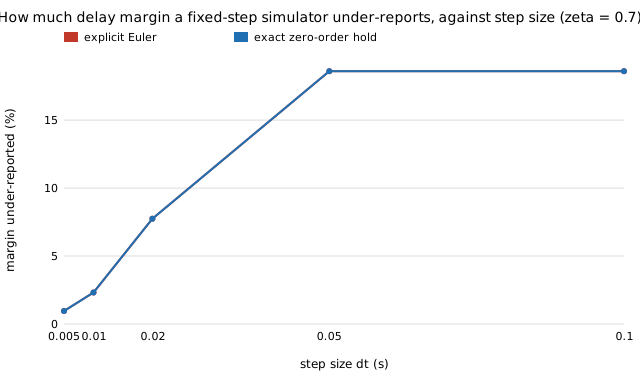
Exact: a fixed-step twin under-reports a PD loop's delay margin by 18.6% at dt = 0.1 s and 1.0% at 5 ms, because the largest stable delay is the largest n with (n + 1/2) dt below the true margin (25 of 25 cases)
What it found
Exact eigenvalue study (no sampling) of a PD-controlled double integrator with feedback delay (kp = 4, damping ratio 0.3 to 2). The continuous-time delay margin is 0.19 to 0.37 s from the frequency-domain crossing. A fixed-step simulator that must represent the delay as whole steps reports a smaller margin: for the well-damped case (ζ = 0.7) 18.6% too small at dt = 0.1 s, 7.8% at 0.02 s, 2.3% at 0.01 s and 1.0% at 5 ms. For exact zero-order-hold integration the largest stable delay in steps is the largest n with (n + ½)·dt below the true margin, which held in 25 of 25 (damping, step) cases; explicit Euler, semi-implicit Euler and the exact hold agree to the step except for the lightly damped loop. One plant and controller form, constant integer delay, no measured latency from any real system.
A figure from its own output
Paper, code and results
More in Digital twins & sim-to-real
- How wrong is a simulator's pendulum period at its default timestep?How wrong is a simulator's pendulum period at its default timestep? Exact elliptic-integral period against Euler, semi-implicit Euler, Verlet and RK4: Euler fails (14% period error at 2 ms), the symplectic pair is 0.75 ppm, and releasing from rest hides the symplectic error.
- Which 95% upper bound on a failure rate actually covers 95% at simulator-rollout sample sizes?Which 95% upper bound on a failure rate really covers 95% at rollout sample sizes: exact coverage shows only Clopper-Pearson never undercovers (min 0.950), Wilson dips to 0.93, Jeffreys to 0.85 and Wald to 0.06–0.75; zero-failure certification of p ≤ 1% takes 299 rollouts (CP), 268 (Wilson) or 191 (Jeffreys).
- How many fixed steps per orbit does a twin need before an eccentric orbit stops drifting?How many fixed steps per orbit does a twin need before an eccentric orbit stops drifting? Against the exact Kepler solution RK4 needs 64 to 4096 steps per orbit (e = 0 to 0.9), the symplectic pair 8 to 16 times more, and at e = 0.9 every fixed step fails.
- How long does a digital twin of a chaotic system stay accurate? Each e-fold of smaller state error buys 1.12 time units on Lorenz-63 (1/lambda = 1.11)How long does a digital twin of a chaotic system stay accurate? On Lorenz-63 each e-fold of smaller state error buys 1.12 time units (1/lambda = 1.11); a parameter error buys 0.85. Mean over 40 starts, one tolerance.
- How many missed samples can a PD loop tuned on a fixed-period twin survive?How many missed samples can a PD loop tuned on a fixed-period twin survive? With samples lost independently and the last command held, a double-integrator loop with twin poles at 0.5 is mean-square stable only up to a 29% loss rate but almost surely stable up to 61%; a deadbeat twin tolerates 7% in mean square.
- Does an inverted-pendulum loop tuned on a fixed-period twin survive missed samples, and does an interval-aware gain fix it?On a linearised pendulum (L = 0.5 m) a fixed twin-tuned gain survives any miss probability with slow poles unless the plant is very unstable per sample (limit q = 0.21 at ωh₀ = 1.4), a deadbeat tuning fails by q = 0.03 to 0.10, and a gain recomputed from the actual interval was stable at every q in all 15 cases. Linear, noise-free, simulated.
All 164 Digital twins & sim-to-real projects →
Other research topics
Proper scoring & elicitation28Effort & peer prediction9Verification games & slashing19Detection & tolerances14Markets as routers13Prediction-market design9Paying contributors8Decentralised training systems23Digital twins & sim-to-real164LLM chip design loops40Robot manufacturing loops53Ambient AI assistant46Self-replicating manufacturing34Simulation-first design64Engineered clothing45Task-specific AI accelerators40Algorithmic chip-design loops42Open-source purpose-built robots44The software-engineering loop43Adversarial human imitation41Open-source residential construction41Autonomous multi-angle capture34Sensing, imaging and 3D31Energy supply and dense energy storage39Robot societies among people31Agentic co-design of low-cost robots27Laundry-hanging robots25Machine learning on qualitative data23Robots on the building site27Civilizations & group psychology1History & human sciences1
Produced with AI assistance (Claude). Results are from the code in this repository and are simulated or stylised unless the abstract says otherwise; nothing here implies affiliation with or endorsement by any lab, researcher or company cited. MIT licensed.