Does a physics-shaped twin of a real buck converter beat plain ARX? Only partly: all models sit at 0.5 to 0.9 V free-run error against a 0.06 V quantisation floor, and the winner flips with which half of the 20 ms record is fitted
research/free-buckreal
Does a physics-shaped twin of a real buck converter beat plain ARX? Only partly: all models sit at 0.5 to 0.9 V free-run error against a 0.06 V quantisation floor, and the winner flips with which half of the 20 ms record is fitted. One 20 ms record; natural frequency fitted, no component values.
What it found
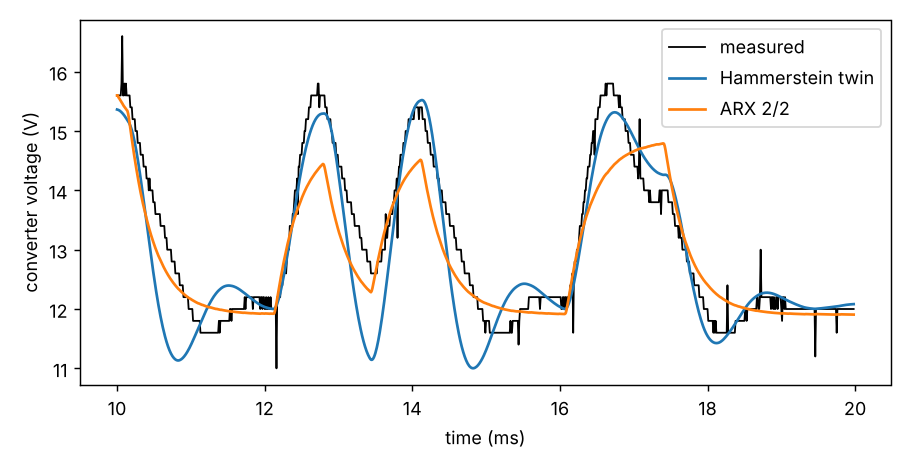
Real buck-converter hardware data (1001 + 999 samples at 10 µs, SysIdentPy data repository, MIT). A 5-parameter twin (static quadratic duty-to-voltage curve into an exactly discretised second-order LC lag, delay chosen on the training half) is compared with ARX 1/1 to 10/10 in free run. Fitting the first 10 ms and testing on the next, the Hammerstein twin has RMSE 0.62 V and ARX 2/2 0.58 V (block-bootstrap interval of the difference −0.28 to +0.26 V); swapping the halves, 0.50 V against 0.82 V (interval +0.22 to +0.49 V). Dropping the curvature costs the twin 0.10 to 0.17 V. Every model stays about nine times above the 0.058 V quantisation floor, so something in the converter (ripple, load, other dynamics) is unmodelled. One 20 ms record, so the two directions are the only replication; the natural frequency is fitted because no component values come with the data.
A figure from its own output
Paper, code and results
More in Digital twins & sim-to-real
- How much feedback delay can a digital twin's controller tolerate, and does a fixed-step simulator get that margin right?Exact: a fixed-step twin under-reports a PD loop's delay margin by 18.6% at dt = 0.1 s and 1.0% at 5 ms, because the largest stable delay is the largest n with (n + 1/2) dt below the true margin (25 of 25 cases)
- How wrong is a simulator's pendulum period at its default timestep?How wrong is a simulator's pendulum period at its default timestep? Exact elliptic-integral period against Euler, semi-implicit Euler, Verlet and RK4: Euler fails (14% period error at 2 ms), the symplectic pair is 0.75 ppm, and releasing from rest hides the symplectic error.
- Which 95% upper bound on a failure rate actually covers 95% at simulator-rollout sample sizes?Which 95% upper bound on a failure rate really covers 95% at rollout sample sizes: exact coverage shows only Clopper-Pearson never undercovers (min 0.950), Wilson dips to 0.93, Jeffreys to 0.85 and Wald to 0.06–0.75; zero-failure certification of p ≤ 1% takes 299 rollouts (CP), 268 (Wilson) or 191 (Jeffreys).
- How many fixed steps per orbit does a twin need before an eccentric orbit stops drifting?How many fixed steps per orbit does a twin need before an eccentric orbit stops drifting? Against the exact Kepler solution RK4 needs 64 to 4096 steps per orbit (e = 0 to 0.9), the symplectic pair 8 to 16 times more, and at e = 0.9 every fixed step fails.
- How long does a digital twin of a chaotic system stay accurate? Each e-fold of smaller state error buys 1.12 time units on Lorenz-63 (1/lambda = 1.11)How long does a digital twin of a chaotic system stay accurate? On Lorenz-63 each e-fold of smaller state error buys 1.12 time units (1/lambda = 1.11); a parameter error buys 0.85. Mean over 40 starts, one tolerance.
- How many missed samples can a PD loop tuned on a fixed-period twin survive?How many missed samples can a PD loop tuned on a fixed-period twin survive? With samples lost independently and the last command held, a double-integrator loop with twin poles at 0.5 is mean-square stable only up to a 29% loss rate but almost surely stable up to 61%; a deadbeat twin tolerates 7% in mean square.
All 164 Digital twins & sim-to-real projects →
Other research topics
Proper scoring & elicitation28Effort & peer prediction9Verification games & slashing19Detection & tolerances14Markets as routers13Prediction-market design9Paying contributors8Decentralised training systems23Digital twins & sim-to-real164LLM chip design loops40Robot manufacturing loops53Ambient AI assistant46Self-replicating manufacturing34Simulation-first design64Engineered clothing45Task-specific AI accelerators40Algorithmic chip-design loops42Open-source purpose-built robots44The software-engineering loop43Adversarial human imitation41Open-source residential construction41Autonomous multi-angle capture34Sensing, imaging and 3D31Energy supply and dense energy storage39Robot societies among people31Agentic co-design of low-cost robots27Laundry-hanging robots25Machine learning on qualitative data23Robots on the building site27Civilizations & group psychology1History & human sciences1
Produced with AI assistance (Claude). Results are from the code in this repository and are simulated or stylised unless the abstract says otherwise; nothing here implies affiliation with or endorsement by any lab, researcher or company cited. MIT licensed.