Can a fixed inflation radius stand in for a rectangular robot's footprint in a narrow gap?
research/footprint-twin
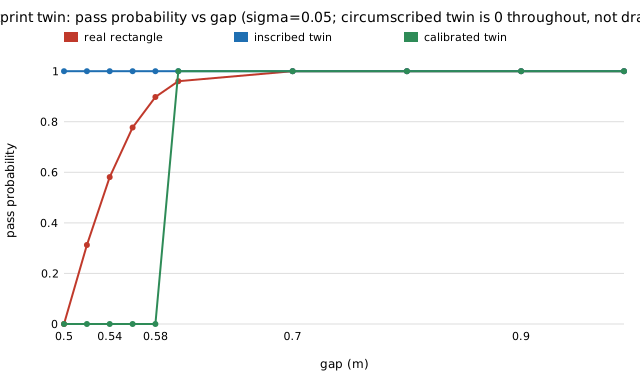
Point/circle/calibrated-inflation footprint twin vs a rectangular robot with heading error in a narrow gap: exact pass probability 2Φ(θ*/σ)−1, circle twins are step functions, a 95%-calibrated inflation is 0.17 m too small at 3× the heading error, 10-gap missions succeed 0.60 where the twin says 1.
What it found
A 1.0×0.5 m robot with Gaussian heading error crossing a gap: pass probability is exactly 2Φ(θ*/σ)−1 with θ* = asin(g/R)−atan(W/L) (matches a corner-geometry Monte Carlo within 0.0013). Inscribed- and circumscribed-circle twins are step functions (always pass / always fail below 1.118 m); an inflation calibrated to 95% at σ = 0.05 is 0.17 m too small at σ = 0.15 (real pass 0.49), and ten-gap missions succeed only 0.60 of the time where the twin says 1. Stylised: simulated robot, Gaussian heading error, no sensing error.
A figure from its own output
Paper, code and results
More in Digital twins & sim-to-real
- If a twin gives every scene the same inlier fraction, how many RANSAC iterations does it say we need, and is that enough when real scenes vary?RANSAC iteration budget from a fixed-inlier-fraction twin (17 for 99%) vs scenes with beta-binomial inlier counts: exact failure 1.3–30% at that budget, 99% needs 19–458 iterations or is unreachable for κ≤2; stylised, line fitting only.
- Can a lidar twin give each beam an independent visibility probability, or do neighbouring beams share occluders?Lidar twin with independent per-beam visibility vs a Poisson occluder field: beams closer than an occluder diameter share occluders, exact blind probability by inclusion–exclusion over union lengths, 8 beams at 25 cm blind 0.0815 vs the twin's 0.0039 (20.9×), the twin is exact once spacing ≥ 2ρ, an occluder-field ensemble matches. Stylised.
- A battery twin with no internal resistance: how much endurance and how large a burst does the real, sagging cell actually give?Battery twin with no internal resistance vs a real sagging cell: endurance exactly
(1+√(1−u))/2of the twin's (0.5 at the fold), 9–94% of charge stranded at the voltage cutoff, a burst of 0.5 fails below 51% charge where the twin's floor is 0 (a flat 20% reserve covers only a third of the full-charge limit), and a constant-derate refit errs +12% to +473% off its fit power. Stylised. - How many real trajectories does a classifier two-sample test need to reject a wrong digital twin, compared with a paired error test?How many real trajectories does a classifier two-sample test need to reject a wrong digital twin? Stylised pendulum: for a 20% Coulomb error a paired error test has power 0.98 at 100 trajectories vs 0.25 for the C2ST (which needs ~200), but for a 10% error the paired test stalls at 0.09–0.20 up to 800 while the C2ST reaches 1.00 at 400, and for same-variance noise-shape error the paired test has power ≤0.07 at every size. Null calibration approximate (60 replicates). Preliminary, simulated only.
- Was the paired digital-twin test weak, or was its statistic?Was the paired twin test weak, or was its statistic? Stylised pendulum, Student-t noise: the mean squared residual has power ~0.1 at a 10% Coulomb error up to n = 400, while median, trimmed, absolute and Huber statistics reach 0.94–1.00 from n = 50; Gaussian noise barely cares.
- Which robust paired test still catches a wrong digital twin when noise has infinite variance or whole runs go bad?Which robust paired test still catches a wrong digital twin when noise has infinite variance or whole runs go bad? Stylised pendulum, 10% Coulomb error: median and trimmed residuals reach power 1.00 under Student-t(2) cells but only 0.17–0.40 under bad runs, where a per-run median reaches 0.89–1.00; no statistic wins both.
All 164 Digital twins & sim-to-real projects →
Other research topics
Proper scoring & elicitation28Effort & peer prediction9Verification games & slashing19Detection & tolerances14Markets as routers13Prediction-market design9Paying contributors8Decentralised training systems23Digital twins & sim-to-real164LLM chip design loops40Robot manufacturing loops53Ambient AI assistant46Self-replicating manufacturing34Simulation-first design64Engineered clothing45Task-specific AI accelerators40Algorithmic chip-design loops42Open-source purpose-built robots44The software-engineering loop43Adversarial human imitation41Open-source residential construction41Autonomous multi-angle capture34Sensing, imaging and 3D31Energy supply and dense energy storage39Robot societies among people31Agentic co-design of low-cost robots27Laundry-hanging robots25Machine learning on qualitative data23Robots on the building site27Civilizations & group psychology1History & human sciences1
Produced with AI assistance (Claude). Results are from the code in this repository and are simulated or stylised unless the abstract says otherwise; nothing here implies affiliation with or endorsement by any lab, researcher or company cited. MIT licensed.