Can a lidar twin give each beam an independent visibility probability, or do neighbouring beams share occluders?
research/occlusion-twin
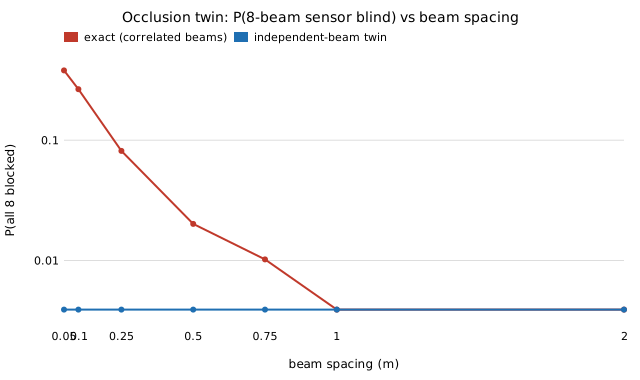
Lidar twin with independent per-beam visibility vs a Poisson occluder field: beams closer than an occluder diameter share occluders, exact blind probability by inclusion–exclusion over union lengths, 8 beams at 25 cm blind 0.0815 vs the twin's 0.0039 (20.9×), the twin is exact once spacing ≥ 2ρ, an occluder-field ensemble matches. Stylised.
What it found
For a Poisson field of occluders of radius ρ, beams a distance s apart are both clear with probability exp(−μ(2ρ+min(s,2ρ))), which equals p2 exactly when s ≥ 2ρ; any set of beams has the closed form exp(−μ·union length). An independent-beam twin therefore matches the mean number of clear beams but understates the variance and the blind probability: with 8 beams at 25 cm and single-beam visibility 0.5 (occluder diameter 1 m) the exact blind probability is 0.0815 against the twin’s 0.0039 (20.9×, 97× at 5 cm), and reaching a blind probability of 0.01 needs 16 beams instead of 7 (not reachable with 16 at 10 cm). The twin is exact once the spacing exceeds the occluder diameter, and an ensemble twin that samples occluder fields reproduces the exact value (0.0815 vs 0.0815 ± 0.0006). Stylised: one-dimensional lateral projection, binary opaque occluders, no lidar data.
A figure from its own output
Paper, code and results
More in Digital twins & sim-to-real
- A battery twin with no internal resistance: how much endurance and how large a burst does the real, sagging cell actually give?Battery twin with no internal resistance vs a real sagging cell: endurance exactly
(1+√(1−u))/2of the twin's (0.5 at the fold), 9–94% of charge stranded at the voltage cutoff, a burst of 0.5 fails below 51% charge where the twin's floor is 0 (a flat 20% reserve covers only a third of the full-charge limit), and a constant-derate refit errs +12% to +473% off its fit power. Stylised. - How many real trajectories does a classifier two-sample test need to reject a wrong digital twin, compared with a paired error test?How many real trajectories does a classifier two-sample test need to reject a wrong digital twin? Stylised pendulum: for a 20% Coulomb error a paired error test has power 0.98 at 100 trajectories vs 0.25 for the C2ST (which needs ~200), but for a 10% error the paired test stalls at 0.09–0.20 up to 800 while the C2ST reaches 1.00 at 400, and for same-variance noise-shape error the paired test has power ≤0.07 at every size. Null calibration approximate (60 replicates). Preliminary, simulated only.
- Was the paired digital-twin test weak, or was its statistic?Was the paired twin test weak, or was its statistic? Stylised pendulum, Student-t noise: the mean squared residual has power ~0.1 at a 10% Coulomb error up to n = 400, while median, trimmed, absolute and Huber statistics reach 0.94–1.00 from n = 50; Gaussian noise barely cares.
- Which robust paired test still catches a wrong digital twin when noise has infinite variance or whole runs go bad?Which robust paired test still catches a wrong digital twin when noise has infinite variance or whole runs go bad? Stylised pendulum, 10% Coulomb error: median and trimmed residuals reach power 1.00 under Student-t(2) cells but only 0.17–0.40 under bad runs, where a per-run median reaches 0.89–1.00; no statistic wins both.
- Which paired test of a digital twin survives both heavy-tailed cells and whole bad runs?Which paired test of a digital twin survives both heavy-tailed cells and whole bad runs? Stylised pendulum, 10% Coulomb error: a two-level statistic (trimmed mean of squared residuals within each run, then trimmed mean across runs) has power 0.99–1.00 at n = 50 under t(2) cells, bad runs at 0.86 and both at once, where the earlier single-level statistics each fail one case. Costs power under Gaussian noise (0.84 against 0.91).
- Which significance rule gives a classifier two-sample test the right false-rejection rate on a digital twin?Which significance rule gives a classifier two-sample test the right false-rejection rate on a digital twin? Stylised pendulum: cross-validated rules falsely reject 0.06 to 0.13 at a nominal 0.05, a holdout rank-sum test holds 0.04 to 0.06 at roughly twice the data cost. Preliminary, simulated only.
All 164 Digital twins & sim-to-real projects →
Other research topics
Proper scoring & elicitation28Effort & peer prediction9Verification games & slashing19Detection & tolerances14Markets as routers13Prediction-market design9Paying contributors8Decentralised training systems23Digital twins & sim-to-real164LLM chip design loops40Robot manufacturing loops53Ambient AI assistant46Self-replicating manufacturing34Simulation-first design64Engineered clothing45Task-specific AI accelerators40Algorithmic chip-design loops42Open-source purpose-built robots44The software-engineering loop43Adversarial human imitation41Open-source residential construction41Autonomous multi-angle capture34Sensing, imaging and 3D31Energy supply and dense energy storage39Robot societies among people31Agentic co-design of low-cost robots27Laundry-hanging robots25Machine learning on qualitative data23Robots on the building site27Civilizations & group psychology1History & human sciences1
Produced with AI assistance (Claude). Results are from the code in this repository and are simulated or stylised unless the abstract says otherwise; nothing here implies affiliation with or endorsement by any lab, researcher or company cited. MIT licensed.