Does agreement pay reward shared laziness?
research/focal-laziness
Peer prediction when lazy verifiers share a default answer: agreement pay is 2G·Cov, effort is a coordination game with threshold a*=(k/2G+s)/(pq+s), the all-lazy equilibrium always exists and pays as much as honesty when the default matches the prior, and gold checks needing more mass than the honest pay close it.
What it found
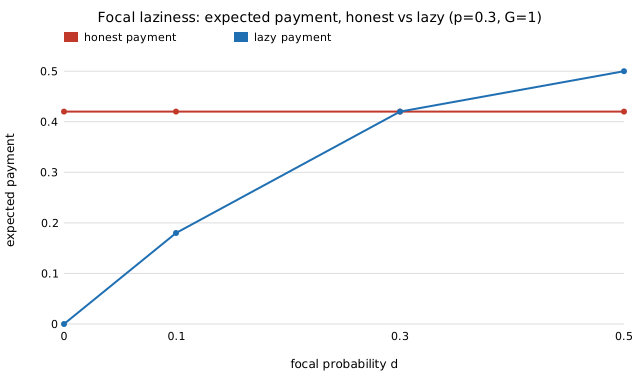
Multi-task peer prediction pays 2G·Cov of two reports. If lazy verifiers copy a shared per-task default (the same public model’s guess) pay becomes 2G[aiajpq + (1−ai)(1−aj)d(1−d)], effort is a coordination game with threshold a* = (k/2G + s)/(pq + s), and the all-lazy profile is always an equilibrium paying 2G·d(1−d): equal to honest pay when the default matches the prior, 1.19× it at p=0.3, d=0.5. Closing it with gold checks needs payment mass (2Gs+k)/(1−accD), larger than the honest pay itself. Stylised.
A figure from its own output
Paper, code and results
More in Effort & peer prediction
- How noisy is peer-prediction pay with finitely many tasks?Finite-sample noise in multi-task peer prediction: the plug-in payment is 2× the sample covariance with an exact variance (matches enumeration), √2 less noisy than fresh penalty tasks, pays a constant reporter 0, and a lazy coin still earns
≈σ/√(2π)under limited liability; deductibles and detection/ranking sample sizes in closed form. - When most verifiers miss a fault, who should be believed?Surprisingly-popular verdicts for rare-but-diagnostic signals: majority errs 0.84 on faulty jobs at n=101 when detection is 0.45, SP is an exact fraction threshold
v/(1−u+v)(2.1×10⁻⁵ error, 47 votes for 10⁻³ vs Bayes 36), a wrong believed prior wrecks finite-n accuracy, a wrong believed detector breaks the limit, Byzantine breakdown at exactly 13.6%. - Why should the first verifiers be sealed?Sequential verifiers who see earlier verdicts herd: wrong-cascade probability exactly
(1−a)²/(a²+(1−a)²), cascade after2/(a²+(1−a)²)signals, accuracy capped at 0.845 (a=0.7) versus ≈1 for an independent majority, and a sealed first batch of ≥3 lifts the cap (0.875 at m=3, 0.949 at m=11); checked against Bayesian agents. - When should a paid verifier stop checking?Verifiers who choose when to stop checking under a proper score: optimal policy is a symmetric threshold (matches dynamic programming), closed-form accuracy
1/(1+((1−a)/a)^k)and costk(2p_k−1)/(2a−1), participationκ ≥ 4c/(2a−1)², and adaptive stopping matches fixed-sample accuracy with 2–3× fewer checks. - Peer-prediction markets for decentralized ML training verificationPeer-prediction and prediction-market mechanisms for verifying decentralized ML training, with adversarial evaluation.
- What does it cost to pay a verifier to check?Paying verifiers for costly checking effort with proper scoring rules: implementable efforts = concave envelope of the value curve, exact Brier rent
(n−1)/(a+b), log score needs half Brier's payout spread on rare-fault priors.
All 9 Effort & peer prediction projects →
Other research topics
Proper scoring & elicitation28Effort & peer prediction9Verification games & slashing19Detection & tolerances14Markets as routers13Prediction-market design9Paying contributors8Decentralised training systems23Digital twins & sim-to-real164LLM chip design loops40Robot manufacturing loops53Ambient AI assistant46Self-replicating manufacturing34Simulation-first design64Engineered clothing45Task-specific AI accelerators40Algorithmic chip-design loops42Open-source purpose-built robots44The software-engineering loop43Adversarial human imitation41Open-source residential construction41Autonomous multi-angle capture34Sensing, imaging and 3D31Energy supply and dense energy storage39Robot societies among people31Agentic co-design of low-cost robots27Laundry-hanging robots25Machine learning on qualitative data23Robots on the building site27Civilizations & group psychology1History & human sciences1
Produced with AI assistance (Claude). Results are from the code in this repository and are simulated or stylised unless the abstract says otherwise; nothing here implies affiliation with or endorsement by any lab, researcher or company cited. MIT licensed.