Which weather year sets the hydrogen store of a zero-emission German power system, and how much does the cost depend on it?
research/energy-mix-years
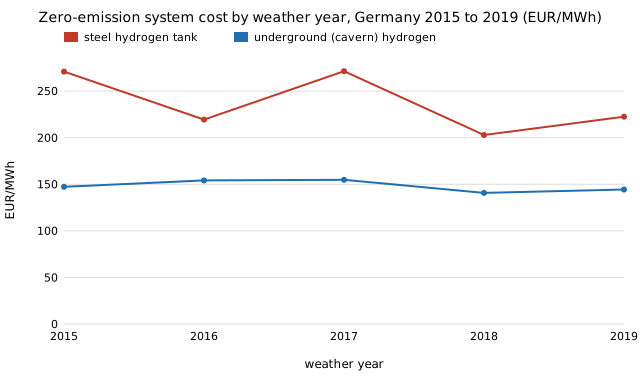
Which weather year sets the hydrogen store of a zero-emission German power system? The same sourced-cost PyPSA model on 2015 to 2019: EUR 203 to 271/MWh with a steel tank, EUR 141 to 155 with caverns, and a cavern store of 24 to 36 TWh depending on the year.
What it found
Re-solves energy-mix-sourced (one-node PyPSA model, solar, onshore wind, gas, Li-ion and hydrogen storage, PyPSA technology-data 2030 costs in 2025 euros) on five weather and demand years of Open Power System Data / ENTSO-E (2015 to 2019) instead of only 2019; 20 deterministic LPs. At zero emissions the cost ranges EUR 203 to 271/MWh with a steel hydrogen tank (2018 cheapest, 2017 and 2015 dearest) and EUR 141 to 155 with caverns, so the tank case moves by about EUR 68 between years and the cavern case by about EUR 14. The hydrogen store is set by the year: 1.1 to 5.6 TWh with a tank (2015 largest) and 23.7 to 35.9 TWh with caverns (2016 largest), against 24.9 TWh in 2019 alone; the tank case needs 1.0 to 1.7 TWh of batteries. At a 95% cut the tank case buys no hydrogen in any year and costs EUR 118 to 133. The 2019 results reproduce the sibling project (EUR 222 and 144). Limitations: five years, each solved separately with perfect foresight (a store sized for all five years together was not solved), one node, no imports or offshore wind, capacity factors from actual generation so they include curtailment, caverns not sited or limited, and the 7% discount rate is not from a source.
A figure from its own output
Paper, code and results
More in Energy supply and dense energy storage
- Does residual load explain German day-ahead electricity prices on a year the model never saw, and how wrong was the flat merit-order price?Does residual load explain German day-ahead prices on a year the model never saw? Yes: correlation 0.87 and RMSE 9.6 EUR/MWh on 2019 against 23.0 for the flat merit-order price; the cheap-quarter mean is within EUR 4–9/MWh; the rest is the fuel-price level.
- Does a weather-dependent heat-pump COP change the sand-store versus heat-pump verdict?Does a weather-dependent heat-pump COP change the sand-store verdict? The table's 3.6 equals a 35 C floor-heating sink; at 45 to 55 C the store's weekly flip multiplier rises 8 to 46%, and 2018 still favours the pump.
- How far must capital costs move to flip the sand-store versus heat-pump verdict, and is that more than the price year moves it?How far must capex move to flip the sand-store vs heat-pump verdict? Weekly cycling flips on a 2 to 40% store-capex change (the cost table's own vintage step is 26%); daily cycling holds to 2 to 3.5 times.
- How much can the sand store's heat exchanger cost before a heat pump wins again?How much can the sand store's heat exchanger cost? Weekly cycling survives about 120 to 270 EUR per kW in four of five price years; daily cycling survives 460 to 900; 2018 never wins.
- Does the sand-store versus heat-pump verdict survive a modelled electricity price instead of the real one?Does the sand-store vs heat-pump verdict survive a modelled price? Mostly: 32 of 40 cells agree with real prices (21 for the flat merit-order price), but weekly cycling, whose margin is under EUR 0.011/kWh, is wrong in sign in 5 of 5 years; as a charge scheduler the model costs under EUR 0.0011/kWh.
- How much cheaper must a store's electricity be than a heat pump's for a sand heat store to deliver heat for less?How much cheaper must electricity be for a sand heat store to beat a heat pump? Sourced costs (PyPSA technology-data) on the
energy-thermalmodel: a daily-cycled store needs the pump's electricity about 2 times dearer, weekly 5, monthly 16, seasonal 120 (house); the heat lost in standby, not the sand, rules out seasonal storage.
All 39 Energy supply and dense energy storage projects →
Other research topics
Proper scoring & elicitation28Effort & peer prediction9Verification games & slashing19Detection & tolerances14Markets as routers13Prediction-market design9Paying contributors8Decentralised training systems23Digital twins & sim-to-real164LLM chip design loops40Robot manufacturing loops53Ambient AI assistant46Self-replicating manufacturing34Simulation-first design64Engineered clothing45Task-specific AI accelerators40Algorithmic chip-design loops42Open-source purpose-built robots44The software-engineering loop43Adversarial human imitation41Open-source residential construction41Autonomous multi-angle capture34Sensing, imaging and 3D31Energy supply and dense energy storage39Robot societies among people31Agentic co-design of low-cost robots27Laundry-hanging robots25Machine learning on qualitative data23Robots on the building site27Civilizations & group psychology1History & human sciences1
Produced with AI assistance (Claude). Results are from the code in this repository and are simulated or stylised unless the abstract says otherwise; nothing here implies affiliation with or endorsement by any lab, researcher or company cited. MIT licensed.