How much of the cost of a zero-emission German power system is the storage assumption, once costs are sourced?
research/energy-mix-sourced
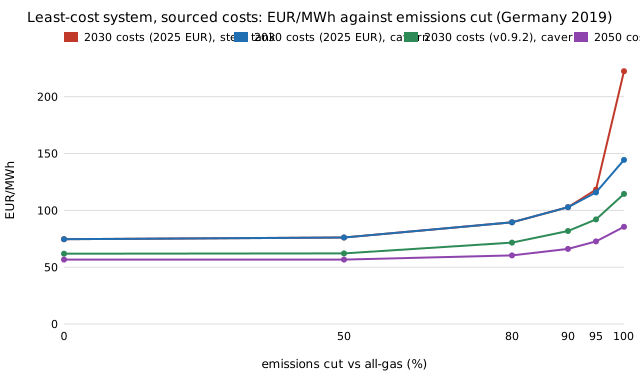
What does a zero-emission German power system cost once energy-mix's assumed costs are replaced by sourced ones? PyPSA on 2019 hourly demand with PyPSA technology-data costs (Danish Energy Agency et al.): EUR 222/MWh with a steel hydrogen tank, EUR 144 with caverns, EUR 75 unconstrained; the storage type moves the answer more than the cost year.
What it found
Re-runs energy-mix (one-node PyPSA model of Germany's 2019 hourly load with solar, onshore wind, gas, Li-ion and hydrogen storage under an emissions cap) with every cost, lifetime, O&M, efficiency, fuel price and CO2 intensity read from PyPSA technology-data at pinned revisions (Danish Energy Agency and other primary sources named per row). On 2030 costs in 2025 euros the unconstrained optimum costs EUR 75/MWh and zero emissions EUR 222/MWh with a steel hydrogen tank (1.3 TWh of hydrogen, 1.4 TWh of batteries) or EUR 144/MWh with underground storage (24.9 TWh); the last 5% of emissions costs about EUR 6,100/t with the tank and EUR 1,700/t with caverns. With caverns, technology-data's older 2030 and 2050 sets give EUR 114.5 and 85.5/MWh. Without batteries zero emissions costs EUR 254 (tank) or 162 (cavern); a discount rate of 3% or 10% gives EUR 152 or 282 (tank). Not from a source: the 7% discount rate (swept). Limitations: cavern storage is a geological resource that the model does not site or limit, one weather year, one node, no imports, central cost values only, and no check against a published whole-system figure.
A figure from its own output
Paper, code and results
More in Energy supply and dense energy storage
- Which weather year sets the hydrogen store of a zero-emission German power system, and how much does the cost depend on it?Which weather year sets the hydrogen store of a zero-emission German power system? The same sourced-cost PyPSA model on 2015 to 2019: EUR 203 to 271/MWh with a steel tank, EUR 141 to 155 with caverns, and a cavern store of 24 to 36 TWh depending on the year.
- Does residual load explain German day-ahead electricity prices on a year the model never saw, and how wrong was the flat merit-order price?Does residual load explain German day-ahead prices on a year the model never saw? Yes: correlation 0.87 and RMSE 9.6 EUR/MWh on 2019 against 23.0 for the flat merit-order price; the cheap-quarter mean is within EUR 4–9/MWh; the rest is the fuel-price level.
- Does a weather-dependent heat-pump COP change the sand-store versus heat-pump verdict?Does a weather-dependent heat-pump COP change the sand-store verdict? The table's 3.6 equals a 35 C floor-heating sink; at 45 to 55 C the store's weekly flip multiplier rises 8 to 46%, and 2018 still favours the pump.
- How far must capital costs move to flip the sand-store versus heat-pump verdict, and is that more than the price year moves it?How far must capex move to flip the sand-store vs heat-pump verdict? Weekly cycling flips on a 2 to 40% store-capex change (the cost table's own vintage step is 26%); daily cycling holds to 2 to 3.5 times.
- How much can the sand store's heat exchanger cost before a heat pump wins again?How much can the sand store's heat exchanger cost? Weekly cycling survives about 120 to 270 EUR per kW in four of five price years; daily cycling survives 460 to 900; 2018 never wins.
- Does the sand-store versus heat-pump verdict survive a modelled electricity price instead of the real one?Does the sand-store vs heat-pump verdict survive a modelled price? Mostly: 32 of 40 cells agree with real prices (21 for the flat merit-order price), but weekly cycling, whose margin is under EUR 0.011/kWh, is wrong in sign in 5 of 5 years; as a charge scheduler the model costs under EUR 0.0011/kWh.
All 39 Energy supply and dense energy storage projects →
Other research topics
Proper scoring & elicitation28Effort & peer prediction9Verification games & slashing19Detection & tolerances14Markets as routers13Prediction-market design9Paying contributors8Decentralised training systems23Digital twins & sim-to-real164LLM chip design loops40Robot manufacturing loops53Ambient AI assistant46Self-replicating manufacturing34Simulation-first design64Engineered clothing45Task-specific AI accelerators40Algorithmic chip-design loops42Open-source purpose-built robots44The software-engineering loop43Adversarial human imitation41Open-source residential construction41Autonomous multi-angle capture34Sensing, imaging and 3D31Energy supply and dense energy storage39Robot societies among people31Agentic co-design of low-cost robots27Laundry-hanging robots25Machine learning on qualitative data23Robots on the building site27Civilizations & group psychology1History & human sciences1
Produced with AI assistance (Claude). Results are from the code in this repository and are simulated or stylised unless the abstract says otherwise; nothing here implies affiliation with or endorsement by any lab, researcher or company cited. MIT licensed.