How should a scarce audit budget be spread?
research/audit-allocation
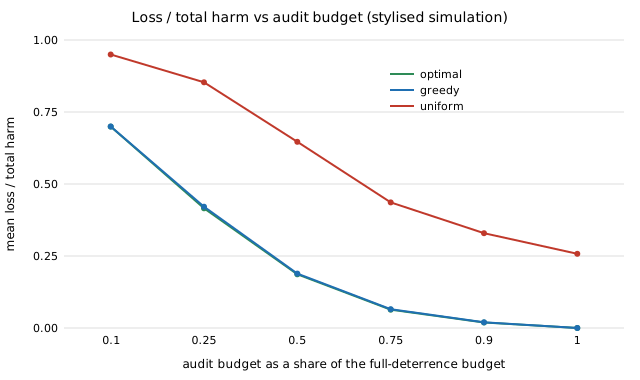
Scarce audit budget across heterogeneous jobs: deterrence threshold g/(g+S) makes it a knapsack, greedy with a 1/3 guarantee (within 1% on 91% of instances), uniform audits need up to 1.9× the budget, heterogeneity lowers deterrence cost (Jensen), stake substitutes for audits.
What it found
Refereed verification with jobs of different gain and harm: a best-responding cheater is deterred iff the audit probability reaches g/(g+S), so allocation is a knapsack (deter a set exactly, spend the rest on one job). Density greedy with a partial-only candidate has a proved 1/3 guarantee and is within 1% of optimal on 91% of random instances; uniform auditing needs up to 1.9× the budget to deter everything and still leaves 26% of harm at that budget; gain heterogeneity lowers deterrence cost (Jensen); stake substitutes for audits via Σ g/(g+S) = B. Stylised.
A figure from its own output
Paper, code and results
More in Verification games & slashing
- How many verifiers does deterrence-by-audit need?Staffing the audit pool that stake-based deterrence needs: exact Erlang-C waiting (matches simulation), square-root staffing
R+1.06√R(spare capacity 60% at R=5, 1.1% at 10⁴), stake–headcount optimumG+S=√(wsG/(rd₀))(cost 24 vs 77 at too little stake), and bursty audit demand delays 1.8× what Allen–Cunneen predicts. - Escalating bonds: cheap challenges, fixed deterrence, a γ-fold capital asymmetryEscalating-bond dispute games: exact deterrence opening bond
εV/((1−ε)C−εD)shrinks geometrically in rounds while the attacker's total outlay barely moves, and a sharp capital race where the defender needsγ·max{C(r) ≤ B_C}≤γ·B_C. - How wide should a dispute bisect?K-ary bisection dispute games: optimal arity solves
k ln k − k + 1 = a/b(binary only ifa/b ≤ 0.386), 1.9–6× cheaper than binary at T=10⁶, adaptive schedules gain ≤1%, leaf-size trade-off, latency as extra round cost. - Can stake shorten a challenge window when proposers can be bribed?Optimistic-verification challenge windows with bribable proposers: exact gamble-then-bribe attacker recursion, closed-form window, stake cannot shorten it under an exogenous bribe price (63 blocks for S=10…1600), bounty-funded priority fees give
S·w ≈ G/((1−ρ)θ). - How much does an appeal ladder of juries buy, and what must appeals cost?Escalating jury appeal ladders with fee-priced appeals: an exact fee window makes error
∏(1−M_k), 11 jurors is the smallest deterring panel at prize 100, 3→11→27 errs 2.4e-4 at 5.8 expected seats vs 12.6% for one 7-seat panel, shared jury bias sets a floorρ(1−a). - Do free retries break hash-derived spot checks?Hash-derived audit challenges under free retries: cheat profit exactly
G − c/p, deterrence needsln(G/c)·T/kopened steps vsln2·T/kfor a beacon (10×–60×), stake is irrelevant, and the proof-of-work optimum isx* = v/λ_p − c0.
All 19 Verification games & slashing projects →
Other research topics
Proper scoring & elicitation28Effort & peer prediction9Verification games & slashing19Detection & tolerances14Markets as routers13Prediction-market design9Paying contributors8Decentralised training systems23Digital twins & sim-to-real164LLM chip design loops40Robot manufacturing loops53Ambient AI assistant46Self-replicating manufacturing34Simulation-first design64Engineered clothing45Task-specific AI accelerators40Algorithmic chip-design loops42Open-source purpose-built robots44The software-engineering loop43Adversarial human imitation41Open-source residential construction41Autonomous multi-angle capture34Sensing, imaging and 3D31Energy supply and dense energy storage39Robot societies among people31Agentic co-design of low-cost robots27Laundry-hanging robots25Machine learning on qualitative data23Robots on the building site27Civilizations & group psychology1History & human sciences1
Produced with AI assistance (Claude). Results are from the code in this repository and are simulated or stylised unless the abstract says otherwise; nothing here implies affiliation with or endorsement by any lab, researcher or company cited. MIT licensed.