Can stake shorten a challenge window when proposers can be bribed?
research/challenge-window
Optimistic-verification challenge windows with bribable proposers: exact gamble-then-bribe attacker recursion, closed-form window, stake cannot shorten it under an exogenous bribe price (63 blocks for S=10…1600), bounty-funded priority fees give S·w ≈ G/((1−ρ)θ).
What it found
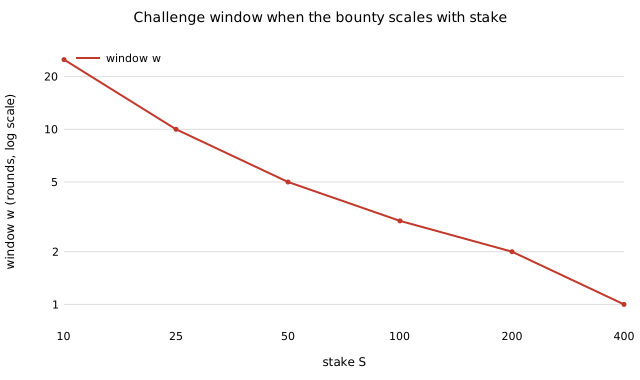
In optimistic verification a fraud pays G unless a challenge is included within w blocks; the attacker controls each proposer w.p. ρ and otherwise pays b to censor. The exact attacker recursion V(n) = ρV(n−1) + (1−ρ)max(−S, V(n−1)−b) gives a closed-form deterrence window (0 mismatches in 5000 instances; Monte Carlo agrees) with a gamble-first, bribe-last optimal attack. A luck-only analysis underestimates the window 100–170×; with an exogenous bribe price the window is 63 blocks for every stake from 10 to 1600; if the bounty is paid as a priority fee the price becomes θS and S·w ≈ G/((1−ρ)θ). Stylised.
A figure from its own output
Paper, code and results
More in Verification games & slashing
- How much does an appeal ladder of juries buy, and what must appeals cost?Escalating jury appeal ladders with fee-priced appeals: an exact fee window makes error
∏(1−M_k), 11 jurors is the smallest deterring panel at prize 100, 3→11→27 errs 2.4e-4 at 5.8 expected seats vs 12.6% for one 7-seat panel, shared jury bias sets a floorρ(1−a). - Do free retries break hash-derived spot checks?Hash-derived audit challenges under free retries: cheat profit exactly
G − c/p, deterrence needsln(G/c)·T/kopened steps vsln2·T/kfor a beacon (10×–60×), stake is irrelevant, and the proof-of-work optimum isx* = v/λ_p − c0. - When do verifiers complement rather than substitute?Verifiers as informational complements: decision value is zero below a closed-form committee size while mutual information is submodular; myopic hiring buys nothing and leave-one-out pay is a sawtooth that vanishes.
- How big should a random verifier committee be?Verifier committees from a finite pool: exact hypergeometric capture (zero once
m ≥ 2B+1, up to 26× below binomial), exact size ≈0.90 ofln(1/ε)/KL(½‖β)vs Hoeffding up to 2.2× too large, stake-weighted draws depend only on Byzantine stake share (20 of 100 nodes at 4× stake capture a 41-committee w.p. ½), and the threshold safety/liveness trade-off. - Are reward pools identity-proof?Identity splitting vs merging under stake-weighted pools: split-invariant iff the weight is linear in stake, per-head optimum
√(Rn/c)−n, sharp deterrence feeRn/((n+1)(n+2)), wagering split-neutral. - Can a bond tell reliable hardware from unreliable?Can a bond tell reliable hardware from unreliable? Single crossing runs the wrong way: reliable rent
(θ_H−θ_L)(c+(1+ρ)s_H)/(1−θ_H)is minimised at zero stake, a flat wage is optimal, and a deterrence stake scales rent by(c+(1+ρ)s)/c.
All 19 Verification games & slashing projects →
Other research topics
Proper scoring & elicitation28Effort & peer prediction9Verification games & slashing19Detection & tolerances14Markets as routers13Prediction-market design9Paying contributors8Decentralised training systems23Digital twins & sim-to-real164LLM chip design loops40Robot manufacturing loops53Ambient AI assistant46Self-replicating manufacturing34Simulation-first design64Engineered clothing45Task-specific AI accelerators40Algorithmic chip-design loops42Open-source purpose-built robots44The software-engineering loop43Adversarial human imitation41Open-source residential construction41Autonomous multi-angle capture34Sensing, imaging and 3D31Energy supply and dense energy storage39Robot societies among people31Agentic co-design of low-cost robots27Laundry-hanging robots25Machine learning on qualitative data23Robots on the building site27Civilizations & group psychology1History & human sciences1
Produced with AI assistance (Claude). Results are from the code in this repository and are simulated or stylised unless the abstract says otherwise; nothing here implies affiliation with or endorsement by any lab, researcher or company cited. MIT licensed.