How much pre-roll buffer does an energy-gated audio pendant need to stop clipping the first word, and what does it cost in RAM and battery?
research/ambient-preroll
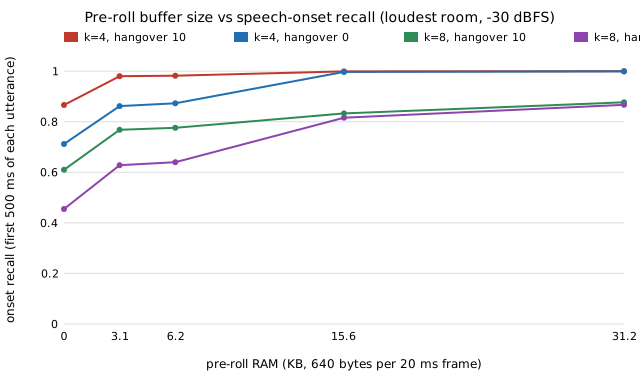
How much pre-roll buffer does an energy-gated audio pendant need to stop clipping the first word? Synthetic audio: no gain in quiet rooms, in the loudest room onset recall 0.866 → 0.980 → 0.999 at 0, 5 and 25 buffered frames (0, 3.1, 15.6 KB) for 90 → 81 → 70 modelled hours; a too-deaf gate is not rescued (stylised)
What it found
A stylised follow-up to ambient-gateroc, which did not measure onset clipping. On synthetic speech over background noise at −60 to −30 dBFS (20 seeds × 120 s per room), a noise-adaptive gate opens on the first frame in quiet rooms, so a pre-roll ring buffer buys nothing and costs battery (82.4 h to 76.9 h at 5 frames). In the loudest room it opens 2.3 frames late on average, and onset recall (first 500 ms of each utterance) goes 0.866, 0.980, 0.999 for 0, 5 and 25 buffered 20 ms frames (0, 3.1, 15.6 KB), at 90.0, 81.1 and 69.7 modelled hours. A gate set too deaf (k = 8) is not rescued: 50 frames lift onset recall only from 0.610 to 0.877. Pre-roll and hangover cost the same per frame and protect different ends of an utterance. Synthetic audio, a stylised power model, no hardware.
A figure from its own output
Paper, code and results
More in Ambient AI assistant
- Does a fixed energy-gate threshold survive different rooms on an always-on audio pendant, and what does an adaptive one buy in battery life?Does a fixed energy-gate threshold survive different rooms on an always-on audio pendant? Synthetic audio, 20 seeds x 4 background levels: any fixed threshold that keeps speech recall >= 0.9 leaves the gate open all the time in the loudest room (57.6 h, no gating gain), while one adaptive threshold (4x a 5 s running-minimum floor) gives 82-90 h at recall 0.89-1.00 in all four; stylised, nothing measured on hardware
- What limits the battery life of a pendant-style always-on audio wearable?What limits battery life in a pendant-style always-on audio wearable: stylised nRF52840-class power model (mic floor ~170 h; speech-gated ~105 h vs 59 h always streaming) plus a 74-byte VAD gate that compiles for Cortex-M4; no hardware measured
- How much latency and memory does an open-model voice pipeline cost on a CPU, and what reply time does it leave?CPU voice pipeline (Silero VAD, Whisper tiny.en, Qwen2.5-0.5B, Piper) on synthetic speech: per-stage latency/RTF/memory and a reply-latency budget of 0.9–1.5 s at 200–800 ms endpoint hangover, ~0.7 s of it compute. Server CPU, not a phone.
- When should an always-on assistant speak, and does a policy tuned in a simulator keep its annoyance budget in a real room?When an always-on assistant should speak: wake, keyword, threshold and learned policies at equal annoyance, and what breaks when the simulator's room differs from the real one
- How much does speech-recognition error hurt an always-on assistant's trigger policies at equal annoyance?How much speech-recognition error hurts an always-on assistant's trigger policies at equal annoyance: from word error rate 0 to 0.5 a two-word wake phrase loses 74% of its recall and a transcript-reading threshold 76%, an acoustic-only score about 54%, and the transcript policy falls behind the acoustic one at WER 0.3 to 0.4 if its separation shrinks as (1-WER)^2 (stylised).
- When moments of need cluster in time, does a cooldown, a boost or a back-off help an always-on assistant at equal annoyance?When moments of need cluster in time, does a cooldown, boost or back-off help an always-on assistant at equal annoyance: an episode-aware boost gains up to 0.05 recall under strong clustering, a cooldown always loses recall, back-off is a wash; stylised simulation.
All 46 Ambient AI assistant projects →
Other research topics
Proper scoring & elicitation28Effort & peer prediction9Verification games & slashing19Detection & tolerances14Markets as routers13Prediction-market design9Paying contributors8Decentralised training systems23Digital twins & sim-to-real164LLM chip design loops40Robot manufacturing loops53Ambient AI assistant46Self-replicating manufacturing34Simulation-first design64Engineered clothing45Task-specific AI accelerators40Algorithmic chip-design loops42Open-source purpose-built robots44The software-engineering loop43Adversarial human imitation41Open-source residential construction41Autonomous multi-angle capture34Sensing, imaging and 3D31Energy supply and dense energy storage39Robot societies among people31Agentic co-design of low-cost robots27Laundry-hanging robots25Machine learning on qualitative data23Robots on the building site27Civilizations & group psychology1History & human sciences1
Produced with AI assistance (Claude). Results are from the code in this repository and are simulated or stylised unless the abstract says otherwise; nothing here implies affiliation with or endorsement by any lab, researcher or company cited. MIT licensed.