What does it cost to skip the slowest workers?
research/straggler-backup
Waiting for the fastest k of n workers: exact order-statistic round times (Pareto mean finite iff n−k+1 > 1/α), exact SGD time-to-accuracy with a minimum k and an interior optimum (34× over wait-for-all at s=0, 1.12× at s=32), joint step tuning, and the exact selection bias of the speed filter with Horvitz–Thompson correction.
What it found
Waiting for the fastest k of n workers has exact round time s + (Hn−Hn−k)/μ for exponential tails, and for Pareto tails the mean is finite iff n−k+1 > 1/α, so with α ≤ 1 waiting for everyone has infinite expected round time. For SGD on a quadratic the time to accuracy has a minimum k and an interior optimum (34× faster than waiting for all at zero fixed cost, 1.12× at large fixed cost). If speed correlates with data, the fastest-k average is biased by Σ(πi/k−1/n)θi; Horvitz–Thompson reweighting removes it but only pays when the bias is large.
A figure from its own output
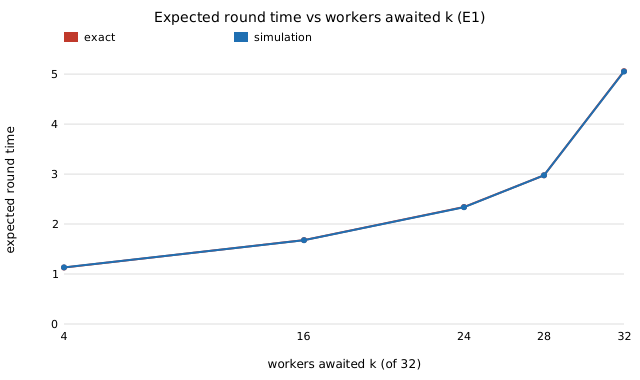
Paper, code and results
More in Decentralised training systems
- Does a bigger swarm learn more from shared rollouts?Rollout sharing in swarm RL as a public-goods game: Nash gives every agent a lone agent's learning level whatever N (total effort caps at
(a/c−1)/θ) while efficient welfare is 4.5× at N=256; at θ=1 one agent generates; a Pigouvian matching subsidy (fractionθ(N−1)/(1+θ(N−1))of cost) implements the optimum; junk beats honesty iffc−ε > p(τ+F). - How stale can a shared rollout be before it is worthless?Stale off-policy rollouts in swarm RL: exact importance-weight moments (
E w²=e^{δ²}, ESS fractione^{−δ²}), closed-form truncation bias/variance verified by simulation, best cap cuts shift-estimation MSE 1.9× atδ=1and ~750× atδ=3, and the staleness window√ln(1/ρ)/drift. - How fast does a shared model forget a task, and does splitting it into modules help?Exact catastrophic-forgetting law for sequential training on random low-rank tasks:
(r/d)(1−r/d)(ρᵏ−λᵏ)rises then vanishes, uniform module routing dilutes it but sharing wins on seen-plus-fresh loss, conflicting tasks leave a floor2rτ²/d. - How should independently trained modules be merged, and how much does parallel training buy?Merging independently trained modules on random low-rank tasks: exact residual
1−2amp+a²(mp+m(m−1)p²), optimal scale1/(1+(m−1)p)(averaging stalls at(1−p)², unscaled sum diverges), harmonic1/mdecay, parallel speedup only logarithmic (8.9× at m=16, d/r=8). - When should a continual learner replay an old task, and does a fixed schedule beat random replay?Exact expected forgetting under replay schedules in sequential training on random low-rank tasks: 2×2 matrix recursion matches simulation, one replay is best at the forgetting-peak lag yet removes only 25–42%, a fixed period beats random replay only below ~1.2–3 peak lags, halving forgetting needs rate 0.25 (
d=12, r=3) to 0.015 (d=128, r=1). - How much of an old task must a continual learner store, and is it better to replay a little often or a lot rarely?Partial replay when only
mof an old task'srexamples are stored: exact 2×2 law interpolating no replay and full replay, best-step saving nearly linear inm/r, and at a fixed example budget a few large replays beat many small ones by only 0.1–6 points.
All 23 Decentralised training systems projects →
Other research topics
Proper scoring & elicitation28Effort & peer prediction9Verification games & slashing19Detection & tolerances14Markets as routers13Prediction-market design9Paying contributors8Decentralised training systems23Digital twins & sim-to-real164LLM chip design loops40Robot manufacturing loops53Ambient AI assistant46Self-replicating manufacturing34Simulation-first design64Engineered clothing45Task-specific AI accelerators40Algorithmic chip-design loops42Open-source purpose-built robots44The software-engineering loop43Adversarial human imitation41Open-source residential construction41Autonomous multi-angle capture34Sensing, imaging and 3D31Energy supply and dense energy storage39Robot societies among people31Agentic co-design of low-cost robots27Laundry-hanging robots25Machine learning on qualitative data23Robots on the building site27Civilizations & group psychology1History & human sciences1
Produced with AI assistance (Claude). Results are from the code in this repository and are simulated or stylised unless the abstract says otherwise; nothing here implies affiliation with or endorsement by any lab, researcher or company cited. MIT licensed.