When should a continual learner replay an old task, and does a fixed schedule beat random replay?
research/replay-law
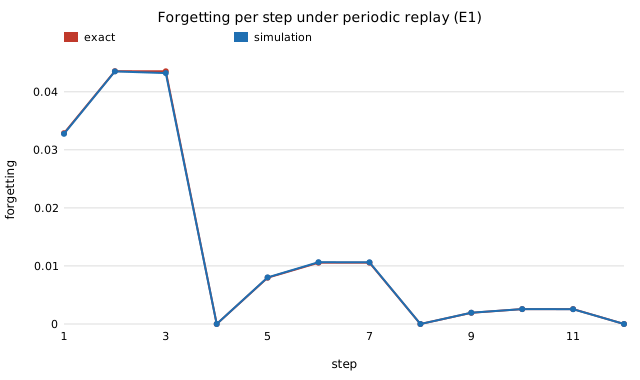
Exact expected forgetting under replay schedules in sequential training on random low-rank tasks: 2×2 matrix recursion matches simulation, one replay is best at the forgetting-peak lag yet removes only 25–42%, a fixed period beats random replay only below ~1.2–3 peak lags, halving forgetting needs rate 0.25 (d=12, r=3) to 0.015 (d=128, r=1).
What it found
Replaying a task alongside each fresh one is a joint projection, so the expected loss on a tracked task is an exact product of 2×2 matrices for any schedule (matched to simulation at every step; recovers the no-replay law). One replay is best at the forgetting-peak lag — 5 at d=32, r=4; 89 at d=128, r=1 — yet removes only 25–42% of total forgetting (replaying at step 1 barely helps at small r/d). A period longer than the peak lag never touches the peak, and a fixed period beats random replay at the same rate only below roughly 1.2–3 peak lags (e.g. 1/8 at d=32, r=4, but random wins at 1/12). Halving forgetting needs a rate 0.25 at d=12, r=3 and 0.015 at d=128, r=1; tasks with 2r≥d are fully recovered by one replay. Stylised: realizable linear regression, exact convergence, one tracked task.
A figure from its own output
Paper, code and results
More in Decentralised training systems
- How much of an old task must a continual learner store, and is it better to replay a little often or a lot rarely?Partial replay when only
mof an old task'srexamples are stored: exact 2×2 law interpolating no replay and full replay, best-step saving nearly linear inm/r, and at a fixed example budget a few large replays beat many small ones by only 0.1–6 points. - When continual-learning tasks conflict, how much does a task-aware router of modules actually buy?Task-aware routing when continual-learning tasks conflict: the long-run floor is
(2r/d)[τ_w²+τ_b²(1−Purity)]with purity = 1 − the router's Gini impurity, random modules buy nothing, a perfect router removes(m−1)/(K−1)of the between-cluster floor, and a 10% routing error gives back 36%. - How should the outer optimiser and sync interval be set when workers run H local steps per round?DiLoCo-style outer momentum:
Hinner steps precondition the outer quadratic (κ_H ≈ κ/H), exact per-mode rates, optimal momentum falls 0.88 → 0.01 withH(fixed 0.7/0.9 Nesterov needs 4–8× more rounds), and the wallclock-optimal sync interval isH* ≈ C(sync cost in inner steps), worth ≈√C/2. - How much gradient noise survives in DiLoCo-style local SGD, and how should the outer step, momentum, worker count and sync interval be set against it?Noise floor of DiLoCo-style local SGD: exact stationary loss
αV(1+β)/((1−β)s(2(1+β)−αs)), independent ofHatα=1, momentum free at equal effective step, near-linear speedup inM, and a noise-limited sync interval that grows as the floor target falls. - What happens to local SGD when workers drop in and out?Local SGD when workers drop in and out: exact floors for participant averaging (
E[1/K|K≥1]) and expected-count normalisation (stable iffαsc<2), at matched speed the fixed normaliser is quieter byE[K]E[1/K]at small steps, and reliable workers bias the fixed point unless inverse-propensity weighted. - What does compressing the pseudo-gradient cost local SGD, and is it better than syncing less often?Local SGD with compressed displacements: exact floor
(1+ω)and stability limitαs(1+ω/N)<2for rand-k (more workers restore the step, not the floor), closed form for norm-scaled quantisation, and at equal bytes syncing less often beats compressing.
All 23 Decentralised training systems projects →
Other research topics
Proper scoring & elicitation28Effort & peer prediction9Verification games & slashing19Detection & tolerances14Markets as routers13Prediction-market design9Paying contributors8Decentralised training systems23Digital twins & sim-to-real164LLM chip design loops40Robot manufacturing loops53Ambient AI assistant46Self-replicating manufacturing34Simulation-first design64Engineered clothing45Task-specific AI accelerators40Algorithmic chip-design loops42Open-source purpose-built robots44The software-engineering loop43Adversarial human imitation41Open-source residential construction41Autonomous multi-angle capture34Sensing, imaging and 3D31Energy supply and dense energy storage39Robot societies among people31Agentic co-design of low-cost robots27Laundry-hanging robots25Machine learning on qualitative data23Robots on the building site27Civilizations & group psychology1History & human sciences1
Produced with AI assistance (Claude). Results are from the code in this repository and are simulated or stylised unless the abstract says otherwise; nothing here implies affiliation with or endorsement by any lab, researcher or company cited. MIT licensed.