In what order should a printer-replicating shop learn its process capabilities?
research/selfrep-capsequence
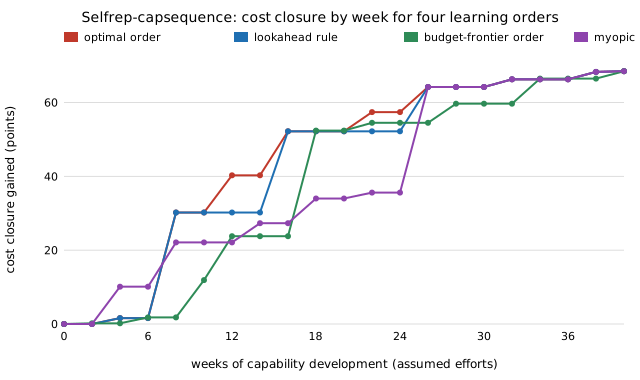
In what order a printer-replicating shop should learn its process capabilities (stylised, assumed efforts): the exact best order over all 362,880 beats walking the budget frontier (54 to 73% of the optimum over 24 weeks); a gain-per-week bundle rule comes within 0 to 6%.
What it found
A stylised, preliminary follow-up to selfrep-capability: a shop learns capabilities one at a time, so the choice is an order, scored by closure-weeks (closure held while still learning). With the assumed efforts, all 9! orders are covered exactly. The best order differs from walking the budget frontier, which scores only 54–73% of the optimum over 24 weeks; a gain-per-week bundle rule is within 0–6%, a one-capability-at-a-time rule 69–80%. The optimal order is moderately fragile to the efforts (within 1% of the optimum in 39–88% of draws scaled 0.5×–2×). Efforts and the capability map are assumptions; nothing was built.
A figure from its own output
Paper, code and results
More in Simulation-first design
- Can Sigmund's 99-line topology optimisation be reproduced in Python and carried through to a printable part?Python reproduction of Sigmund's 99-line SIMP topology optimisation (cantilever, half-MBB; filter removes 11.5% checkerboards) with the density field exported as a mirrored, extruded STL; stylised 2D compliance only.
- How much stiffness does a topology-optimised cantilever lose when the real load points a different way than the model assumed?How much stiffness a topology-optimised cantilever loses when the real load direction differs from the modelled one: 1.57× at 60° and 2.58× at horizontal for the nominal design; a multi-load design at 0, ±60° cuts the worst case to 2.00× for 0.6% nominal cost; stylised 2D, preliminary.
- Does a density filter with Heaviside projection close the gap between a topology-optimised density field and the black-and-white part?Density filter and Heaviside projection added to the SIMP code: the optimiser's compliance matches the thresholded part's to 0.1% (sensitivity filter: 10% off) but the parts are equally stiff within 0.9%; β continuation needed (β=64 from the start: 344.8 vs 192.1); a minimum-length-scale check found no advantage (negative); stylised 2D.
- Does a topology-optimised beam survive a 0.2 threshold error, and what does the robust formulation cost?Does a topology-optimised beam survive a 0.2 threshold error? The plain Heaviside design disconnects when eroded on all three meshes; the robust eroded/blueprint/dilated design stays at 224–226 (14–16% above nominal) for 0.8–3.4% more nominal compliance, but shows no minimum-length-scale gain (negative; stylised).
- Does the filter radius or the threshold gap set the minimum feature size of a robust topology-optimised beam?Does the filter radius or the threshold gap set a robust beam's minimum feature size? A gap of 0.1 already stops the erosion failure (eroded compliance 255–276 against 187–200 nominal; plain design disconnects), but solid feature size is 3 px at both radius 4 and 6 (negative; stylised, one mesh).
- Does the minimum feature of a robust topology-optimised beam follow the filter radius when the mesh is refined?Does the minimum feature follow the filter radius once the mesh is refined? No: at 180×60 it is 5 px at radii of 6, 9 and 12 px; across meshes it grows with the grid (1, 3, 5 px), not the radius (negative; two poor 60×20 robust runs reported; stylised).
All 64 Simulation-first design projects →
Other research topics
Proper scoring & elicitation28Effort & peer prediction9Verification games & slashing19Detection & tolerances14Markets as routers13Prediction-market design9Paying contributors8Decentralised training systems23Digital twins & sim-to-real164LLM chip design loops40Robot manufacturing loops53Ambient AI assistant46Self-replicating manufacturing34Simulation-first design64Engineered clothing45Task-specific AI accelerators40Algorithmic chip-design loops42Open-source purpose-built robots44The software-engineering loop43Adversarial human imitation41Open-source residential construction41Autonomous multi-angle capture34Sensing, imaging and 3D31Energy supply and dense energy storage39Robot societies among people31Agentic co-design of low-cost robots27Laundry-hanging robots25Machine learning on qualitative data23Robots on the building site27Civilizations & group psychology1History & human sciences1
Produced with AI assistance (Claude). Results are from the code in this repository and are simulated or stylised unless the abstract says otherwise; nothing here implies affiliation with or endorsement by any lab, researcher or company cited. MIT licensed.