How fine must the MuJoCo contact settings be for a moving grasp?
research/robofab-solrefmap
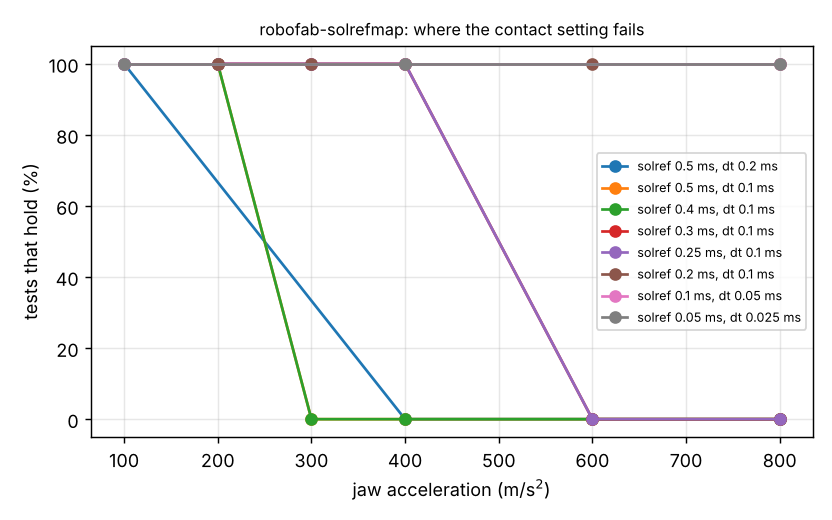
How fine must MuJoCo contact settings be for a moving grasp? On all seven toy-gripper parts, solref 0.2 ms and below reproduce the jaw-force bound (0.98–1.04×) at 100–800 m/s²; 0.5 ms fails at 400 and above, and the adequate value falls with acceleration (stylised, upward load only).
What it found
A follow-up to robofab-graspfast. On all seven printed parts of a toy gripper, a jaw assembly accelerating upward at 100, 400 and 800 m/s2 needs a simulated minimum force of 0.98–1.04 times the bound at contact time constants of 0.2 ms and below (63 cases). At 0.5 ms the bound is matched at 100 m/s2 but no force up to 60 N holds any part at 400 or 800. A scan on one part shows the largest adequate time constant falls with acceleration and is not a single threshold on their product. Stylised: upward load only, rigid box pads, one friction value, no arm.
A figure from its own output
Paper, code and results
More in Robot manufacturing loops
- Is it the contact time constant or the timestep that breaks a moving grasp?Is it
solrefor the timestep that breaks a moving MuJoCo grasp? On a 24-cell grid only 6 cells hold; a coarse step always fails, a finer step does not rescue a marginalsolref, andsolref0.1 ms holds at steps of 0.1 ms and below (stylised). - Is MuJoCo's refsafe clamp what breaks a moving grasp at a coarse timestep?Does MuJoCo's
refsafeclamp break a moving grasp at a coarse timestep? Switching it off changes 7 of 32 grid cells' outcomes (11 hold on, 10 off), 10 runs go unstable, and the non-monotone timestep behaviour survives (stylised). - Does an off-centre centre of mass need a harder grasp?Does an off-centre centre of mass need a harder grasp? Ball-pad elliptic-cone bound matches MuJoCo within 1.1% (5× force at 20 mm offset); flat-pad MuJoCo lies between an equal-split and a best-split corner-contact bound (stylised).
- Does the friction-grasp bound survive lift acceleration and an off-centre centre of mass?Does the friction-grasp bound survive lift acceleration and an off-centre centre of mass? Scaled bound matches MuJoCo within 6% over 66 cases; the torque bracket for an off-centre bar is inconclusive and depends on the rotation tolerance (stylised).
- Is the off-centre bar result in robofab-liftload a grasp effect or solver creep?Is the off-centre bar result in
robofab-liftloada grasp effect or solver creep? The bar creeps at about 3.7 deg/s from 0.3 to 3 N in MuJoCo, with a rate set by contact settings, so the earlier verdict reflects the simulator (stylised). - Does a rate-based "holds" criterion make a MuJoCo grasp verdict independent of solver settings?Does a rate-based "holds" criterion make a MuJoCo grasp verdict independent of solver settings? No: the minimum holding force still varies 33x to 400x or more across contact settings, like a 1 degree tolerance (negative, stylised).
All 53 Robot manufacturing loops projects →
Other research topics
Proper scoring & elicitation28Effort & peer prediction9Verification games & slashing19Detection & tolerances14Markets as routers13Prediction-market design9Paying contributors8Decentralised training systems23Digital twins & sim-to-real164LLM chip design loops40Robot manufacturing loops53Ambient AI assistant46Self-replicating manufacturing34Simulation-first design64Engineered clothing45Task-specific AI accelerators40Algorithmic chip-design loops42Open-source purpose-built robots44The software-engineering loop43Adversarial human imitation41Open-source residential construction41Autonomous multi-angle capture34Sensing, imaging and 3D31Energy supply and dense energy storage39Robot societies among people31Agentic co-design of low-cost robots27Laundry-hanging robots25Machine learning on qualitative data23Robots on the building site27Civilizations & group psychology1History & human sciences1
Produced with AI assistance (Claude). Results are from the code in this repository and are simulated or stylised unless the abstract says otherwise; nothing here implies affiliation with or endorsement by any lab, researcher or company cited. MIT licensed.