Is a clear-air or mean-rain-rate radar twin right when rain comes in cells?
research/rain-twin
Clear-air or mean-rain-rate radar twin vs intermittent storm-cell attenuation: Jensen gap 1.52× in the rain-rate power law, Lambert-W mean-rate range reached by only 39% of real fields, mean-matching barely helps, a rain ensemble scores Brier 0.038 vs 0.101 clear air. Stylised.
What it found
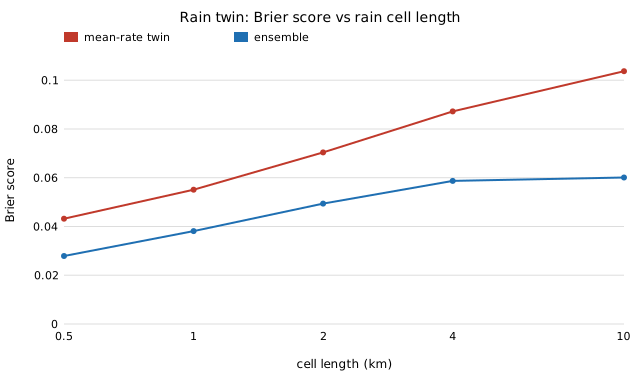
Radar detection range under intermittent rain attenuation. The power law in rain rate has a Jensen gap (1.52× the mean-rate attenuation), so a mean-rate twin (closed-form Lambert W range, 18.84 km) is reached by only 39% of real storm fields; matching the mean attenuation barely helps (Brier 0.054 vs 0.055). A rain ensemble scores 0.038 vs 0.101 for clear air, and long cells flip the mean-rate twin from optimistic to pessimistic. Stylised: simulated rain, illustrative coefficients, no radar data.
A figure from its own output
Paper, code and results
More in Digital twins & sim-to-real
- How long must a real test run be when its length was sized in a twin with the wrong plant pole?Real test-run length sized in a wrong-pole twin: exact autocorrelated-cost variance, 3.8× too short (coverage 0.69 vs 0.95) or 2.1× too long depending on the real closed-loop pole, and a pilot-run repair that under-sizes half the time.
- What does a radar twin with unlimited unambiguous velocity over-certify?What a radar twin with unlimited unambiguous velocity over-certifies: exact wrapped-Gaussian bias (
−Vatμ=V) and MSE with abias²floor so averaging widens the gap (7.9× → 2.1×10³ atμ=0.8V, n=1→10⁴), safe speed≈V+sΦ⁻¹(tol/2V), and prior-unwrapping failure2Φ(−V/√(s²+s_p²))needing prior error ≤ 0.26V. - Which rungs of a ladder of digital twins are worth running?Which rungs of a multi-fidelity twin ladder to run: exact nested-estimator variance, a cheaper rung pays iff
ρ₂/ρ₁ > 2√r/(1+r)(step correlation, 0.943 for halved cost), using all rungs can be worse than none (1.41× real-only at q=0.9) while the best subset gets 0.83, and a timestep-ladder plant shows 0.156 of real-only variance (0.204 single twin) collapsing to the cheapest twin when disturbance replay is only 90%. - A heartbeat twin that drops packets independently: how often does the real bursty link trip a missed-beat watchdog, and what timeout is safe?I.i.d.-loss heartbeat twin vs a bursty Gilbert link: a 5-missed-beat watchdog false-trips every 3.4e6 ticks in the twin but every 235–990 on the real link, worst at burst length ≈ m (mean time to trip ≈ e·m/p), and a 1e6-tick target needs m = 16–154 instead of the twin's 5. Stylised.
- A twin whose sensor never produces outliers: does an innovation gate help or hurt the real estimator, and what does it do after a jump?Gaussian-sensor twin vs a real sensor with outliers under an innovation gate: the twin says the gate costs 8.5% MSE, the real sensor gains 3.0× from it, the worst outlier scale for a gated filter is finite (κ≈4) while ungated error grows as κ², and a gate locks out recovery from a jump for ≈76·D² steps. Stylised.
- A twin without ground effect: where does a landing altitude loop go wrong?Rotorcraft altitude twin without ground effect vs real thrust gain
1/(1−(R/4z)²): hover sits 18 mm high at one rotor radius (twin: 0), and a delayed loop with 28% twin headroom goes unstable at 0.54 rotor radii. Stylised.
All 164 Digital twins & sim-to-real projects →
Other research topics
Proper scoring & elicitation28Effort & peer prediction9Verification games & slashing19Detection & tolerances14Markets as routers13Prediction-market design9Paying contributors8Decentralised training systems23Digital twins & sim-to-real164LLM chip design loops40Robot manufacturing loops53Ambient AI assistant46Self-replicating manufacturing34Simulation-first design64Engineered clothing45Task-specific AI accelerators40Algorithmic chip-design loops42Open-source purpose-built robots44The software-engineering loop43Adversarial human imitation41Open-source residential construction41Autonomous multi-angle capture34Sensing, imaging and 3D31Energy supply and dense energy storage39Robot societies among people31Agentic co-design of low-cost robots27Laundry-hanging robots25Machine learning on qualitative data23Robots on the building site27Civilizations & group psychology1History & human sciences1
Produced with AI assistance (Claude). Results are from the code in this repository and are simulated or stylised unless the abstract says otherwise; nothing here implies affiliation with or endorsement by any lab, researcher or company cited. MIT licensed.