Should the hand-coded audit for a group gap be stratified by group?
research/qual-stratified
Should the hand-coded audit for a group gap be stratified by group? On 3,188 GoEmotions comments, it made no difference for a 36% group and a random audit gave intervals 1.7 times as wide for an 11% group at 100 items. Equal numbers per group matched the optimal split. Not an LLM; one corpus.
What it found
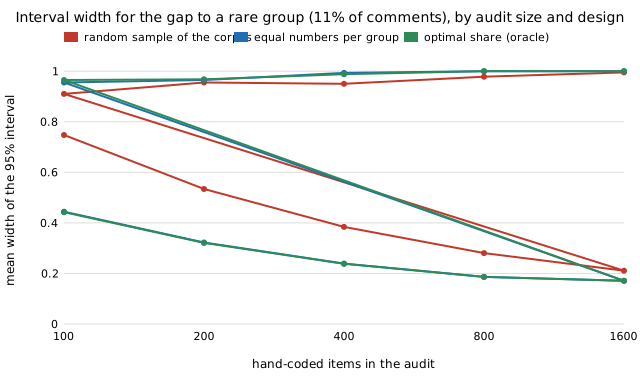
On 3,188 real GoEmotions comments, with the group-wise prediction-powered gap estimator, the design of the hand-coded audit mattered a great deal for a rare group and not at all for a common one. For a short-vs-long split (36% of the corpus in the smaller group) a random audit, equal numbers per group and the variance-minimising split gave interval widths within 1–2% of each other at every size from 100 to 1,600 items. For a rare group (the longest 11% of comments, 352 items) a random audit gave intervals 1.7 times as wide at 100 items (0.75 against 0.44) and 1.2 times at 1,600, left 1–2% of 100-item draws with under 5 audited items in the group, and had worst-case 95% coverage of 0.91 at 100 items against 0.96 for stratified audits. The oracle optimal split (about 55% to the rare group) was indistinguishable from an even split. A z test on the gap bias had less power under random sampling for the rare group (a coder with a gap error was trusted in 25% of draws at 400 items, against 0% stratified). Coders are naive-Bayes classifiers with a moved cut-off and a word list, not LLMs; one corpus, one split, one seed.
A figure from its own output
Paper, code and results
More in Machine learning on qualitative data
- Can you do machine learning on qualitative data with an LLM, and when can you trust the numbers?Can you do machine learning on qualitative data with an LLM, and when can you trust the numbers? Simulated LLM coders with known error: an 89%-accurate coder (κ = 0.72) understates a 30% code at 26% with 0% interval coverage, and when it reads one group's answers less accurately the naive group gap has the wrong sign (+3.6 against −4 points, "significant" 80% of the time). Prediction-powered inference with 200 hand-coded answers per group removes the bias and narrows intervals 23–26% against hand-coding alone, but is wider below ~80% coder accuracy. Stdlib tool (κ, Krippendorff's α, PPI). Simulated, no real model.
- What happens to a regression coefficient when the regressor is an LLM's code?What happens to a regression coefficient when the regressor is an LLM's code? Naive OLS gives 0.74 for a true 1.00 (0% coverage) and biases a perfectly measured covariate when coder error depends on it; DSL with ~210 hand-coded items fixes both (coverage 94–97%) but narrows the coded coefficient's interval only 14%; per-class PPI fixes 3-class shares. Simulated coders.
- Does the prediction-powered correction work on real hand-coded text?Does the prediction-powered correction work on real hand-coded text? On 3,188 GoEmotions comments a naive-Bayes coder (kappa 0.14) is wrong on prevalence (13% against 25%, 0% coverage) and overstates a length gap six-fold; PPI repairs both but is wider than hand-coding alone. Not an LLM (no key).
- How much hand-coding can an LLM coder replace, with a valid interval, when its error differs by group and the category is rare?Research programme: valid inference from LLM-coded qualitative data under group shift and rare categories; on 44,485 real tweets a pooled PPI interval covers as little as 67% when the audit's language mix differs from the corpus, a language-stratified one 94 to 96%
- How well does an LLM-style coder count negative emotion in real comments, and does the correction still pay?How well does an LLM-style coder count negative emotion in real comments? The Claude session agent, coding 300 GoEmotions comments blind, flags 44% as negative against a human 23% (opposite error to the classical stand-ins); accuracy 0.71 matches naive Bayes and trails a word list, and prediction-powered inference stays valid but 29% wider than hand-coding. One reader, not an API model.
- Does an automated coder's error differ across languages, and how much does that move group comparisons?Does an automated coder's error differ across languages? On 44,485 real tweets in Hausa, Igbo, Nigerian Pidgin and Yoruba, an English word-list coder and an English-trained classifier read almost none of the negative sentiment in Hausa, Igbo and Yoruba (sensitivity 0.4–11%), flipping some language gaps' sign (Hausa–Yoruba +10.6 points true, −6.5 reported); PPI keeps coverage at 93–96% but is never narrower than hand-coding. Not an LLM (no key)
All 23 Machine learning on qualitative data projects →
Other research topics
Proper scoring & elicitation28Effort & peer prediction9Verification games & slashing19Detection & tolerances14Markets as routers13Prediction-market design9Paying contributors8Decentralised training systems23Digital twins & sim-to-real164LLM chip design loops40Robot manufacturing loops53Ambient AI assistant46Self-replicating manufacturing34Simulation-first design64Engineered clothing45Task-specific AI accelerators40Algorithmic chip-design loops42Open-source purpose-built robots44The software-engineering loop43Adversarial human imitation41Open-source residential construction41Autonomous multi-angle capture34Sensing, imaging and 3D31Energy supply and dense energy storage39Robot societies among people31Agentic co-design of low-cost robots27Laundry-hanging robots25Machine learning on qualitative data23Robots on the building site27Civilizations & group psychology1History & human sciences1
Produced with AI assistance (Claude). Results are from the code in this repository and are simulated or stylised unless the abstract says otherwise; nothing here implies affiliation with or endorsement by any lab, researcher or company cited. MIT licensed.