What does a 2-joint feeding arm cost against a 6-joint one once the whole bill of materials is priced?
research/osrobot-dofbom
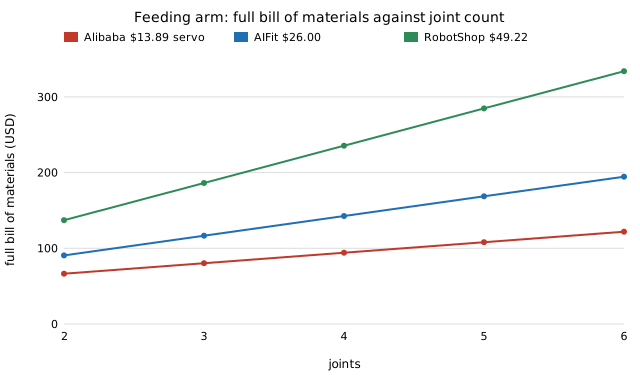
What does a 2-joint feeding arm cost against a 6-joint one once the whole bill of materials is priced? About 1.8 times, not 3: $66 against $122 at the SO-ARM101 table's $13.89 servo, rising to 2.4 times at a $49 retail servo.
What it found
osrobot-dof priced servos alone and said extra joints triple the cost. Pricing the whole arm from the published SO-ARM101 parts list (board, cable, power supply, clamps, screwdrivers; the model reproduces the table's $121.94 follower and $229.88 two-arm totals exactly) gives a 6-joint to 2-joint ratio of 1.84 at the table's $13.89 servo ($66.38 against $121.94), 2.15 at a $26.00 retail listing and 2.44 at $49.22; it reaches 2.5 only at a $57.90 servo. Printed links add $1.50 to $4.00 across a swept $15 to $40 per kg filament price. Prices are a snapshot, the 7.4 V and 12 V servo classes are mixed, and camera, mount and safety stop are not priced, so every total is a lower bound. Only the filament price is not from a source (swept).
A figure from its own output
Paper, code and results
More in Open-source purpose-built robots
- Does treating weeds as you drive still beat scouting first when the robot uses published laser-weeder numbers?Re-running the
osrobot-fieldweeding model with sourced laser-weeder constants (2 m swath, 0.73 s per weed, 99.2% kill) halves the time but keeps the ranking: inline treatment takes 71.7 min against 79.3 for scout-then-treat at 0.3 weeds/m² and 1 km/h, and scout never wins across densities, speeds and detector hit rates - Can a stdlib static linter catch the lab-protocol faults the Opentrons simulator accepts?Can a stdlib static linter catch the lab-protocol faults the Opentrons simulator accepts? It flags 362 of the 522 seeded faults to the simulator's 270, adding reused tips, tips left on, sub-minimum volumes and carry-over; stylised, partly circular.
- Does the MuJoCo feeding-arm result change when the lips have the ISO/TS 15066 face stiffness and the safe force comes from the standard?At the ISO/TS 15066 face stiffness (75 N/mm) the blocked-arm impact peak only doubles (7.56 N against 3.68 N at 0.10 m/s), and every camera-arm trial stays under the 65 N and 130 N face limits (worst peak 53 N), where the assumed 2 N limit had flagged most; contact damping is unsourced and swept (MuJoCo, simulation only)
- How much force can a feeding-arm tip apply to a lip before the tissue bottoms out on bone?With tissue as a 5 to 20 mm layer bonded to bone at 4 to 45 kPa, the force that indents it 30 % is 0.05 to 9 N, 1.3 to 1000 times below the simulated 12.6 to 53 N trial forces, so the arm needs a newton-scale force cap, not 65 N (published bottom-effect corrections, no FE run)
- Is the feeding-arm tip's contact pressure computable at a measured face modulus?Published in-vivo face and lip moduli are 4 to 45 kPa, below the 0.05 to 5 MPa that osrobot-mjpress swept; at them a 4 mm tip at 53 N would sink 48 to 241 mm in a Hertz model, so the model is out of range and tip radius or depth, not 65 N, is the design question (closed-form, simulation forces)
- Does the feeding arm's tip pressure, not its force, break the ISO/TS 15066 face limits?A 4 mm feeding-arm tip that meets the 65 N face force limit still needs 0.5 to 2.7 cm² of contact to meet a 110 to 20 N/cm² pressure limit at its worst trial (53 N); the answer flips on an unsourced face modulus (MuJoCo, simulation only)
All 44 Open-source purpose-built robots projects →
Other research topics
Proper scoring & elicitation28Effort & peer prediction9Verification games & slashing19Detection & tolerances14Markets as routers13Prediction-market design9Paying contributors8Decentralised training systems23Digital twins & sim-to-real164LLM chip design loops40Robot manufacturing loops53Ambient AI assistant46Self-replicating manufacturing34Simulation-first design64Engineered clothing45Task-specific AI accelerators40Algorithmic chip-design loops42Open-source purpose-built robots44The software-engineering loop43Adversarial human imitation41Open-source residential construction41Autonomous multi-angle capture34Sensing, imaging and 3D31Energy supply and dense energy storage39Robot societies among people31Agentic co-design of low-cost robots27Laundry-hanging robots25Machine learning on qualitative data23Robots on the building site27Civilizations & group psychology1History & human sciences1
Produced with AI assistance (Claude). Results are from the code in this repository and are simulated or stylised unless the abstract says otherwise; nothing here implies affiliation with or endorsement by any lab, researcher or company cited. MIT licensed.