What share of the mass should a new module get?
research/module-entry
Admitting new modules to a Hedge/LMSR router: regret certificates obey a Kraft identity Σ e^{−c_i}=1, so uniform entry 1/(n+1) is the unique minimax rule; prior-optimal shares P_j/S_j cost H(P); the price of entry is exactly ln(1/π)/η independent of the quality gap.
What it found
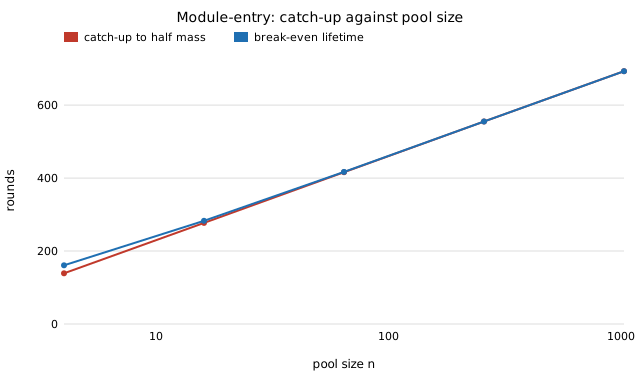
When a modular system adds an expert to a Hedge/LMSR router, the regret certificate to every expert is ci/η + ηT/8 with ci = ln(1/πi) + Σj>i ln(1/(1−πj)), and for any share sequence Σi e−ci = 1 (a Kraft identity). So uniform entry π = 1/(n+1) is the unique minimax rule (every ci = ln N, against 4.1–9.7 for constant shares at 4+12 modules), and against a prior on which module will be best the optimal shares are Pj/Sj with expected coefficient equal to the entropy of the prior. The price of entry is exactly ln(1/π)/η for a better arrival and ln(1/(1−π))/η for a worse one, independent of the quality gap; a recency prior cuts simulated regret from 3.11 to 2.70 nats. Known arrival rounds, fixed η. Pure-Python, 6 tests.
A figure from its own output
Paper, code and results
More in Markets as routers
- How much liquidity does a payment system need, and what do netting and gridlock resolution save?Does bilateral or multilateral netting, or gridlock resolution, save a payment system liquidity? A simulator fitted to Bech and Soramäki's Danish and Finnish bounds (34.7% and 10.1% of gross value against the published 37.2% and 10.7% for DK) shows reciprocal flows are what make netting work, and resolution cuts delay by 24–46% in the Danish-shaped system but 34–62% in the Finnish-shaped one, where the paper found about 10%.
- How much longer is an electric delivery fleet's route plan once the battery and the chargers are counted, and does a charge-aware search recover it?Solomon RC208 (100 customers) with a battery: keeping the battery-blind routes and adding charging stops costs 28% more distance at 150 range units, a charge-aware search brings that to 5%; the battery is harmless above 200 units.
- Markets as routers: LMSR = Hedge, quadratic potential = sparsemaxCost-function markets as expert routers: LMSR = Hedge, quadratic potential = sparsemax; regret/loss bounds verified, continual-learning simulation.
- Wagering mechanisms as routers for modular, continually learning expertsSelf-financed wagering mechanisms as verifiable routers for modular, continually learning experts; shows plain WSWM locks in under recurring regimes and a fixed-share tax fixes it at the cost of subsidising free-riders.
- How much should a router extremize?Pooling calibrated experts with shared training data: Bayes-optimal extremization
a* = n/(1+(n−1)ρ)verified numerically, saturation atn_eff → 1/ρ, asymmetric robustness, and online learning of the exponent. - What does late feedback cost a market router?Hedge/LMSR routing with delayed feedback: regret
≤ ln N/η + ηT/8 + ηD/2(mean delay inflates horizon by1+4d̄), 12× regret from ignoring delay against a reactive adversary, delay-tuned rate too cautious on oblivious data, LMSR subsidy ~20× at mean delay 5.
All 13 Markets as routers projects →
Other research topics
Proper scoring & elicitation28Effort & peer prediction9Verification games & slashing19Detection & tolerances14Markets as routers13Prediction-market design9Paying contributors8Decentralised training systems23Digital twins & sim-to-real164LLM chip design loops40Robot manufacturing loops53Ambient AI assistant46Self-replicating manufacturing34Simulation-first design64Engineered clothing45Task-specific AI accelerators40Algorithmic chip-design loops42Open-source purpose-built robots44The software-engineering loop43Adversarial human imitation41Open-source residential construction41Autonomous multi-angle capture34Sensing, imaging and 3D31Energy supply and dense energy storage39Robot societies among people31Agentic co-design of low-cost robots27Laundry-hanging robots25Machine learning on qualitative data23Robots on the building site27Civilizations & group psychology1History & human sciences1
Produced with AI assistance (Claude). Results are from the code in this repository and are simulated or stylised unless the abstract says otherwise; nothing here implies affiliation with or endorsement by any lab, researcher or company cited. MIT licensed.