Does giving a Markov chain dwell times or a second-order memory let it fool a webcam-signal detector?
research/mimic-webcam-semimarkov
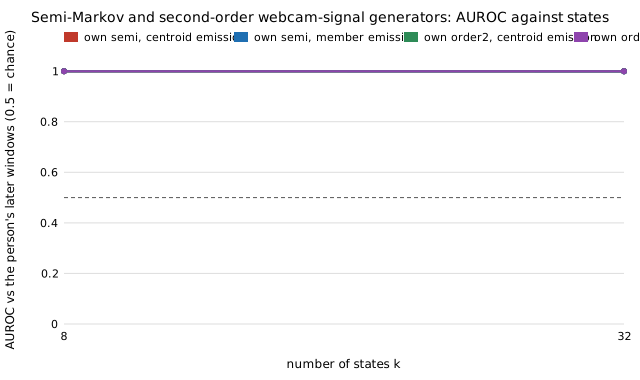
Does giving a chain over a person's frames dwell times or second-order memory help? No: semi-Markov and second-order chains (8 or 32 states, own or pooled fit, centre or real-frame emission) are all caught at AUROC 0.999 to 1.000.
What it found
The predecessor project's first-order Markov chains over DUX webcam-signal frames were caught at AUROC 1.000. Two fixes it named are tried here: a semi-Markov chain that holds each k-means state for a dwell time drawn from that state's empirical run lengths, and a second-order chain whose next state depends on the last two (backing off to first order for unseen pairs). With 8 or 32 states, fitted on one person's earlier windows or on the other 45 people's, emitting state centres or real frames, all 16 cells are scored at AUROC 0.999 to 1.000 by a boosted-tree detector over 3 seeds, in the population and profile-aware detectors alike. Neither fix reaches the 0.57 to 0.65 of stitching 50-frame real blocks. Stylised: one form-filling context, 46 people, k of 8 and 32 only, empirical dwell times without drift.
A figure from its own output
Paper, code and results
More in Adversarial human imitation
- Why is block-stitched real webcam signal still caught: the joins, or mixing people?Why is block-stitched real webcam signal still caught? With 50-frame blocks random stitching gives AUROC 0.887, one person's windows only 0.687, join-matched 0.796, both 0.588 (= whole-window replay 0.597); at 5 frames all are caught (8 seeds).
- How well do prompt-free detectors tell people from a plainly prompted LLM, and do they carry over to unseen kinds of text?How well do prompt-free detectors tell people from a plainly prompted LLM, and do they carry over to unseen kinds of text? Eight RAID families split by family: n-gram detector AUROC 0.93 and Binoculars-style 0.80 on held-out families, length at chance. Preliminary first step of track 11.
- Do the file sizes and line counts of this repository follow Benford’s law?Do this repository's file sizes follow Benford's law? Not as a whole (byte MAD 0.018, nonconforming) because templated files repeat the same size thousands of times; counting each distinct size once gives acceptable conformity (MAD 0.0068).
- Can prompt search alone move a frozen 0.5B imitator past a prompted 0.5B detector, and which proposer does it best at equal budget?Can prompt search alone move a frozen 0.5B imitator past a prompted 0.5B detector? A stylised first run of the imitation game, four proposers at equal budget on two families: the starting detector is below chance, proposers cannot be ranked at this size, and length is a major confound.
- Does the prompt-only imitation game settle or cycle, and does beating the latest detector mean beating the others?Does the prompt-only imitation game settle or cycle? Every imitator prompt from
mimic-loopagainst every detector prompt (0.5B on both sides): pure equilibria below chance (reddit 0.396, reviews 0.292), no cycles at a noise margin, and text length tracks detector accuracy. Stylised, one loop seed; model-size question open. - Does a prompt-free human-vs-machine detector hold up on context families it never saw?Does a prompt-free n-gram human-vs-machine detector hold up on context families it never saw? Detector side of
mimic-anycontextwith no LLM (model download was blocked): AUROC 0.934 on unseen families against 0.985 in-family, and 40 target items close most of the gap on recipes. Stylised: plain-prompt RAID text only.
All 41 Adversarial human imitation projects →
Other research topics
Proper scoring & elicitation28Effort & peer prediction9Verification games & slashing19Detection & tolerances14Markets as routers13Prediction-market design9Paying contributors8Decentralised training systems23Digital twins & sim-to-real164LLM chip design loops40Robot manufacturing loops53Ambient AI assistant46Self-replicating manufacturing34Simulation-first design64Engineered clothing45Task-specific AI accelerators40Algorithmic chip-design loops42Open-source purpose-built robots44The software-engineering loop43Adversarial human imitation41Open-source residential construction41Autonomous multi-angle capture34Sensing, imaging and 3D31Energy supply and dense energy storage39Robot societies among people31Agentic co-design of low-cost robots27Laundry-hanging robots25Machine learning on qualitative data23Robots on the building site27Civilizations & group psychology1History & human sciences1
Produced with AI assistance (Claude). Results are from the code in this repository and are simulated or stylised unless the abstract says otherwise; nothing here implies affiliation with or endorsement by any lab, researcher or company cited. MIT licensed.