How many milestones does an unenforced job need?
research/milestone-schedules
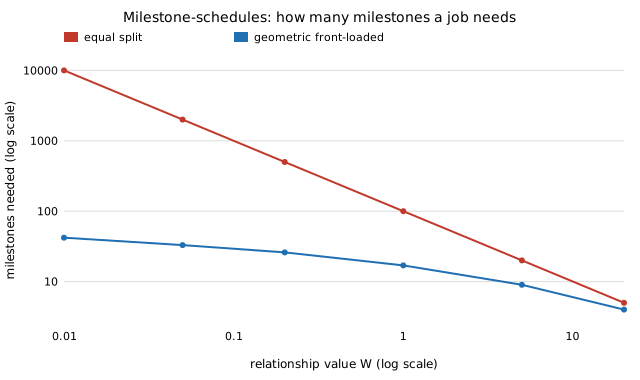
Milestone payments without enforcement: a split pre-payment needs only the pooled relationship value (C/(W_r+W_w) vs P/W_r, C/W_w), and front-loading makes the milestone count logarithmic, ⌈ln(1+(V−C)/W)/ln(V/C)⌉ (17 vs 100 at W=1).
What it found
A requester and an anonymous worker split a job into milestones, each a stage of pre-payment, work and late payment, with a grim trigger that forfeits the remaining surplus and a relationship value W. A milestone is self-enforcing under some pre-payment split iff its cost is at most the pooled continuation value, so pay-after-delivery needs P/Wr equal milestones, pay-before C/Ww, and the best split C/(Wr+Ww) (110, 25 and 20 in the example), whoever holds the value. Because early defection also forfeits the remaining work, the largest milestone shrinks geometrically and the minimum count is ⌈ln(1+(V−C)/W)/ln(V/C)⌉: 17 instead of 100 at C=100, V=120, W=1, with the first milestone 1−(C−W)/V of the job. Cheap re-entry caps W and costs ln(1/e) milestones. Matched on 2000 random instances. Stylised: complete information, pro-rata value.
A figure from its own output
Paper, code and results
More in Verification games & slashing
- What is the cheapest payment-and-audit protocol that makes honest ML training an equilibrium?Research programme: incentive-compatible verification of outsourced ML training; first measurement on real training finds a tolerance-tau referee passes a skip-steps cheat on 30% of steps at tau = 1e-2 while the held-out loss stays within one seed std, and the loss only suffers at tau about 10x the worst benign drift; milestone 4 prices contracts by linear programme: with a tolerance, audit-only cannot enforce full effort and the joint contract beats both checks only when the score is precise (4 of 45 cells); milestone 6: against a coordinating majority replication adds no deterrence beyond the audit and the stake is flat in the number of workers (140 cells); milestone 5: an agreement term between redundant workers is worth nothing beyond the audit once cheats copy one trajectory (0 of 1,349 random instances), and a proved one-sided bound max(C, g/p - S) holds in 2,755 instances but is vacuous for a noisy score
- Economics of refereed verificationInspection-game economics of refereed verification: stake substitutes for re-execution, extra verifiers free-ride, and optimal tolerance/stake under floating-point drift.
- Bribing the verifiersBribing verifiers in refereed verification: closed-form bribe floor, a sharp collusion-proof stake that falls as 1/m, and jackpots that raise the floor one-for-one.
- Do verifiers and solvers learn the audit equilibrium?No-regret learning in the refereed-verification inspection game: conserved potential, closed-form cycle period, averages converge but per-round audit probability collapses; optimistic Hedge converges.
- Many verifiers, one solver: the volunteer's dilemma in refereed verificationM verifiers in the inspection game: detection pinned at s/(s+S), cheating rises with m under split rewards, symmetric equilibrium is a saddle (volunteer's dilemma), bandit learners need an exploration floor.
- Are stake and audits substitutes in trace verification?Sampled audits of committed training traces: payoff is convex in corrupted steps, deterrence iff
min(F, f·k) ≥ T·g, so stake and audits are complements and stake must scale with job length.
All 19 Verification games & slashing projects →
Other research topics
Proper scoring & elicitation28Effort & peer prediction9Verification games & slashing19Detection & tolerances14Markets as routers13Prediction-market design9Paying contributors8Decentralised training systems23Digital twins & sim-to-real164LLM chip design loops40Robot manufacturing loops53Ambient AI assistant46Self-replicating manufacturing34Simulation-first design64Engineered clothing45Task-specific AI accelerators40Algorithmic chip-design loops42Open-source purpose-built robots44The software-engineering loop43Adversarial human imitation41Open-source residential construction41Autonomous multi-angle capture34Sensing, imaging and 3D31Energy supply and dense energy storage39Robot societies among people31Agentic co-design of low-cost robots27Laundry-hanging robots25Machine learning on qualitative data23Robots on the building site27Civilizations & group psychology1History & human sciences1
Produced with AI assistance (Claude). Results are from the code in this repository and are simulated or stylised unless the abstract says otherwise; nothing here implies affiliation with or endorsement by any lab, researcher or company cited. MIT licensed.