Does solar gain through windows change which envelope is cheapest over 30 years, and is the direction the windows face worth money?
research/house-solar
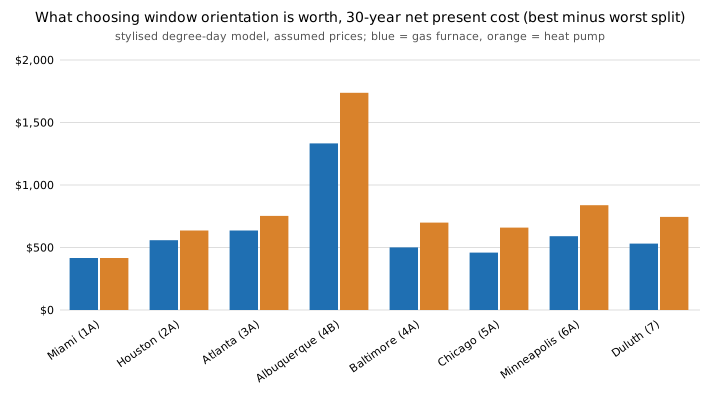
Does solar gain through windows change the cheapest envelope, and is window orientation worth money? Adds first-principles solar geometry to house-energy: U 0.50 stays optimal in 15 of 16 cases, and orientation is worth $420–$1,740 of 30-year cost. Stylised: degree-day model, assumed prices and clearness, not EnergyPlus.
What it found
Adds window solar gain, computed from solar geometry by orientation, to house-energy’s 640-package net-present-cost search. U 0.50 windows stay the optimum in 15 of 16 climate and system cases (Miami moves to U 0.35), and forcing U 0.20 glass costs $5,300 to $5,700 whatever its solar heat gain coefficient, so the earlier window result was not an artifact of the missing solar term. Which way the windows face is free and worth $420 to $1,740 of 30-year cost per house, south-heavy glazing best except in Miami. Stylised: degree-day model, assumed prices, latitudes and clearness, trigonometry written from memory and not validated against weather data.
A figure from its own output
Paper, code and results
More in Open-source residential construction
- When should a builder order long-lead materials once holding them costs money?When should a builder order long-lead materials once holding them costs money? Extends
house-schedule: ordering ~2 lead times ahead of plan cuts the build from 214 to 182 working days and total cost from 3.34% to 2.91% of price; ordering everything on day 0 saves more days but costs more (4.00%). - Does a roof overhang over south windows pay for itself, and in which climates does it cost energy instead of saving it?Does a roof overhang over south windows pay for itself, and where does it cost energy instead? Adds profile-angle shading of south beam radiation to
house-solar; at an assumed $12 per ft of width per ft of projection no overhang is optimal in 8 climates (gross value at most $280 of 30-year NPC, negative past 1 ft in cold climates). Stylised degree-day model. - Where in a wall does water vapor condense, and does a vapor retarder or exterior foam fix it, by climate?Where in a wall does vapor condense, and does a vapor retarder or exterior foam fix it? Steady-state Glaser check of a 2x6 wall in four assumed climates; winter condensation appears in Chicago and Duluth only, and only polyethylene clears Duluth. Stylised.
- What does a new home cost to build in the US and Colorado in 2026, and where does the money go?What does a new home cost to build in the US and Colorado in 2026, and where does the money go? Sourced market report: median new US home $393,700 (Aug 2026, −5.8% y/y) while input costs rose 10.3%; NAHB's breakdown puts construction at 64.4% of price and foundations, framing and exterior at 26%, so a 20% cheaper structure moves the price 5.2%; manufactured homes cost ~52% of site-built per sq ft; Denver fees and plan-review delay are ~12% of a modelled $462k (lot excluded) home against 3.5% nationally.
- Does the cost-optimal home envelope change when invented fuel prices are replaced by EIA state prices?Does the cost-optimal home envelope change when invented fuel prices are replaced by EIA state prices? Optimum unchanged in 10 of 12 cases; 30-year saving moves by −$496 to +$549; advanced 2x6 walls still win and R-49 attics and U 0.27 windows still do not pay. Only fuel prices are sourced.
- How much dearer can a heat pump be than a gas furnace plus AC before gas wins on 30-year cost?How much dearer can a heat pump be than a gas furnace plus AC before gas wins on 30-year cost? Break-even premium $84 to $735 in the South; in Chicago to Duluth it would have to cost $5,399 to $6,698 less. No equipment prices used; stylised.
All 41 Open-source residential construction projects →
Other research topics
Proper scoring & elicitation28Effort & peer prediction9Verification games & slashing19Detection & tolerances14Markets as routers13Prediction-market design9Paying contributors8Decentralised training systems23Digital twins & sim-to-real164LLM chip design loops40Robot manufacturing loops53Ambient AI assistant46Self-replicating manufacturing34Simulation-first design64Engineered clothing45Task-specific AI accelerators40Algorithmic chip-design loops42Open-source purpose-built robots44The software-engineering loop43Adversarial human imitation41Open-source residential construction41Autonomous multi-angle capture34Sensing, imaging and 3D31Energy supply and dense energy storage39Robot societies among people31Agentic co-design of low-cost robots27Laundry-hanging robots25Machine learning on qualitative data23Robots on the building site27Civilizations & group psychology1History & human sciences1
Produced with AI assistance (Claude). Results are from the code in this repository and are simulated or stylised unless the abstract says otherwise; nothing here implies affiliation with or endorsement by any lab, researcher or company cited. MIT licensed.