Does the month a house build starts change how long it takes and the interest paid?
research/house-season
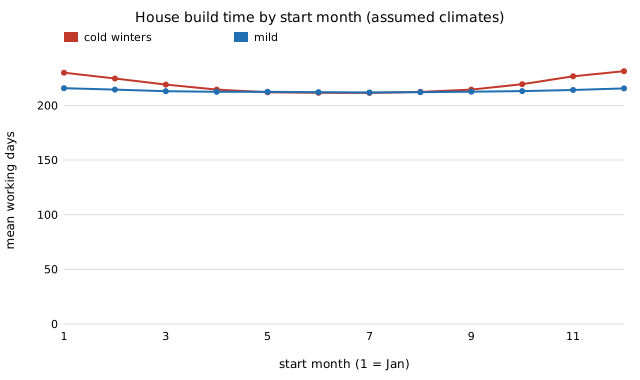
Does the month a house build starts change how long it takes? Same Monte Carlo as house-schedule with a monthly weather calendar: in an assumed cold climate a December start takes 231 working days against 211 for July (~20 d); in a mild one, 4 d. Early ordering saves ~63 d in every month. Weather numbers assumed.
What it found
Reruns the house-schedule Monte Carlo (3,000 builds per cell) with a monthly weather calendar and a slower concrete cure in the cold, starting in each month. In an assumed cold-winter climate a December start takes 231 working days against 211 for July (about 20 days, 0.3 points of the price in interest); in an assumed mild climate the swing is 4 days. Ordering all materials at day 0 saves about 63 days in every month, so the two levers add. A flat climate reproduces house-schedule exactly (tested). Stylised: the monthly loss fractions are my assumptions, not weather data, and seasonal prices are ignored.
A figure from its own output
Paper, code and results
More in Open-source residential construction
- Does solar gain through windows change which envelope is cheapest over 30 years, and is the direction the windows face worth money?Does solar gain through windows change the cheapest envelope, and is window orientation worth money? Adds first-principles solar geometry to
house-energy: U 0.50 stays optimal in 15 of 16 cases, and orientation is worth $420–$1,740 of 30-year cost. Stylised: degree-day model, assumed prices and clearness, not EnergyPlus. - When should a builder order long-lead materials once holding them costs money?When should a builder order long-lead materials once holding them costs money? Extends
house-schedule: ordering ~2 lead times ahead of plan cuts the build from 214 to 182 working days and total cost from 3.34% to 2.91% of price; ordering everything on day 0 saves more days but costs more (4.00%). - Does a roof overhang over south windows pay for itself, and in which climates does it cost energy instead of saving it?Does a roof overhang over south windows pay for itself, and where does it cost energy instead? Adds profile-angle shading of south beam radiation to
house-solar; at an assumed $12 per ft of width per ft of projection no overhang is optimal in 8 climates (gross value at most $280 of 30-year NPC, negative past 1 ft in cold climates). Stylised degree-day model. - Where in a wall does water vapor condense, and does a vapor retarder or exterior foam fix it, by climate?Where in a wall does vapor condense, and does a vapor retarder or exterior foam fix it? Steady-state Glaser check of a 2x6 wall in four assumed climates; winter condensation appears in Chicago and Duluth only, and only polyethylene clears Duluth. Stylised.
- What does a new home cost to build in the US and Colorado in 2026, and where does the money go?What does a new home cost to build in the US and Colorado in 2026, and where does the money go? Sourced market report: median new US home $393,700 (Aug 2026, −5.8% y/y) while input costs rose 10.3%; NAHB's breakdown puts construction at 64.4% of price and foundations, framing and exterior at 26%, so a 20% cheaper structure moves the price 5.2%; manufactured homes cost ~52% of site-built per sq ft; Denver fees and plan-review delay are ~12% of a modelled $462k (lot excluded) home against 3.5% nationally.
- Does the cost-optimal home envelope change when invented fuel prices are replaced by EIA state prices?Does the cost-optimal home envelope change when invented fuel prices are replaced by EIA state prices? Optimum unchanged in 10 of 12 cases; 30-year saving moves by −$496 to +$549; advanced 2x6 walls still win and R-49 attics and U 0.27 windows still do not pay. Only fuel prices are sourced.
All 41 Open-source residential construction projects →
Other research topics
Proper scoring & elicitation28Effort & peer prediction9Verification games & slashing19Detection & tolerances14Markets as routers13Prediction-market design9Paying contributors8Decentralised training systems23Digital twins & sim-to-real164LLM chip design loops40Robot manufacturing loops53Ambient AI assistant46Self-replicating manufacturing34Simulation-first design64Engineered clothing45Task-specific AI accelerators40Algorithmic chip-design loops42Open-source purpose-built robots44The software-engineering loop43Adversarial human imitation41Open-source residential construction41Autonomous multi-angle capture34Sensing, imaging and 3D31Energy supply and dense energy storage39Robot societies among people31Agentic co-design of low-cost robots27Laundry-hanging robots25Machine learning on qualitative data23Robots on the building site27Civilizations & group psychology1History & human sciences1
Produced with AI assistance (Claude). Results are from the code in this repository and are simulated or stylised unless the abstract says otherwise; nothing here implies affiliation with or endorsement by any lab, researcher or company cited. MIT licensed.