Does a tighter envelope let a 480 sq ft backyard cottage use a smaller heat pump, and is the saving worth counting?
research/house-hpsize
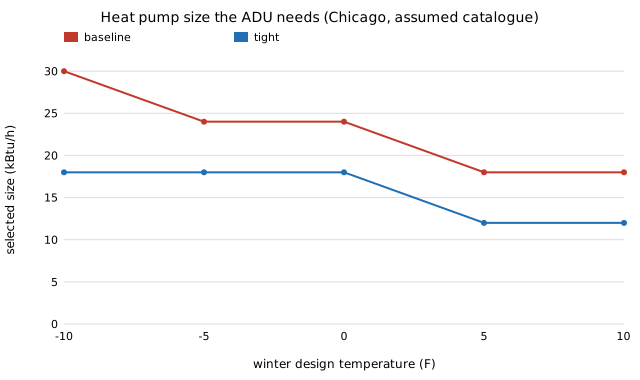
Does a tighter envelope let a 480 sq ft backyard cottage use a smaller heat pump? The tight package cuts the design heating load about 36.5%, worth a $450 to $1,800 equipment step credit (assumed catalogue and prices) that nearly closes the payback gap of the costed upgrades in three colder climates. Stylised.
What it found
Adds the term house-breakeven left out: the equipment downsizing credit. The design heating load (UA × design temperature difference) of the house-open-design ADU falls about 36.5% with the tight envelope in every climate, but equipment comes in discrete sizes, so the credit is a step: with an assumed catalogue and prices it is $450 (Houston), $1,350 (Baltimore), $900 (Chicago) and $1,800 (Minneapolis) for the whole package, and it is mostly the wall switch that moves the size. Added to the energy break-even, the three costed upgrades (assumed extra cost $2,211) come within $98 to $463 of paying back in the three colder cities but not in Houston ($1,607 short). The size is sensitive to the assumed design temperature and sizing margin, which are unchecked memory, so the credit is a range of one or two catalogue steps, not a number. Stylised: no EnergyPlus, no Manual J, no sourced prices.
A figure from its own output
Paper, code and results
More in Open-source residential construction
- When does cooling, not heating, set the heat pump size for a 480 sq ft backyard cottage?When does cooling, not heating, set the heat pump size for a 480 sq ft backyard cottage? Adding a summer load (conduction, window solar gain, internal gains) shows cooling governs only in Houston (12 kBtu/h baseline, 9 tight); sizes and credits elsewhere are unchanged, and Houston's credit swings between $0 and $900 with SHGC and latent allowance (stylised, assumed inputs).
- How much lumber does a prefabricated roof truss save over rafters and ceiling joists?How much lumber does a prefabricated roof truss save over rafters and ceiling joists? A pin-jointed W truss with NDS checks uses 40-55% less nominal lumber per sq ft of plan than 16 in rafters plus ceiling joists over 12-30 ft spans at 30 psf snow (stylised: no plates, bracing or heel details).
- When does building a house's wall shell in a factory beat building it on site?When does building a house's wall shell in a factory beat building it on site? Panel layout, sheathing nesting (1 sheet in 33 saved) and a Monte Carlo of the shell: panelised takes 2.17 d against 1.96 d on site and costs 38% more at assumed rates; it is faster only from about 58 ft long. Closed panels (insulation, wiring, windows built in) cut the gap: cost parity at a factory labour ratio of about 0.45 and a day saved. Stylised, every rate assumed.
- Which foundation is cheapest for a small house as the frost line gets deeper?Which foundation is cheapest for a small house as the frost line deepens? At 48 in frost a frost-protected shallow foundation is $13.2k against $20.6k slab, $24.1k crawlspace and $54.9k basement in a stylised model.
- Does a factory-built shell pay once the interest on the days it saves is counted?Does a factory-built shell pay once the interest on the days it saves is counted? Alone it saves 15.5 working days (0.22% of price) and breaks even near a $629,000 house at an assumed $1,500 crane day.
- How much do fewer handoffs, parallel trades, early ordering and a factory shell cut the time to build a house?How much do fewer handoffs, parallel trades, early ordering and a factory shell cut a house's build time? Discrete-event Monte Carlo: critical path 100 working days, baseline 214; early ordering -63 d, fewer handoffs -21, a factory shell only -6 unless ordered at day 0 (-78). Stylised, uncalibrated.
All 41 Open-source residential construction projects →
Other research topics
Proper scoring & elicitation28Effort & peer prediction9Verification games & slashing19Detection & tolerances14Markets as routers13Prediction-market design9Paying contributors8Decentralised training systems23Digital twins & sim-to-real164LLM chip design loops40Robot manufacturing loops53Ambient AI assistant46Self-replicating manufacturing34Simulation-first design64Engineered clothing45Task-specific AI accelerators40Algorithmic chip-design loops42Open-source purpose-built robots44The software-engineering loop43Adversarial human imitation41Open-source residential construction41Autonomous multi-angle capture34Sensing, imaging and 3D31Energy supply and dense energy storage39Robot societies among people31Agentic co-design of low-cost robots27Laundry-hanging robots25Machine learning on qualitative data23Robots on the building site27Civilizations & group psychology1History & human sciences1
Produced with AI assistance (Claude). Results are from the code in this repository and are simulated or stylised unless the abstract says otherwise; nothing here implies affiliation with or endorsement by any lab, researcher or company cited. MIT licensed.