How far ahead should a controller planned in a twin with the wrong plant pole look?
research/horizon-twin
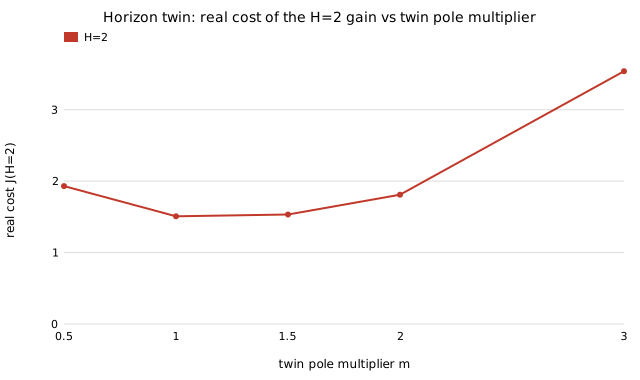
How far ahead a controller planned in a wrong-pole twin should look: exact real cost per horizon is non-monotone when the twin overstates the pole (1.81 at H=2 vs 3.97 at H=60, optimum 1.48), the twin's own claim ranks horizons backwards, exact two-step stability edge, and a Riccati terminal cost removes the effect.
What it found
A receding-horizon controller uses the H-step gain of a twin whose pole is m× the real one; the real cost of that fixed gain is exact (matched to simulation within 0.3%). When the twin overstates the pole the gain rises with H past the real optimum, so cost is not monotone in the horizon: at m=2 (a=0.9, r=1) the real cost is 1.81 at H=2 and 3.97 at H=60 against an optimum of 1.48, and the saving rises from 12% to 91% as control cost goes from 0.1 to 20. The twin cannot see this (its own claim falls from 9.5 to 3.5 as H grows, ranking horizons backwards); the two-step controller stays stable up to m=(1+a)(r+b2q)/(abq) (4.22 vs 2.51 for H=60 at r=1). A terminal cost equal to the twin’s Riccati solution removes the effect. Stylised: scalar linear-Gaussian, only the pole wrong, best horizon chosen with the real cost known.
A figure from its own output
Paper, code and results
More in Digital twins & sim-to-real
- How should cheap biased twin samples be weighted against scarce real ones?Mixing cheap biased twin samples with scarce real ones: exact optimal weight, twin worth capped at
σ²/δ²real samples, equal pooling helps iffδ²<a+b, and estimating the bias from data is costly (plug-in worse than real-only for large bias). - How much load can a shared lab instrument carry when its twin assumes exponential service?How much load a shared lab instrument carries when its twin assumes exponential service: exact Pollaczek–Khinchine wait off by
(1+c²)/2, twin admits ρ=0.667 vs real 0.444 (c²=4) or 0.133 (c²=25), tails 11.7× worse, infinite mean wait for Pareto index < 2, and a plug-inc²repair that violates the SLA 70–89% of the time. - How much smoothing does a differentiable twin of a hard contact event need, and what does it cost?Smoothing a hard contact edge to make a twin trainable: real gradient is zero, twin ascent is trapped below
τ_c=0.105and misses the edge aboveR/(8cm), annealing crosses the trap, and the overshoot≈τ ln(R/(2cmτ))is an implicit safety margin capped at 0.168. - How many redundant sensors does a twin with independent errors say a robot needs?How many redundant sensors a twin with independent errors says a robot needs: exact equicorrelated fused variance,
n_eff < 1/ρand a floorσ√ρ, twin says 16 sensors vs real 30 (ρ=0.03) or none (ρ≥0.0625), 3σ gate false-alarms 8.6× too often, and a plug-in ρ repair that misses the target about half the time. - How much is one long digital-twin run worth when its output is serially correlated?How much one long digital-twin run is worth when its output is autocorrelated: exact AR(1) run-mean variance, M/M/1 wait inflation 9.7×–363× (ρ=0.5–0.9), naive 95% intervals cover 9–53%, false SLA certification 26% vs 4.8% with batch means, and batch means fail when batches are shorter than the correlation time.
- How much of a digital-twin run should be thrown away because it started in the wrong state?A twin started in the wrong state: exact AR(1) warm-up bias and MSE-optimal deletion (≈ one relaxation time, ≤1.5× gain), M/M/1 empty-start bias (−21% at ρ=0.9, n=500; 1% at 10⁴), and a negative result: MSER-5 truncation leaves more bias and more false SLA certifications than fixed deletion.
All 164 Digital twins & sim-to-real projects →
Other research topics
Proper scoring & elicitation28Effort & peer prediction9Verification games & slashing19Detection & tolerances14Markets as routers13Prediction-market design9Paying contributors8Decentralised training systems23Digital twins & sim-to-real164LLM chip design loops40Robot manufacturing loops53Ambient AI assistant46Self-replicating manufacturing34Simulation-first design64Engineered clothing45Task-specific AI accelerators40Algorithmic chip-design loops42Open-source purpose-built robots44The software-engineering loop43Adversarial human imitation41Open-source residential construction41Autonomous multi-angle capture34Sensing, imaging and 3D31Energy supply and dense energy storage39Robot societies among people31Agentic co-design of low-cost robots27Laundry-hanging robots25Machine learning on qualitative data23Robots on the building site27Civilizations & group psychology1History & human sciences1
Produced with AI assistance (Claude). Results are from the code in this repository and are simulated or stylised unless the abstract says otherwise; nothing here implies affiliation with or endorsement by any lab, researcher or company cited. MIT licensed.