Should a laundry robot hang a garment or fold it, and what can it sense to tell?
research/hanger-fold
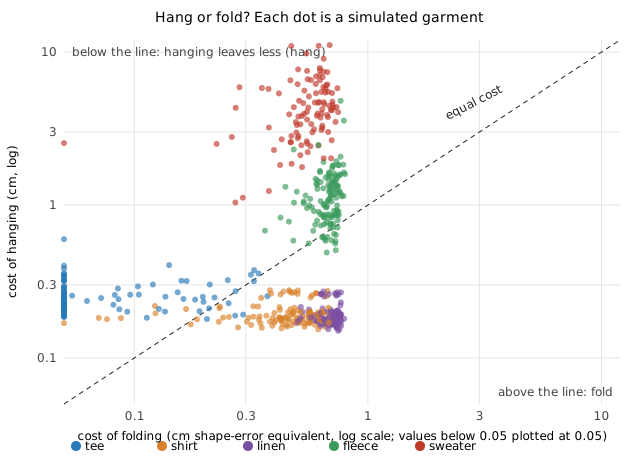
Should a laundry robot hang a garment or fold it, and what can it sense to tell? A stretch-set and crease-set model on five fabric archetypes: woven shirts and linen are better hung, tees, fleece and heavy knits better folded; shoulder width, mass and stretch when lifted pick the better action for 89–91% of 600 simulated garments (always fold: 59%). The split depends mostly on the assumed crease model. Stylised, assumed fabric constants.
What it found
Adds a stretch-set model for hanging (permanent shoulder lengthening from hanger-fit’s drape) and a crease-set model for folding to five fabric archetypes, prices both in cm of departure from the pressed shape, and learns a rule on 600 simulated garments. Woven shirts and linen are better hung, t-shirts, fleece and heavy knits better folded. Shoulder width, mass and stretch when lifted choose the better action for 89–91% of garments in 5-fold cross-validation (always fold: 59%; adding the fabric class: 94%); width alone adds nothing. The split is driven by the assumed crease model: a 6 h stack instead of 48 h moves the share better hung from 41% to 8%, while a hundredfold change in the stretch penalty moves it from 48% to 37%. Stylised: every fabric constant is assumed, the population is synthetic, no motion.
A figure from its own output
Paper, code and results
More in Laundry-hanging robots
- How does a laundry robot get a hanger into a garment, and what does it cost the neck?How does a laundry robot get a hanger into a garment, and what does it cost the neck? A swept-section model of a rigid, telescoping or folding hanger passing a neck or hem loop: rigid hangers need 43–61 cm of loop, a tee's neck stretches up to 33% and a buttoned shirt collar cannot take them at all (shirts go in at the hem, 10 s against 6 s); a hanger that collapses to a 10 cm half width needs 31 cm. The round end
hanger-fitwants costs about 3 cm more. Stylised, assumed constants. - How many dryers can one laundry-hanging robot serve, and what limits it?How many dryers can one laundry-hanging robot serve, and what limits it? A discrete-event model of the whole cell (pick, sense, feeder, insertion, rail, fold table) fed by
hanger-insertandhanger-fold: with assumed times one arm clears a 25-item load in 8.9 min (about 5 dryers), a second arm adds 22% before the fold table binds, and the five hanger designs differ by at most 3%; pick and fold times dominate. Stylised, assumed station times. - Can the hanger a cloth simulation designed be 3D-printed, and does it hold a garment?Can the hanger a cloth simulation designed be 3D-printed, and does it hold a garment?
hanger-fit's adjustable shape and four-width rack as parametric STL and OpenSCAD with a beam check: the round-ended arm has a safety factor of 40–70 in assumed PLA, a wire-like arm 0.13, and no useful width fits a 220 mm bed whole (one arm with its hub does). Stylised, assumed material constants. - How should a laundry robot pick one garment out of a tangled dryer load?How should a laundry robot pick one garment out of a tangled dryer load? In a stylised disc-pile model aiming at a visible opening takes 13.4 assumed seconds per garment against 22.7 for pinching the top and regrasping, and pushing garments aside first is slower (17.7 s); one arm then serves 151, 110 and 127 items an hour. Assumed times, not a robot.
- How long may a laundry robot spend finding a garment's opening before blind pinching is faster?How long may a laundry robot spend finding a garment's opening before blind pinching is faster? On paired piles of the stylised pick model, aiming wins only if the detector costs under about 9 s per pick (95% interval 8.9 to 9.6, assumed times); the limit falls as regrasps get likelier to succeed or more openings are hidden. Stylised.
- How often may a laundry robot's opening detector aim wrong before blind pinching is faster?How often may a laundry robot's opening detector aim wrong before blind pinching is faster? In the stylised
hanger-pickmodel each 10 points of detector error cost about 1 s of look-time budget: 9.2 s per pick when perfect, 4.5 s at 50% wrong, none when always wrong. Stylised.
All 25 Laundry-hanging robots projects →
Other research topics
Proper scoring & elicitation28Effort & peer prediction9Verification games & slashing19Detection & tolerances14Markets as routers13Prediction-market design9Paying contributors8Decentralised training systems23Digital twins & sim-to-real164LLM chip design loops40Robot manufacturing loops53Ambient AI assistant46Self-replicating manufacturing34Simulation-first design64Engineered clothing45Task-specific AI accelerators40Algorithmic chip-design loops42Open-source purpose-built robots44The software-engineering loop43Adversarial human imitation41Open-source residential construction41Autonomous multi-angle capture34Sensing, imaging and 3D31Energy supply and dense energy storage39Robot societies among people31Agentic co-design of low-cost robots27Laundry-hanging robots25Machine learning on qualitative data23Robots on the building site27Civilizations & group psychology1History & human sciences1
Produced with AI assistance (Claude). Results are from the code in this repository and are simulated or stylised unless the abstract says otherwise; nothing here implies affiliation with or endorsement by any lab, researcher or company cited. MIT licensed.