Does a twin with no gravity certify PD gains that sag, or cannot hold a pose at all?
research/gravity-twin
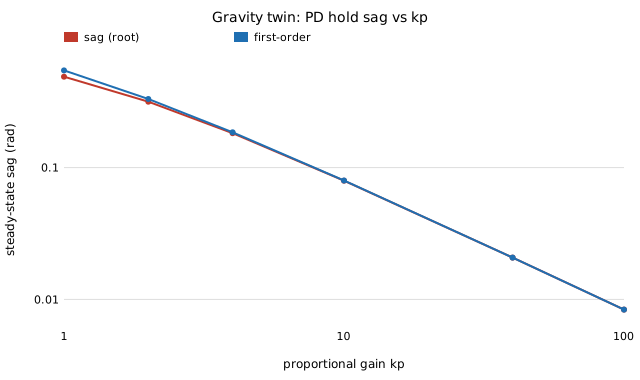
A gravity-free twin certifies PD with zero error; the real pendulum sags to the root of kp(θ*−θ)=g sin θ (0.18 rad at kp=4, falling only as ~1/kp), cannot hold upright unless kp>g (basin 0.12 rad at 1.02g), and a 10%-off gravity feedforward leaves a sag linear in the error.
What it found
A pendulum under PD control u=kp(θ*−θ)−kdω; the twin omits gravity and promises zero error at every gain. The real hold sags to the root of kp(θ*−θ)=g sinθ nearest the target (RK4 agrees to six digits; 0.182 rad at kp=4, θ*=1), falling only as ≈1/kp. Holding upright is stable iff kp>g: below it the arm settles 0.2–1.9 rad away, and just above it the basin is tiny (0.116 rad at 1.02g, 0.519 at 1.05g, none below 3 rad from 1.1g; numerical scan). A gravity feedforward with calibration error leaves a sag linear in (g(g−gff)minus;gff) (±0.0185 rad at ±10%). Companion to the lag and flex twins. Stylised: one rigid joint, noiseless, no friction.
A figure from its own output
Paper, code and results
More in Digital twins & sim-to-real
- A continuous-time twin certifies PD at every gain: which gains survive a zero-order-hold sampled loop?A continuous-time twin certifies PD at every gain; the real zero-order-hold loop is stable iff
kp·T/2 < kd < 2/T(ωn·T < min(4ζ, 1/ζ)), overshoot is 5× the twin's atωn·T= 1.2, raisingωnpastωn·T≈ 1 slows settling, and deadbeat (2 samples) is the real speed limit. - A linear-drag twin of a quadratic-drag vehicle: what does it get wrong about braking, terminal speed and the safe speed under a stopping limit?A linear-drag twin of a quadratic-drag vehicle: coast-down time and terminal speed are off by fit-speed ratios, least-squares fit gives
k = 3c·vmax/4, and the safe speed under a stopping limit is mis-stated by −21% to +41% with sign set by the fit speed. - A kinematic-bicycle twin ignores tyre slip: how wrong is its turning radius, and does calibrating that reveal where a twin-tuned steering loop goes unstable?A kinematic-bicycle twin of a car ignores tyre slip: steady-turn radius is off by exactly
1 + Kv²/L(twin 4–63% too small, half at the characteristic speed), calibratingKfixes that but both twins certify steering gains stable at every speed while 11 of 30 real gain pairs lose stability below 60 m/s. - A grid twin over-states every route by a heading-dependent factor: does a finer grid fix it, and can it rank two routes the wrong way round?A grid twin over-states every route by a heading-dependent factor that cell size does not shrink (8-connected: mean
8(√2−1)/π = 1.0548, worst 1.0824 at 22.5°), calibrating the mean leaves −5.2% to +2.6%, and the twin ranks two routes (lengths 1 and 1.03) the wrong way round 19% of the time; rotating the map flips a fixed pair for 31% of orientations. - A global-shutter twin of a rolling-shutter camera ignores target motion: how biased is a twin-trained orientation estimate, and what does the same frame reveal?A global-shutter twin of a rolling-shutter camera ignores target motion: a moving rectangle is sheared and stretched by exact closed forms, a twin-trained orientation estimate is biased by half the edge tilt (1.79° at 1000 px/s), and one frame of a known-size target identifies pose and velocity (0.027° and 16 px/s at 0.25 px noise). Stylised.
- A snapshot twin of a spinning lidar ignores that the platform moves during the sweep: how biased is the map, what does one scan reveal, and what do yaw and acceleration do?A snapshot-scan twin of a spinning lidar ignores motion during the sweep: length biased by exactly
vτ/2(0.5 m at 10 m/s), parallel walls converge byvτ/2π·(1/d₁+1/d₂), one scan gives speed to 0.13 m/s, yaw scales bearings by−κβ/(1+κ), acceleration biases odometry bya·t_fwithout accumulating.
All 164 Digital twins & sim-to-real projects →
Other research topics
Proper scoring & elicitation28Effort & peer prediction9Verification games & slashing19Detection & tolerances14Markets as routers13Prediction-market design9Paying contributors8Decentralised training systems23Digital twins & sim-to-real164LLM chip design loops40Robot manufacturing loops53Ambient AI assistant46Self-replicating manufacturing34Simulation-first design64Engineered clothing45Task-specific AI accelerators40Algorithmic chip-design loops42Open-source purpose-built robots44The software-engineering loop43Adversarial human imitation41Open-source residential construction41Autonomous multi-angle capture34Sensing, imaging and 3D31Energy supply and dense energy storage39Robot societies among people31Agentic co-design of low-cost robots27Laundry-hanging robots25Machine learning on qualitative data23Robots on the building site27Civilizations & group psychology1History & human sciences1
Produced with AI assistance (Claude). Results are from the code in this repository and are simulated or stylised unless the abstract says otherwise; nothing here implies affiliation with or endorsement by any lab, researcher or company cited. MIT licensed.