Why does the Rd low-discrepancy lattice lose its advantage at d = 5 when evaluating a twin policy?
research/free-rdseeds
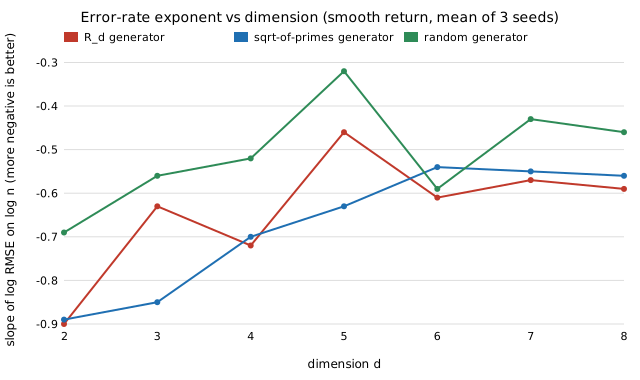
Why does the R_d low-discrepancy lattice lose its edge at d=5 when scoring a twin policy? Not a seed fluke (exponent −0.45 ± 0.01 over six seeds) and not a smooth dimension effect (a dip between d=4 and d=6); a √p generator gets −0.66 at d=5. A simple resonance score does not explain it. Stylised.
What it found
Follow-up to free-qmcdr. The shifted Rd lattice’s error exponent at d = 5 is −0.45 ± 0.01 over six seed strings, no better than iid, so it is not a seed fluke; across d = 2…8 it dips at 5 between −0.72 and −0.61 neighbours, so it is not a smooth dimension effect; a generator built from √pj reaches −0.66 at d = 5. A resonance score against small integer relations scores both generators alike, so the mechanism is not identified. Stylised analytic returns, not a simulator.
A figure from its own output
Paper, code and results
More in Digital twins & sim-to-real
- How long does a float32 twin of a chaotic system shadow the float64 one, and do its statistics survive?How long does a float32 twin of a chaotic system shadow the float64 one, and do its statistics survive? Lorenz and Rössler: float32 departs from float64 after a median 12.3 and 164 time units, like a float64 start error of about 5×10⁻⁶ (100× the float32 roundoff), but the Lyapunov exponent and time-averaged statistics agree within sampling error (stylised).
- Does a float32 simulation of a bouncing, chaotic system lose its statistics? Sinai billiard against float64Does a float32 simulation of a bouncing, chaotic system lose its statistics? Sinai billiard: float32 leaves the float64 trajectory after a median 21 collisions, like a float64 start error of about one unit roundoff, and changes the event order one collision later, but the mean free path and circle-hit share agree with float64 and with Cauchy's exact value (stylised).
- How many research READMEs admit their citations are unchecked, and which works need checking first?Audit of how many research READMEs flag a citation as unchecked: 94 of 550 (17.1%), with Dawid and Skene (1979), Zhang et al. (2019), Horowitz (2014) and Horvitz (1999) the most repeated; counts admissions only, nothing verified.
- How much does noisy scoring cost the secretary problem, and should the 1/e cutoff move?How much noisy scoring costs the secretary problem: with n = 50 the best cutoff stays at 16–17 (19 noiseless) while P(best) falls from 0.373 to 0.145 at noise 1; cutoff rules only, simulation.
- How many simulator rollouts does a sequential test save when certifying a failure rate?How many simulator rollouts a sequential test saves when certifying a failure rate: exact dynamic programming shows Wald's SPRT uses about half the rollouts of the best fixed test at either hypothesis (79/113 vs 181 for 1% vs 5%), and 6–17% fewer at its worst point in between.
- How long can a sequential rollout test run, and what does capping it cost?How long can a sequential rollout test run, and what does capping it cost? Exact: the SPRT's 99th percentile is 309 rollouts against a 79 mean (1% vs 5%; fixed test 181), 28% of runs exceed the fixed size at the midpoint rate; capping at the fixed size adds 34–38% to the error, a cap of 1.5 times it keeps the error at 0.053 to 0.057 for a mean within 2% of uncapped.
All 164 Digital twins & sim-to-real projects →
Other research topics
Proper scoring & elicitation28Effort & peer prediction9Verification games & slashing19Detection & tolerances14Markets as routers13Prediction-market design9Paying contributors8Decentralised training systems23Digital twins & sim-to-real164LLM chip design loops40Robot manufacturing loops53Ambient AI assistant46Self-replicating manufacturing34Simulation-first design64Engineered clothing45Task-specific AI accelerators40Algorithmic chip-design loops42Open-source purpose-built robots44The software-engineering loop43Adversarial human imitation41Open-source residential construction41Autonomous multi-angle capture34Sensing, imaging and 3D31Energy supply and dense energy storage39Robot societies among people31Agentic co-design of low-cost robots27Laundry-hanging robots25Machine learning on qualitative data23Robots on the building site27Civilizations & group psychology1History & human sciences1
Produced with AI assistance (Claude). Results are from the code in this repository and are simulated or stylised unless the abstract says otherwise; nothing here implies affiliation with or endorsement by any lab, researcher or company cited. MIT licensed.