Does a float32 simulation of a bouncing, chaotic system lose its statistics? Sinai billiard against float64
research/free-f32bounce
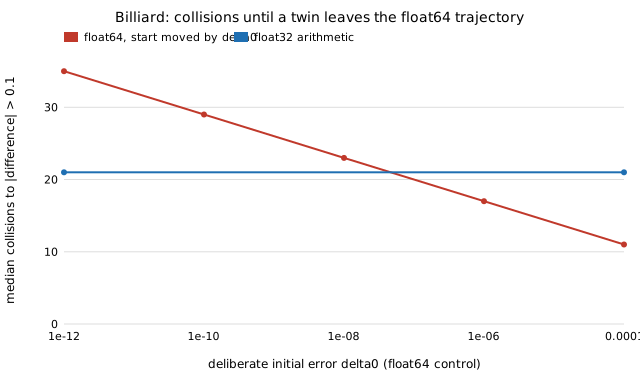
Does a float32 simulation of a bouncing, chaotic system lose its statistics? Sinai billiard: float32 leaves the float64 trajectory after a median 21 collisions, like a float64 start error of about one unit roundoff, and changes the event order one collision later, but the mean free path and circle-hit share agree with float64 and with Cauchy's exact value (stylised).
What it found
A point particle in a unit square with a circular obstacle (Sinai billiard), event-driven with specular reflection, run in float32 and float64 from the same start. Float32 leaves the float64 trajectory (position differs by > 0.1) after a median 21 collisions, equal to a float64 start error of 4.6×10⁻⁸, about one float32 unit roundoff (the smooth flows of free-f32shadow needed about 100×). The first different surface is hit exactly one collision after the position departs, at every error size tried. Mean free path (0.45296 vs 0.45325) and the circle's share of collisions agree within sampling error (|z| < 0.6), and match Cauchy’s exact mean free path 0.45321; no particle escaped and the direction vector’s length drifted by about 10−5 after 2000 collisions. Stylised: straight-line flights, no time-stepped contact; a first attempt on a vibrating-table bouncing ball was not chaotic and is not used.
A figure from its own output
Paper, code and results
More in Digital twins & sim-to-real
- How many research READMEs admit their citations are unchecked, and which works need checking first?Audit of how many research READMEs flag a citation as unchecked: 94 of 550 (17.1%), with Dawid and Skene (1979), Zhang et al. (2019), Horowitz (2014) and Horvitz (1999) the most repeated; counts admissions only, nothing verified.
- How much does noisy scoring cost the secretary problem, and should the 1/e cutoff move?How much noisy scoring costs the secretary problem: with n = 50 the best cutoff stays at 16–17 (19 noiseless) while P(best) falls from 0.373 to 0.145 at noise 1; cutoff rules only, simulation.
- How many simulator rollouts does a sequential test save when certifying a failure rate?How many simulator rollouts a sequential test saves when certifying a failure rate: exact dynamic programming shows Wald's SPRT uses about half the rollouts of the best fixed test at either hypothesis (79/113 vs 181 for 1% vs 5%), and 6–17% fewer at its worst point in between.
- How long can a sequential rollout test run, and what does capping it cost?How long can a sequential rollout test run, and what does capping it cost? Exact: the SPRT's 99th percentile is 309 rollouts against a 79 mean (1% vs 5%; fixed test 181), 28% of runs exceed the fixed size at the midpoint rate; capping at the fixed size adds 34–38% to the error, a cap of 1.5 times it keeps the error at 0.053 to 0.057 for a mean within 2% of uncapped.
- With noisy scores, does a "beat the record by a margin" rule pick the best candidate more often than the best cutoff?With noisy scores, a rule that must beat the earlier best by a margin raises P(pick the true best) from 0.233 to 0.244 at noise 0.5 and 0.143 to 0.149 at noise 1 (n = 50, fresh-trial test); no gain at noise 2; simulation.
- Does a sampled-data loop tuned on a fixed-period twin survive random sampling intervals?Does a sampled-data loop tuned on a fixed-period twin survive random sampling intervals? Uniform jitter up to ±100% never destabilises it, but missed samples do: almost-surely stable up to miss probability 0.556, mean-square stable only to 0.270 (0.05 for a deadbeat tuning); at 0.4 all 2000 simulated runs converge. Stylised scalar model.
All 164 Digital twins & sim-to-real projects →
Other research topics
Proper scoring & elicitation28Effort & peer prediction9Verification games & slashing19Detection & tolerances14Markets as routers13Prediction-market design9Paying contributors8Decentralised training systems23Digital twins & sim-to-real164LLM chip design loops40Robot manufacturing loops53Ambient AI assistant46Self-replicating manufacturing34Simulation-first design64Engineered clothing45Task-specific AI accelerators40Algorithmic chip-design loops42Open-source purpose-built robots44The software-engineering loop43Adversarial human imitation41Open-source residential construction41Autonomous multi-angle capture34Sensing, imaging and 3D31Energy supply and dense energy storage39Robot societies among people31Agentic co-design of low-cost robots27Laundry-hanging robots25Machine learning on qualitative data23Robots on the building site27Civilizations & group psychology1History & human sciences1
Produced with AI assistance (Claude). Results are from the code in this repository and are simulated or stylised unless the abstract says otherwise; nothing here implies affiliation with or endorsement by any lab, researcher or company cited. MIT licensed.