How much energy can each storage technology hold per kilogram, at the most?
research/energy-density
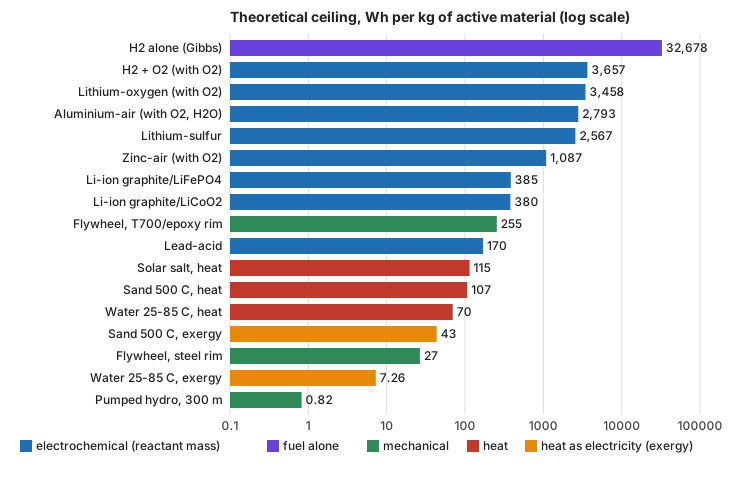
How much energy can each storage technology hold per kilogram, at the most? First-principles ceilings that reproduce five published values within 0.3% (Li-S 2,567, Li-O2 3,458 Wh/kg). No battery couple exceeds 1.65 eV per reactant atom, so light atoms set the winners (Wh/kg = 26,801 × eV/atom ÷ g/mol); flywheels top out near 0.3 eV/atom, heat and pumped hydro far lower. Active material only. First project of track 16.
What it found
Theoretical ceilings from first principles for batteries, hydrogen, flywheels, pumped hydro and heat, reproducing five published values to within 0.3% (lead-acid 170, Zn-air 1,086, Li-S 2,567, Li-O2 3,458 Wh/kg; Al-air 8,100 on Al). No battery couple releases more than 1.65 eV per reactant atom, so the spread comes from atomic mass: Wh/kg = 26,801 × eV per atom / mean g/mol. A carbon-fibre flywheel holds at most 756 Wh/kg (0.34 eV per atom), sand at 500 °C 107 Wh/kg of heat (41% recoverable as electricity) and water lifted 300 m 0.82 Wh/kg. Ceilings for the active material only, with some voltages and material properties assumed.
A figure from its own output
Paper, code and results
More in Energy supply and dense energy storage
- How much energy can each storage chemistry hold per litre, and does the ranking by weight survive?How much energy can each storage chemistry hold per litre, and does the ranking by weight survive? Volumetric ceilings from reactant densities: zinc-air 9,659 Wh/L with air, Li-ion 1,382, lead-acid 724, hydrogen 1,314 at 700 bar.
- How close do real batteries, flow cells and hydrogen tanks get to their first-principles ceilings?How close do real batteries, flow cells and hydrogen tanks get to their first-principles ceilings? A Panasonic NCR18650B cell reaches 0.64 of the Li-ion reactant ceiling (243 of 380 Wh/kg), LiFePO4 0.25–0.45, lead-acid 0.21–0.24; DOE's projected 700 bar H2 system is 5.1% hydrogen by mass against 24–41% ideal. Small sourced dataset, primary and secondary rows marked. Second project of track 16.
- Can a house-sized sand heat store carry summer heat into winter, and how does its electricity use compare with a heat pump?Can a house-sized sand heat store carry summer heat into winter? A transient model: 10 MWh after 120 days needs 222 m³ (70 if lossless) and returns 26% of the electricity as heat, so a COP-4 heat pump wins unless its electricity is 15× dearer; a days-scale store at house size. Stylised.
- Which energy-storage technology is cheapest per MWh delivered at 1 hour, 1 day and 3 weeks?Which storage technology is cheapest per MWh delivered, by duration? Li-ion wins to about 4 h ($116/MWh), cavern stores beyond ($109 vs Li-ion $337 at 24 h), cavern hydrogen only past ~300 h. All inputs assumed. Stylised.
- How much better can a lithium-ion cell get by redesigning its electrodes, and does a smarter search help?How much better can a Li-ion cell get by redesigning its electrodes, and does a smarter search help? In a PyBaMM model, thicker, more porous electrodes with more negative capacity lift energy after 100 cycles from 109 to ~143 Wh/kg (+30%); random, Bayesian and session-agent proposers end within 3% of each other. One aggressively ageing parameter set. Stylised.
- How robust is the cheapest energy-storage technology at each duration when costs are uncertain?How robust is the cheapest storage technology by duration to uncertain costs? Monte Carlo over
energy-lcos: Li-ion wins 96% of scenarios at 2 h but 18% at 8 h; no technology wins over 48% between 6 and 12 h; caverns win most from 24 h. Ranges assumed. Stylised.
All 39 Energy supply and dense energy storage projects →
Other research topics
Proper scoring & elicitation28Effort & peer prediction9Verification games & slashing19Detection & tolerances14Markets as routers13Prediction-market design9Paying contributors8Decentralised training systems23Digital twins & sim-to-real164LLM chip design loops40Robot manufacturing loops53Ambient AI assistant46Self-replicating manufacturing34Simulation-first design64Engineered clothing45Task-specific AI accelerators40Algorithmic chip-design loops42Open-source purpose-built robots44The software-engineering loop43Adversarial human imitation41Open-source residential construction41Autonomous multi-angle capture34Sensing, imaging and 3D31Energy supply and dense energy storage39Robot societies among people31Agentic co-design of low-cost robots27Laundry-hanging robots25Machine learning on qualitative data23Robots on the building site27Civilizations & group psychology1History & human sciences1
Produced with AI assistance (Claude). Results are from the code in this repository and are simulated or stylised unless the abstract says otherwise; nothing here implies affiliation with or endorsement by any lab, researcher or company cited. MIT licensed.