How close do real batteries, flow cells and hydrogen tanks get to their first-principles ceilings?
research/energy-practical
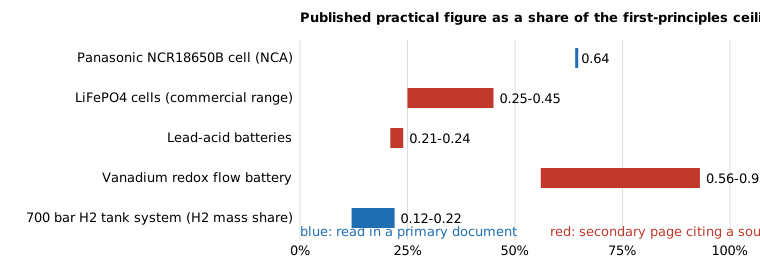
How close do real batteries, flow cells and hydrogen tanks get to their first-principles ceilings? A Panasonic NCR18650B cell reaches 0.64 of the Li-ion reactant ceiling (243 of 380 Wh/kg), LiFePO4 0.25–0.45, lead-acid 0.21–0.24; DOE's projected 700 bar H2 system is 5.1% hydrogen by mass against 24–41% ideal. Small sourced dataset, primary and secondary rows marked. Second project of track 16.
What it found
A small sourced dataset set beside the ceilings of energy-density. A Panasonic NCR18650B cell (data sheet) stores 243 Wh/kg, 0.64 of the 380 Wh/kg graphite/LiCoO2 reactants could release; commercial LiFePO4 reaches 0.25–0.45 and lead-acid 0.21–0.24. DOE’s projected 700 bar hydrogen system (1.71 kWh/kg) is 5.1% hydrogen by mass against 23.8–41.3% for an ideal carbon-fibre sphere. Round-trip efficiency runs from 50% (compressed air) to 85% (advanced lead-acid). Limited: five families, five of seven data rows read through secondary pages, gap not split into causes.
A figure from its own output
Paper, code and results
More in Energy supply and dense energy storage
- Can a house-sized sand heat store carry summer heat into winter, and how does its electricity use compare with a heat pump?Can a house-sized sand heat store carry summer heat into winter? A transient model: 10 MWh after 120 days needs 222 m³ (70 if lossless) and returns 26% of the electricity as heat, so a COP-4 heat pump wins unless its electricity is 15× dearer; a days-scale store at house size. Stylised.
- Which energy-storage technology is cheapest per MWh delivered at 1 hour, 1 day and 3 weeks?Which storage technology is cheapest per MWh delivered, by duration? Li-ion wins to about 4 h ($116/MWh), cavern stores beyond ($109 vs Li-ion $337 at 24 h), cavern hydrogen only past ~300 h. All inputs assumed. Stylised.
- How much better can a lithium-ion cell get by redesigning its electrodes, and does a smarter search help?How much better can a Li-ion cell get by redesigning its electrodes, and does a smarter search help? In a PyBaMM model, thicker, more porous electrodes with more negative capacity lift energy after 100 cycles from 109 to ~143 Wh/kg (+30%); random, Bayesian and session-agent proposers end within 3% of each other. One aggressively ageing parameter set. Stylised.
- How robust is the cheapest energy-storage technology at each duration when costs are uncertain?How robust is the cheapest storage technology by duration to uncertain costs? Monte Carlo over
energy-lcos: Li-ion wins 96% of scenarios at 2 h but 18% at 8 h; no technology wins over 48% between 6 and 12 h; caverns win most from 24 h. Ranges assumed. Stylised. - Do the lithium-ion cell designs found with a fast model still win under the full porous-electrode model?Re-scoring 49 designs from energy-cell under PyBaMM's full DFN model instead of SPMe: rank correlation 0.86 at cycle 100, the SPMe winner is 3rd of 45 and still +38% over the reference cell (+31% under SPMe), DFN reports about 19 Wh/kg more on average, and SPMe fails to cycle 3 designs DFN handles (modelled, stack level)
- How hard does a least-cost zero-emission German grid cycle its storage, and does the levelised-cost map survive that use?How hard does a least-cost zero-emission German grid cycle its storage? Batteries about 1,700–1,900 h a year (near the assumed 2,000), cavern hydrogen only 719 h, which more than doubles its LCOS to $864/MWh.
All 39 Energy supply and dense energy storage projects →
Other research topics
Proper scoring & elicitation28Effort & peer prediction9Verification games & slashing19Detection & tolerances14Markets as routers13Prediction-market design9Paying contributors8Decentralised training systems23Digital twins & sim-to-real164LLM chip design loops40Robot manufacturing loops53Ambient AI assistant46Self-replicating manufacturing34Simulation-first design64Engineered clothing45Task-specific AI accelerators40Algorithmic chip-design loops42Open-source purpose-built robots44The software-engineering loop43Adversarial human imitation41Open-source residential construction41Autonomous multi-angle capture34Sensing, imaging and 3D31Energy supply and dense energy storage39Robot societies among people31Agentic co-design of low-cost robots27Laundry-hanging robots25Machine learning on qualitative data23Robots on the building site27Civilizations & group psychology1History & human sciences1
Produced with AI assistance (Claude). Results are from the code in this repository and are simulated or stylised unless the abstract says otherwise; nothing here implies affiliation with or endorsement by any lab, researcher or company cited. MIT licensed.