How does the burstiness of an always-on trigger's false-wake counts grow with the counting window when the noise level drifts for hours?
research/ambient-driftwindow
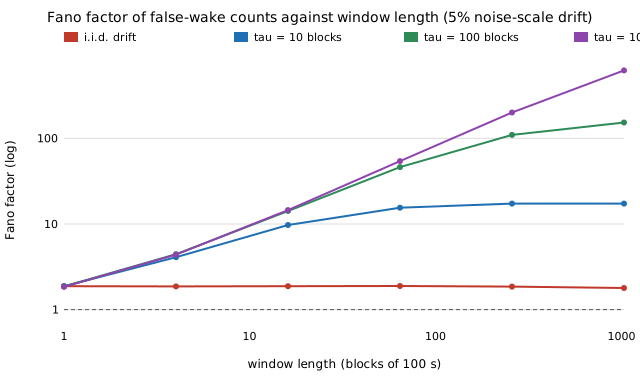
How does the Fano factor of false-wake counts grow with the counting window when the noise level drifts for hours? At 5% persistent drift (about 3 h correlation time) it grows from 1.9 at 100 s to about 150 at 28 h, against a flat 1.9 for independent drift. Stylised; the drift is assumed.
What it found
A stylised follow-up to ambient-wakeburst, which drew a fresh noise level per window. With a noise scale that drifts persistently (log-scale AR(1), 5% sd) the Fano factor of false-wake counts rises with the window instead of staying flat: about 1.9 at 100 s for any correlation time, then 14, 110 and 150 at 16, 256 and 1,024 blocks (28 h) for a 2.8 h correlation time, and 620 at 28 h for a 28 h correlation time, while the mean moves only 5%. A Poisson-given-scale (Cox) model, checked against a frame-level simulation (4.7 vs 4.7 and 44 vs 44), and a closed form (mean error 2% on the busy trigger, worst 11%) explain it. The drift is assumed, not measured, and the ‘rare’ trigger is one wake per 500 s, not one a day. Stylised.
A figure from its own output
Paper, code and results
More in Ambient AI assistant
- Do a dual-MAC energy loop and a divide-free threshold make the Cortex-M4 voice gate cheaper?Do a dual-MAC energy loop and a divide-free threshold make the Cortex-M4 voice gate cheaper: 17-37% fewer instructions with the block-minimum floor, slower without it, RAM doubled; decisions unchanged (emulator counts, synthetic audio)
- What does the adaptive voice gate cost on a Cortex-M4, in flash and instructions per frame, and is the block-minimum floor worth it?What does the adaptive voice gate cost on a Cortex-M4?
ambient-gatefw's C gate built with clang for Thumb-2 and run in an emulator: bit-exact, about 250 bytes of code, 3237 instructions per frame exact and 2096 with the block-10 floor, because the energy sum dominates. Instructions, not cycles; stylised. - Can a noise-adaptive voice gate fit in about 120 bytes of RAM on a pendant microcontroller, and does a cheaper noise floor cost battery life?Can a noise-adaptive voice gate fit in about 120 bytes of RAM on a pendant microcontroller? C port of
ambient-gateroc's adaptive energy gate, bit-exact with the Python reference; a block-minimum noise floor cuts state from 1020 to 120 bytes and comparisons per frame from 249 to 24, moving modelled battery life by at most 0.07 h. Synthetic audio, host build only. - How much pre-roll buffer does an energy-gated audio pendant need to stop clipping the first word, and what does it cost in RAM and battery?How much pre-roll buffer does an energy-gated audio pendant need to stop clipping the first word? Synthetic audio: no gain in quiet rooms, in the loudest room onset recall 0.866 → 0.980 → 0.999 at 0, 5 and 25 buffered frames (0, 3.1, 15.6 KB) for 90 → 81 → 70 modelled hours; a too-deaf gate is not rescued (stylised)
- Does a fixed energy-gate threshold survive different rooms on an always-on audio pendant, and what does an adaptive one buy in battery life?Does a fixed energy-gate threshold survive different rooms on an always-on audio pendant? Synthetic audio, 20 seeds x 4 background levels: any fixed threshold that keeps speech recall >= 0.9 leaves the gate open all the time in the loudest room (57.6 h, no gating gain), while one adaptive threshold (4x a 5 s running-minimum floor) gives 82-90 h at recall 0.89-1.00 in all four; stylised, nothing measured on hardware
- What limits the battery life of a pendant-style always-on audio wearable?What limits battery life in a pendant-style always-on audio wearable: stylised nRF52840-class power model (mic floor ~170 h; speech-gated ~105 h vs 59 h always streaming) plus a 74-byte VAD gate that compiles for Cortex-M4; no hardware measured
All 46 Ambient AI assistant projects →
Other research topics
Proper scoring & elicitation28Effort & peer prediction9Verification games & slashing19Detection & tolerances14Markets as routers13Prediction-market design9Paying contributors8Decentralised training systems23Digital twins & sim-to-real164LLM chip design loops40Robot manufacturing loops53Ambient AI assistant46Self-replicating manufacturing34Simulation-first design64Engineered clothing45Task-specific AI accelerators40Algorithmic chip-design loops42Open-source purpose-built robots44The software-engineering loop43Adversarial human imitation41Open-source residential construction41Autonomous multi-angle capture34Sensing, imaging and 3D31Energy supply and dense energy storage39Robot societies among people31Agentic co-design of low-cost robots27Laundry-hanging robots25Machine learning on qualitative data23Robots on the building site27Civilizations & group psychology1History & human sciences1
Produced with AI assistance (Claude). Results are from the code in this repository and are simulated or stylised unless the abstract says otherwise; nothing here implies affiliation with or endorsement by any lab, researcher or company cited. MIT licensed.