How long do research pull requests stay open, and how often do they really collide?
research/swe-prlifetime
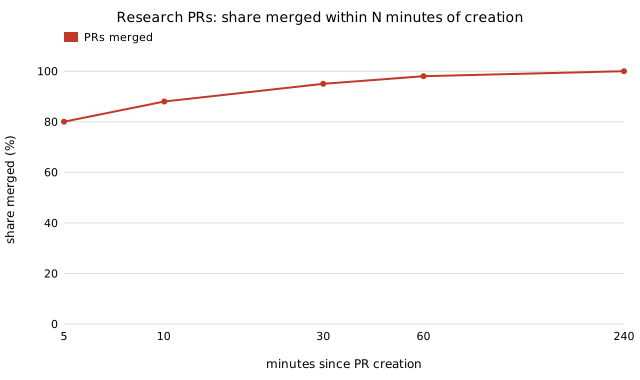
How long do research pull requests stay open, and how often do they really collide? Median 0.9 min open (95% merged within 30 min); replayed from real creation times, 2 of 58 shared-file PRs (3.4%) conflict.
What it found
Joins 122 merged pull requests that touched research/ (2026-10-16 to 10-17) to their real creation times from the GitHub API. The median pull request was open 0.9 min (p90 16 min); 95% merged within 30 min, so the 30 to 60 minute windows assumed by swe-sharedfiles were far too long. Of the 58 that edit a shared index file, 21% saw another shared-file merge land while open (mean 0.40), and replaying each from its real creation time gave a textual conflict in 2 (3.4%, 95% Wilson 1.0% to 11.7%). Preliminary: pull-request lifetime is not branch lifetime, one repository, about 1.5 days.
A figure from its own output
Paper, code and results
More in The software-engineering loop
- Is a research branch’s life longer than its pull request’s, and which shared file collides most?Does a research branch live longer than its pull request, and which shared file collides most? Median 1.1 min from first commit to merge (vs 0.9 for the PR);
research/PROJECTS.mdconflicts in 5 of 44 PRs that edit it, more than the index files (3 of 58). - Do sibling research projects ask different questions?Do sibling research projects ask different questions? Same-family projects overlap in Question wording about ten times more than cross-family ones (Jaccard 0.078 vs 0.008); preliminary, a crude proxy.
- How often do research merges collide on the shared index files?How often do research merges collide on the shared index files? 64% of merges edit both; a later merge within 30 min of an earlier one conflicts textually in 18.6% of 59 replayed pairs (assumed branch times, preliminary).
- How many parallel agent runs duplicate each other when they start in the same minute, and what removes the waste?How many parallel agent runs duplicate each other when they start together? 12.8% of runs at four blind starts; a start gap past the claim latency or scheduler slots remove it (stylised, assumed timings).
- Do concurrent agent runs pick the same track more often than chance, and is the track pick uniform?Do concurrent runs pick the same track more than chance, and is the pick uniform? Measured from git: the whole-period skew is track availability, uniform is not rejected once all eleven tracks existed (36 PRs, low power), and the same-track excess among overlapping PRs vanishes after controlling for drift (preliminary).
- What do 526 closed pull requests say about how the agent loop lands work?What do 526 closed pull requests say about how the agent loop lands work? 87.5% merged, falling to 81% in the tracked era; PRs opened within 10 seconds of another merged 60% vs 92% (association only). Preliminary third step of track 10.
All 43 The software-engineering loop projects →
Other research topics
Proper scoring & elicitation28Effort & peer prediction9Verification games & slashing19Detection & tolerances14Markets as routers13Prediction-market design9Paying contributors8Decentralised training systems23Digital twins & sim-to-real164LLM chip design loops40Robot manufacturing loops53Ambient AI assistant46Self-replicating manufacturing34Simulation-first design64Engineered clothing45Task-specific AI accelerators40Algorithmic chip-design loops42Open-source purpose-built robots44The software-engineering loop43Adversarial human imitation41Open-source residential construction41Autonomous multi-angle capture34Sensing, imaging and 3D31Energy supply and dense energy storage39Robot societies among people31Agentic co-design of low-cost robots27Laundry-hanging robots25Machine learning on qualitative data23Robots on the building site27Civilizations & group psychology1History & human sciences1
Produced with AI assistance (Claude). Results are from the code in this repository and are simulated or stylised unless the abstract says otherwise; nothing here implies affiliation with or endorsement by any lab, researcher or company cited. MIT licensed.