What can the run log measure about the agent loop today?
research/swe-ledger
What can the run log measure about the agent loop today? Cost fields are present in at most 1% of 189 runs, a third of listed projects are follow-up families, and every recorded CI-failure count is zero. Preliminary first step of track 10.
What it found
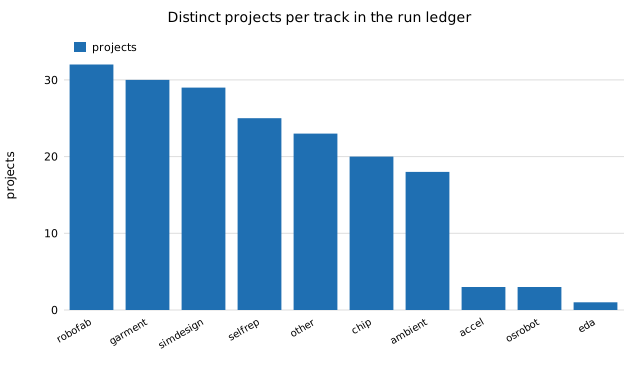
A stdlib reader of a snapshot of prompts/runs.jsonl (189 runs, 184 listed projects) reports coverage and throughput proxies. Token, cost and tool-call fields are present in at most 1% of runs and wall time is derivable for only 15, so no cost-per-project figure is possible yet. About a third of listed projects sit in follow-up families of three or more, and 24 slugs appear in more than one run. All 143 recorded CI-failure counts are zero, which looks like a success-only field, not a clean record. Preliminary: first step of the ledger milestone; no git-history backfill, no value or correctness scoring.
A figure from its own output
Paper, code and results
More in The software-engineering loop
- What does an agent run cost, and which runs cost the most?What does an agent run cost, and which cost the most? 355 priced runs (14 to 18 October): median $0.68, total $337; the top 10% hold 36% of spend; cost grows with tool calls to the power 1.18 (preliminary; API-equivalent estimates).
- What do agent runs record going wrong, and does it relate to partial outcomes or cost?What do agent runs record going wrong? 17% of 1,027 runs record an error (24.5% of research runs); environment 28%, own mistakes 21%, collisions 17%; runs with an error end partial twice as often (12.6% vs 6.0%) and cost about twice as much. Preliminary: keyword classifier, self-reported.
- Do the swe-errors keyword rules sort run-record errors correctly?Do the
swe-errorskeyword rules sort run-record errors correctly? On a 60-entry blind hand-labelled sample they agree on 40 (66.7%, Wilson 54.1% to 77.3%; kappa 0.59); theci-or-toolingrule never wins and own-mistake recall is 55%, so the earlier shares are a lower bound for those two. Preliminary: one labeller. - Can the swe-errors keyword rules be improved on 30 hand labels and still help on the other 30?Can the
swe-errorskeyword rules be improved on 30 hand labels and still help on the other 30? A two-fold held-out refit (rule order plus greedy keywords) averages 68.5% agreement with the hand labels against 66.7% for the shipped rules (+1.1 entries over 200 splits, range -4 to +7), while the same procedure scores 85% on its own 60 training entries: mostly memorisation. Preliminary. - Did research brief v1 change how runs go?Did research brief v1 change how runs go? Same-days comparison of v0 (342 runs) and v1 (67) on 15 to 18 October: no detectable difference in cost, time or success; the lower v1 error rate (7.5% vs 17.0%) vanishes within unlabelled-task runs (8.3% vs 9.6%); v1 records more doc-friction entries (1.24 vs 0.72 per run, p = 0.0001). Observational.
- Does Opus pay for itself on this portfolio's runs? Cost ratio by track, and the sample needed to find outDoes Opus pay for itself on this portfolio's runs? An Opus run costs about 8 to 9 times a Sonnet run in the same track; with 12 priced Opus runs the ledger cannot compare value per dollar, and a 50% difference in projects per run needs about 129 runs per arm (preliminary; cost only).
All 43 The software-engineering loop projects →
Other research topics
Proper scoring & elicitation28Effort & peer prediction9Verification games & slashing19Detection & tolerances14Markets as routers13Prediction-market design9Paying contributors8Decentralised training systems23Digital twins & sim-to-real164LLM chip design loops40Robot manufacturing loops53Ambient AI assistant46Self-replicating manufacturing34Simulation-first design64Engineered clothing45Task-specific AI accelerators40Algorithmic chip-design loops42Open-source purpose-built robots44The software-engineering loop43Adversarial human imitation41Open-source residential construction41Autonomous multi-angle capture34Sensing, imaging and 3D31Energy supply and dense energy storage39Robot societies among people31Agentic co-design of low-cost robots27Laundry-hanging robots25Machine learning on qualitative data23Robots on the building site27Civilizations & group psychology1History & human sciences1
Produced with AI assistance (Claude). Results are from the code in this repository and are simulated or stylised unless the abstract says otherwise; nothing here implies affiliation with or endorsement by any lab, researcher or company cited. MIT licensed.